“Stay Home, Mom!” My Son Took His Family on a $12,500 Christmas Vacation I Paid For—But One Phone Call Changed Everything
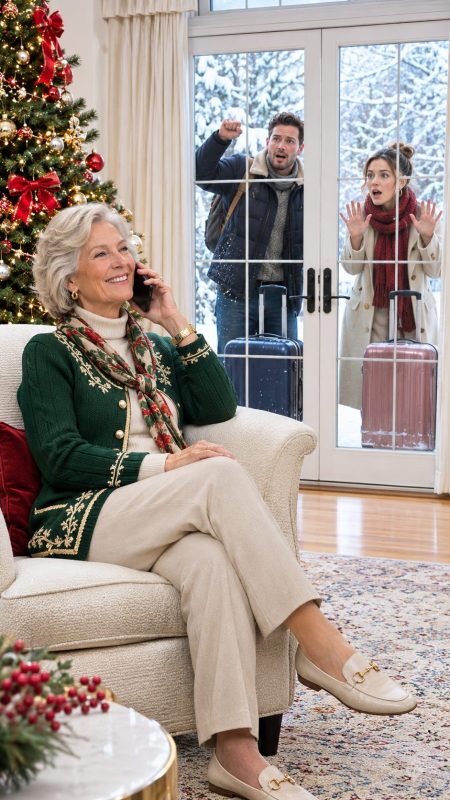
“Mom! They’re refusing to give us our rooms! What did you do to our reservation?” my son screamed through the phone.

I glanced at the Christmas decorations surrounding my fireplace and answered calmly.
“I simply decided not to finance a holiday I wasn’t welcome to attend.”
For several seconds, Caleb said nothing.
Then I heard his wife shouting behind him.
But by that point, I’d already made my decision.
My name is Helena Whitmore. I’m 68, and I’ve lived alone since my husband passed away. Or at least, that’s how my life should have been.
For the previous three years, my son Caleb, his wife Sloan, and their two children had occupied most of my Pittsburgh home.
They paid no rent. I handled the electricity, heating, groceries, and countless household expenses. Whenever they needed someone to watch the children, I was available.
I told myself I was helping them build a better future.
Unfortunately, my kindness had gradually become something they considered an entitlement.
The trouble began when Caleb suggested spending Christmas at an exclusive mountain resort.
He spoke enthusiastically about snowy landscapes, elegant restaurants, and holiday activities for the children.
Wanting to create wonderful family memories, I offered to pay for everyone’s accommodations.
Seven nights at the resort cost $12,500.
It was a substantial amount of money, but I considered it a special Christmas gift.
Sloan then asked whether her parents and sister could join us.
“Of course,” I said. “Christmas is about bringing family together.”
I imagined all of us sitting beside a beautifully decorated tree, exchanging presents and sharing stories.
What I never imagined was being deliberately left behind.
On Christmas Eve, I awoke shortly after six in the morning.
The house was unusually quiet.
When I walked downstairs, I discovered that Caleb’s vehicle was missing. So was the van they’d rented for the trip.
The children’s winter coats had disappeared from the hallway, and every suitcase was gone.
I reached for my phone.
There were no messages explaining where everyone had gone.
Even more surprisingly, I could no longer access our family group chat.
A terrible suspicion began forming in my mind.
I called Caleb immediately.
Sloan answered instead.
“Helena! Merry Christmas Eve!” she said brightly.
“Where are you?” I demanded.
“We’re on our way to the mountains. The children are so excited!”
I struggled to understand her words.
“You’ve already left? Without me?”
There was an uncomfortable pause.
“Well, we thought you’d prefer a relaxing holiday at home. All that traveling can be exhausting, you know.”
I stared at the empty dining room.
“Did anyone bother asking what I wanted?”
“Please don’t turn this into an argument,” she replied. “You can enjoy some peace and quiet while we’re away.”
Before I could respond, she hung up.
I remained standing in the kitchen, trying to comprehend what had happened.
I’d paid for a magnificent Christmas getaway, yet the people I’d invited had decided I didn’t deserve to join them.
Then I noticed something in the kitchen trash.
A printed sheet of paper had been crumpled and tossed away.
I unfolded it.
It contained the resort’s final room assignments.
Caleb and Sloan had a spacious suite. The children had an adjoining room. Sloan’s parents and sister had their own accommodations.
Every guest was listed.
Except me.
My exclusion wasn’t a misunderstanding.
Someone had intentionally removed me from the plans.
I felt humiliated, but beneath the hurt, something else began to emerge.
Clarity.
The reservation had been made using my credit card, and my name was the only one listed as the booking holder.
I remembered reading the cancellation policy.
A full refund was available until noon on December 24.
I checked the time.
It was still morning.
Without calling anyone, I opened my laptop and accessed the resort’s booking website.
I reviewed the reservation one final time.
Then I selected the cancellation option.
A confirmation appeared on the screen.
The entire $12,500 reservation had been canceled, and the refund was being processed.
For the first time that morning, I felt completely in control.
I prepared a cup of tea, turned on some Christmas music, and enjoyed the peaceful house.
At 2:47 p.m., my phone started ringing.
Caleb.
I ignored the first call.
Then the second.
By the fifteenth attempt, I decided to answer.
“MOM! THE FRONT DESK SAYS WE DON’T HAVE A RESERVATION!”
“I know, Caleb.”
“What do you mean, you know?”
“I canceled it.”
He sounded stunned.
“You canceled our Christmas vacation?”
“No,” I corrected him. “I canceled the Christmas vacation I paid for.”
“But we’re already here! The kids are exhausted! Sloan’s family is waiting in the lobby!”
“Then perhaps you should have considered that before deciding I wasn’t part of the family celebration.”
I heard Sloan yelling that I was being selfish.
Caleb desperately tried another approach.
“Mom, please. We made a mistake. Just call the resort and get our rooms back.”
I refused.
The resort had already released the accommodations, and holiday demand meant there were no equivalent rooms left.
Their carefully planned luxury vacation had disappeared.
Eventually, they found rooms at a small motel some distance away.
Meanwhile, I spent Christmas Eve in my own home, enjoying a quiet dinner without anyone demanding something from me.
But the following day brought another unpleasant revelation.
An email from the resort confirmed that Sloan had contacted the reservations department three weeks earlier.
She had requested changes to the room arrangements and informed the staff that I had supposedly decided not to attend.
Three weeks before Christmas.
That meant she’d been planning to exclude me while allowing me to believe we would all celebrate together.
The realization hurt more than the canceled vacation.
It wasn’t merely a thoughtless decision.
It was a calculated betrayal.
On December 26, I contacted my attorney.
I explained the situation and described how my son and daughter-in-law had been living in my home without contributing financially.
Over the years, I’d postponed retirement plans, reduced my personal spending, and repeatedly put their needs before my own.
I finally understood that helping someone shouldn’t require abandoning your own well-being.
My attorney guided me through the appropriate legal steps to end their rent-free living arrangement.
When Caleb and his family returned on December 28, I didn’t confront them at the door.
My grandchildren had done nothing wrong.
I welcomed them, prepared a meal, and gave them the Christmas presents I’d bought weeks earlier.
After they went upstairs, I asked their parents to join me at the dining table.
I placed the formal notice in front of them.
Caleb read the first page, then looked up.
“Mom, what’s this?”
“It’s time for you and Sloan to find a home of your own.”
Sloan pushed back her chair.
“You’re throwing your own son and grandchildren out because we went on vacation without you?”
I remained composed.
“No. I’m ending an arrangement that stopped being fair a long time ago. Christmas simply made me realize how little respect I’ve been receiving.”
She began arguing, but I refused to raise my voice.
Caleb looked genuinely shaken.
“We don’t have enough money saved to move immediately.”
“That’s why you’re being given the legally required notice,” I explained. “You have time to make arrangements, but the decision is final.”
Later that evening, Caleb approached me privately.
His expression was different from the one he’d worn at the resort.
There was no anger.
Only regret.
“Mom, I never realized how badly we’ve treated you,” he admitted. “You made everything so easy for us that I stopped thinking about what it cost you.”
He paused.
“I’m sorry. You deserved to feel appreciated.”
I believed he meant it.
And I forgave him.
But forgiveness didn’t mean returning to the same unhealthy arrangement.
By February, Caleb and Sloan had rented a modest townhouse.
For the first time in years, they were paying their own housing costs, managing their household budget, and handling their responsibilities independently.
Our relationship didn’t improve overnight.
At first, conversations were awkward, and Sloan remained distant.
But gradually, things began to change.
Caleb started visiting simply because he wanted to see me.
He asked about my hobbies, my plans, and how I was feeling.
He no longer assumed that my time or money was automatically available.
Almost a year later, he invited me to spend Christmas at their new home.
I accepted, cautiously hopeful.
When I arrived, the children rushed to greet me.
The table was beautifully decorated, and dinner was already being prepared.
Nobody mentioned money.
Nobody expected me to cook, clean, or organize the celebration.
Before we sat down, Sloan approached me.
“Helena, I owe you an apology,” she said quietly.
I waited.
“What I did last Christmas was cruel. I convinced myself you wouldn’t mind staying behind, but I knew it was wrong. I’m sorry.”
It was the first time she’d openly acknowledged her actions.
“Thank you for saying that,” I replied.
That evening, we shared a pleasant meal, exchanged gifts, and enjoyed one another’s company.
Just before I left, my granddaughter Emma appeared with a small package wrapped in red paper.
“Grandma, this one’s special!”
Inside was a handmade Christmas stocking.
A silver H had been carefully embroidered across the front.
“I made it for you,” Emma explained proudly. “Now you’ll always have your own place at Christmas.”
I held the stocking gently, overwhelmed by the simplicity of her gesture.
It hadn’t cost thousands of dollars.
It didn’t involve luxury accommodations or expensive presents.
Yet it meant more to me than anything I’d purchased for my family.
When I returned home, I hung the stocking above my fireplace.
For years, I’d tried to secure my place in my family’s life by giving them everything they wanted.
I believed that generosity would guarantee affection, gratitude, and togetherness.
But Christmas had taught me a lesson I should have learned much earlier.
You cannot buy genuine respect.
You cannot purchase a meaningful relationship.
And you should never have to exhaust your savings to prove that you deserve a place in your own family.
The Christmas I canceled a $12,500 vacation was painful, but it became the turning point we all needed.
My son learned to take responsibility.
My daughter-in-law learned that kindness should never be mistaken for weakness.
And I learned that setting boundaries doesn’t make you less loving.
Sometimes, it’s the very thing that allows love to grow in a healthier way.
That year, I finally received the Christmas gift I’d wanted all along.
Not an expensive trip.
Not a luxury hotel.
Just a seat at the family table, offered because I was loved—not because I was paying the bill.