My Sister Promised 22 Relatives a Free Stay at My New Beach House — So I Let Her Learn a Very Expensive Lesson
I had owned the beach house for forty-three minutes when my sister decided it belonged to the entire family.
I still had the closing folder tucked under my arm when my phone started ringing.
I was standing in the middle of the empty living room, staring through floor-to-ceiling windows at the Atlantic. The tide was pulling back from the dunes, and the late afternoon light made the water look like sheets of hammered silver.
The place was quiet.
That was what I loved most about it.
After twelve years of saving, postponing vacations, taking extra work, and telling myself “maybe next year,” I finally had something I had earned entirely for myself.
Then Marissa called.
I almost ignored it.
My sister rarely phoned without a request attached.
I answered anyway.
“Hey.”
“Finally,” she said. “I’ve been trying to reach you.”
“I was signing the paperwork.”
“For the beach house?”
“Yes. I just got the keys.”
“Perfect.”
The way she said it immediately made me suspicious.
Then she added, “We’ll be there Friday.”
I frowned.
“Who’s we?”
“Me, Greg, his parents, his sisters, their husbands, the cousins, and all the kids.”
I waited.
She did not elaborate.
“How many people is that?”
“Twenty-three total.”
I actually laughed.
Not because it was funny.
Because the number sounded absurd.
“Twenty-three people?”
“Yes. So make sure the bedrooms are cleared out. The younger kids can sleep in the den or on air mattresses. And we’ll need plenty of towels.”
I slowly turned and looked around.
Three bedrooms.
One modest office.
A den barely large enough for a sofa.
A kitchen I had spent months choosing appliances for.
And a deck where I had imagined eating breakfast in silence.
“Marissa, no.”
She paused.
“What do you mean, no?”
“I mean you are not bringing twenty-two other people here for two weeks.”
She laughed as if I were pretending to be difficult.
“Oh, please. Don’t do this.”
“Do what?”
“Make it awkward. Greg’s family already arranged time off. His mother bought new luggage. The kids are excited.”
“You invited them without asking me?”
“We’re family.”
Of course.
There it was.
Marissa’s favorite sentence whenever she wanted something.
When we were teenagers, “we’re family” meant I had to sleep on the couch because she wanted my room for her friends.
When she was twenty-six, it meant I covered her insurance bill because she had spent her money on a weekend trip.
When she had her first baby, it meant I planned the shower, paid for half of it, and then listened while she complained that the decorations looked inexpensive.
Family, according to Marissa, always seemed to mean that I gave and she decided how much.
I looked toward the ocean.
“No.”
This time, I said it without explanation.
Her voice changed.
“What did you just say?”
“You heard me.”
“You seriously won’t let your own sister use the house?”
“It’s not about you using the house. You invited twenty-two people into my home without asking.”
“You bought a beach house. Obviously people are going to want to stay there.”
“I bought it because I wanted to live there.”
She gave an irritated sigh.
“You’re unbelievable.”
“I have three bedrooms.”
“People can share.”
“No.”
“The kids can sleep on the floor.”
“No.”
“You can use the office.”
“No.”
Her voice hardened.
“You owe me.”
I almost smiled.
“What exactly do I owe you?”
“For disappearing after Mom died, for one thing.”
That hit exactly where she intended it to.
Mom had been gone for five years.
I had moved away afterward because I received a job offer in another city.
Marissa had spent years describing that decision as abandonment.
“I moved for work.”
“You left everyone behind.”
“I was an adult, Marissa.”
“You’ve always thought you were better than the rest of us.”
“And now this house proves it?”
“You knew I’d always wanted a beach vacation.”
I stared at the phone.
“Are you actually suggesting I bought a house to deprive you of a vacation?”
“You know that’s not what I mean.”
“I honestly don’t.”
She went quiet for a moment.
Then she said, “Mom would be ashamed of how selfish you’ve become.”
Once, that sentence would have destroyed me.
It would have been enough to make me surrender.
I would have opened the doors, bought groceries, found mattresses, smiled through my exhaustion, and spent two weeks cleaning up after people who had never even asked whether they were welcome.
But that day, something was different.
Maybe it was the keys in my hand.
Maybe it was the ocean outside.
Maybe I was simply tired.
“I’m done talking about this.”
“Fine,” she snapped. “I’ll tell everyone what you’re doing.”
She hung up.
Ten minutes later, my phone started vibrating without stopping.
A cousin messaged first.
Then one of our aunts.
Then Greg’s mother.
I had met Greg’s mother twice in my life.
By noon, Marissa had also posted online.
Her version was impressive.
According to her, I had invited the entire family to celebrate my new house and then cruelly canceled at the last moment because I suddenly decided I was “too good” for them.
People began sending me messages about promises I had never made.
One relative told me I should be grateful people wanted to spend time with me.
Another said I was humiliating Greg’s family.
Then someone wrote that Mom would have wanted me to share.
That message hurt.
But only briefly.
I typed three different responses.
Then deleted all of them.
Explaining myself had become another form of surrender.
So instead, I made preparations.
On Thursday, I called a locksmith.
Marissa did not have a key, but I knew enough about my sister to prefer certainty.
I also installed cameras around the property.
Then I booked a room at a small inn several miles down the coast.
Before leaving, I taped a notice inside the glass front door.
It read:
PRIVATE RESIDENCE
NO UNAUTHORIZED GUESTS
THIS PROPERTY IS NOT A RENTAL
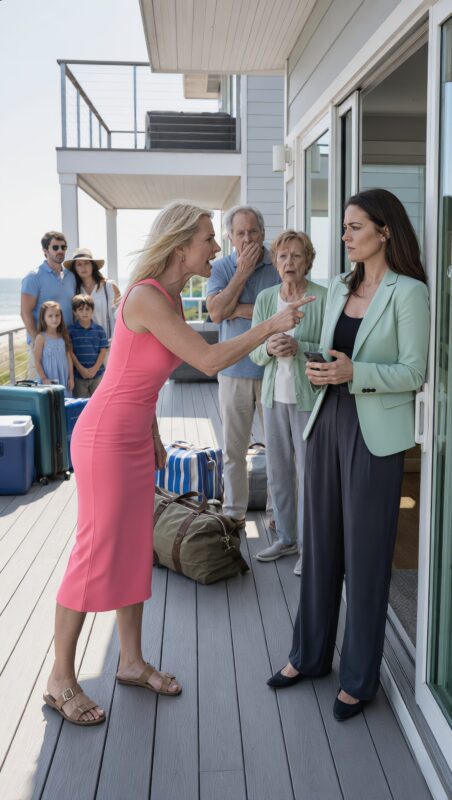
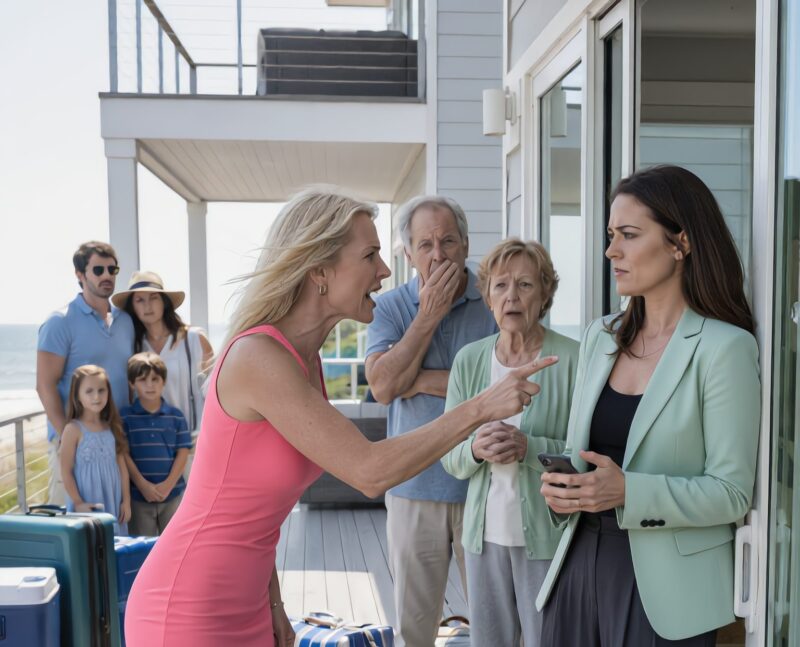
Friday afternoon, the security camera alerted me.
They had arrived.
Three SUVs.
Two rental vans.
Suitcases stacked high.
Coolers.
Beach toys.
Folded chairs.
A ridiculous inflatable flamingo, despite the fact that my house did not even have a swimming pool.
I watched Marissa walk to the front door.
She tried the handle.
Then tried it again.
A minute later, my phone rang.
I ignored it.
She called again.
Then again.
By the time she reached the twelfth call, I muted my phone.
At seventeen, I finally answered.
“Hello?”
“Where are you?”
She was shouting.
“Not there.”
“The house is locked!”
“Yes.”
“There’s a sign on the door!”
“I know.”
“What is wrong with you? Everyone is outside!”
I could hear voices in the background.
Children complaining.
Adults arguing.
Greg telling someone to calm down.
“You need to come here right now and open this door.”
“No.”
She sounded stunned.
“What?”
“I said no.”
“You cannot seriously leave twenty-three people standing outside.”
“I didn’t bring twenty-three people there.”
Her voice cracked with anger.
“You embarrassed me in front of Greg’s entire family!”
I sat on the balcony of the inn with a cup of coffee and watched waves break against the shore.
“No, Marissa. You embarrassed yourself.”
“I told them we were staying here!”
“And you had no right to tell them that.”
“They drove all this way!”
“Because you invited them.”
“You could fix this in five minutes.”
“I could.”
She stopped.
Then I added, “I’m choosing not to.”
There was complete silence.
When she finally spoke, her voice was lower.
“You would really do this to family?”
I looked out at the water.
“No. I’m allowing you to deal with the consequences of a promise you made with property that wasn’t yours.”
For once, Marissa had no comeback.
Greg’s relatives eventually found rooms elsewhere.
Some checked into hotels.
A few turned around and drove home.
For several days, I heard through other family members that everyone was furious with me.
I also heard that Marissa had spent most of the first night crying because I had “ruined everything.”
I did not respond.
For the next two weeks, I stayed away from the beach house.
Not because I feared Marissa.
I simply refused to let the first memories of my new home be arguments, resentment, and twenty-three people treating it like a free resort.
When I finally returned, I unlocked the door and stepped inside.
The house was silent.
Nothing had been moved.
Nothing had been broken.
No one had slept in my bedroom.
It felt exactly the way I had imagined it would.
Mine.
That evening, I began unpacking boxes.
One of them contained things I had kept after Mom died.
Old recipe cards.
Birthday notes.
Christmas ornaments.
Photographs from trips I barely remembered.
Near the bottom, I found one I had not seen in years.
Mom was standing barefoot at the edge of the ocean.
Her hair was blowing wildly across her face, and she was laughing at whoever had taken the picture.
She looked younger than I ever remembered seeing her.
I turned it over.
There was a sentence written on the back in faded blue ink.
Don’t disappear trying to please everyone.
I sat there holding the photograph for a long time.
It felt almost unfair that I had spent years remembering Mom as the woman Marissa used in arguments instead of the woman who had actually raised us.
Mom had spent much of her own life saying yes when she wanted to say no.
I suddenly wondered whether that message had been written for herself as much as anyone else.
I carried the photograph onto the deck.
The evening sky was turning gold over the water.
For most of my life, I had confused love with availability.
If someone needed a room, I made space.
If someone needed money, I found it.
If someone was angry with me, I tried to make them comfortable again.
I had treated other people’s disappointment like an emergency.
That house changed something.
It reminded me that kindness without boundaries eventually becomes resentment.
That generosity should be offered, not demanded.
And that loving your family does not mean handing them unrestricted access to everything you have worked for.
Sometimes love means opening the door.
Sometimes it means welcoming people inside.
And sometimes it means standing on the other side of that door, holding the key, and finally understanding that you are allowed to keep it locked.