My Wealthy Neighbor Had My Old Car Sealed Under Concrete Because She Called It an Eyesore—She Never Imagined My Eight-Year-Old Daughter Would Be the One to Stop Her
The day my father left me his tiny cabin by the lake, I thought life was finally giving my daughter and me a chance to start over.
The house certainly wasn’t impressive. The siding was weathered, the porch leaned a little, and my fifteen-year-old blue Chevrolet barely squeezed into the narrow driveway.
But it belonged to us.
My daughter, Olivia, didn’t notice any of the flaws. She spent her first afternoon exploring the yard, adopted a little frog she named Kevin, and insisted we’d found the perfect home.
Unfortunately, not everyone shared her excitement.
Our neighbor, Valerie, lived in the grandest house on the hillside. Her balcony overlooked the entire shoreline, and from the moment she spotted my old Chevrolet, she treated it as if it were a personal insult.
“You really should park somewhere else,” she said during our first conversation.
“I’m afraid I can’t,” I replied. “The driveway is the only place I have.”
She folded her arms.
“That wreck destroys the view from my balcony.”
Over the following days, her comments became increasingly cruel. She mocked my finances, reminded me that I was raising a child alone, and hinted that people like me didn’t belong in such an expensive neighborhood.
Thankfully, someone else lived next door.
Harold had known my father since they were teenagers. He welcomed us with warm smiles, homemade cookies, and advice I didn’t fully appreciate at the time.
“Don’t fight with Valerie,” he told me. “Just keep records. Eventually people create problems they can’t escape.”
Then he revealed something surprising.
Much of Valerie’s luxury landscaping—including a stone retaining wall, decorative statues, and part of her oversized balcony—had been built beyond her property line on protected public land. Harold had spent years collecting permits, photographs, surveys, and official correspondence.
I thanked him, but honestly, I assumed I’d never need any of it.
I was wrong.
The following Friday, I pulled onto my street and froze.
A concrete mixer was parked outside my driveway.
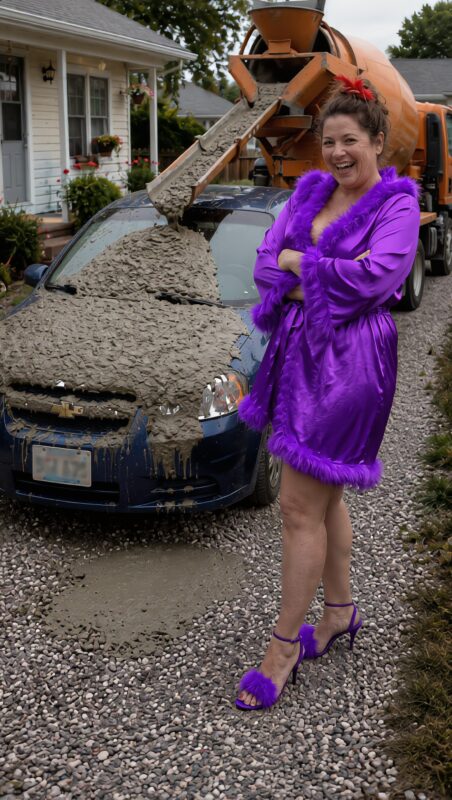
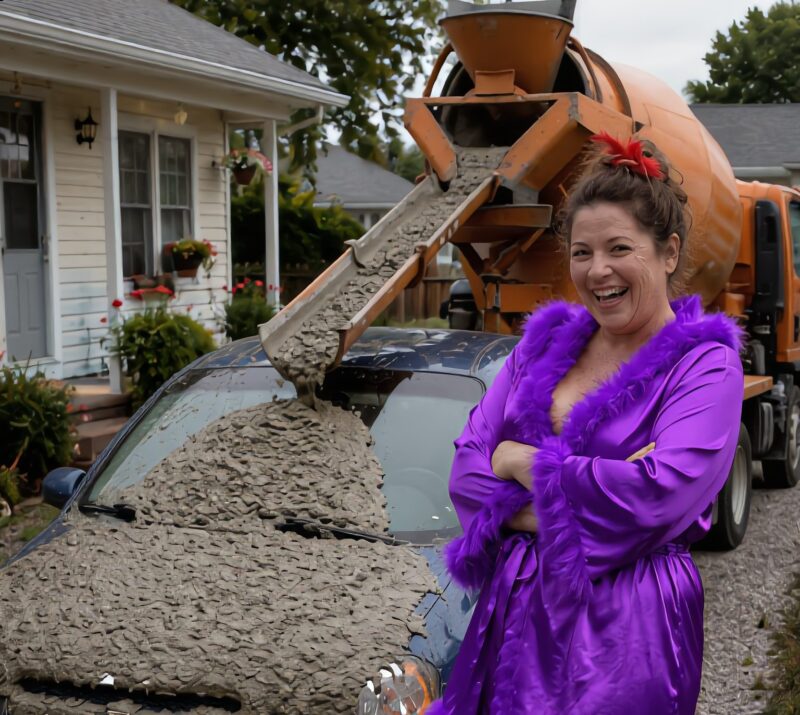
Workers were pouring wet concrete directly around my Chevrolet.
I jumped out of the car and ran.
Valerie stood nearby with a satisfied expression.
“I figured this would encourage you to remove that embarrassing car,” she said.
I reached for my phone, ready to report the destruction.
Before I could make the call, Olivia quietly stepped onto our porch with a juice box in one hand.
She looked at Valerie and spoke in the calmest voice imaginable.
“Excuse me… I think you should look at your house.”
Every head turned uphill.
Two municipal inspectors were placing a bright orange enforcement notice across Valerie’s front entrance while another official questioned the supervisor of the concrete company.
The smile disappeared from Valerie’s face.
I looked at Olivia.
“What just happened?”
She shrugged.
“This morning, while I was waiting for the school bus, she was talking on her phone really loudly. She told the concrete company to come to our address but said it belonged to her.”
Olivia hadn’t thought much about it.
She simply mentioned the conversation to Harold.
Harold immediately recognized what Valerie was planning.
One phone call led to another.
Before the concrete had time to harden, the company realized it had been deliberately deceived. The supervisor stopped the project, while city inspectors opened Harold’s extensive file documenting every questionable construction project Valerie had completed over the years.
Inside were property surveys, permit histories, photographs, measurements, and records stretching back several seasons.
In just a few minutes, Valerie stopped worrying about my Chevrolet.
She was suddenly trying to explain years of unauthorized building work.
The concrete company accepted responsibility for the damage, arranged to restore my vehicle, and informed Valerie that every expense would ultimately be billed to her because of her false instructions.
Meanwhile, inspectors continued documenting violation after violation.
As everyone watched, Olivia slowly walked over to Valerie.
She held out her unopened juice box.
“My mom says juice makes people feel better when they’re upset.”
For a long moment, Valerie couldn’t find a single word to say.
Several weeks later, my Chevrolet looked better than it had in years.
Harold spent weekends helping us repair the porch, Olivia proudly painted the railings bright yellow, and eventually a real estate sign appeared in Valerie’s front yard after the fines and legal notices kept arriving.
One quiet evening, Olivia and I watched the sunset shimmer across the lake.
That’s when I realized my father hadn’t simply left us a piece of property.
He’d left us a home surrounded by people who understood that honesty, patience, and quiet courage always outlast arrogance.
And my daughter taught me one final lesson.
Sometimes the smallest person in the neighborhood is the one who changes everyone’s future without ever raising her voice.