My wife came home from our son’s wedding looking as though every ounce of strength had left her.
One shoe was missing. Her silver gown was badly creased, strands of hair had escaped her carefully styled updo, and a dark bruise in the shape of a hand was already spreading across her arm.
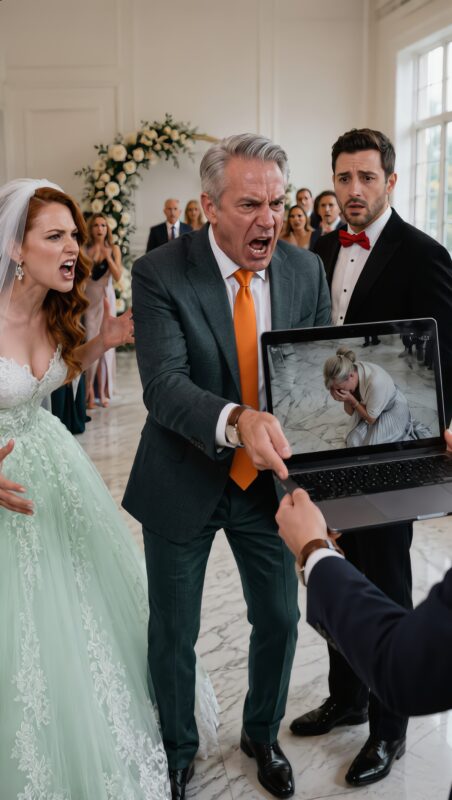
“I tripped,” Ellen whispered.
She begged me not to create a scene or ruin Michael’s wedding day. I honored her request, but for the next forty-eight hours she refused to tell me anything else.
Then my phone rang.
The manager of The Hawthorne Estate explained that recently recovered security footage had uncovered an incident involving my family.
I assumed it would show a simple fall.
Instead, I watched my own son betray his mother.
The recording showed Ellen carrying a velvet box containing my late father’s silver cufflinks—a treasured family heirloom she wanted Michael to have. Before she could hand them over, Cassandra slapped the box from her hands. As Ellen bent toward the floor, Michael seized her by the arm and shoved her hard into the hallway wall. She collapsed, stunned, while Cassandra stood over her with a mocking smile. Neither of them offered a hand before walking away together.
I requested a copy of the recording and returned home without saying a word.
Only then did Ellen finally tell me what had happened.
Cassandra had called her an embarrassment and claimed women like her made elegant weddings look inexpensive. When Ellen quietly reminded them that she was still Michael’s mother, he tightened his grip on her arm and said only four words:
“Not tonight, Mom.”
That sentence erased thirty-one years of excuses.
Inside my office safe sat two things meant for Michael’s future.
The first was an envelope containing the $100,000 Ellen and I had saved as a down payment for his first home.
The second was his employment agreement. He held a management position at my construction company—not because he had earned it, but because I had created it for him.
Neither would remain his.
The following morning I met with our attorney, Margaret Ellis. She reminded me to separate family heartbreak from business responsibility. Together we reviewed Michael’s employment history, documented repeated performance failures, withdrew the wedding gift, and began the legal process leading to disciplinary action.
Before making anything official, I asked Ellen one question.
“What do you want?”
She didn’t hesitate.
“I don’t want revenge. I want peace. And I want you to stop protecting him from the consequences of his choices.”
She was absolutely right.
For years I had mistaken rescuing my son for loving him. I had covered his debts, found him better jobs, fixed his mistakes, and convinced myself I was helping him become a better man.
I was only preventing him from growing up.
When Michael returned from his honeymoon expecting congratulations, he found a formal performance review waiting on his desk. Missed deadlines. Client complaints. Failed inspections. At the end of the meeting, I informed him that the promised wedding gift had been withdrawn.
His first question wasn’t about Ellen.
It was about the house he and Cassandra had already chosen.
A few days later Cassandra called Ellen, insisting the entire incident had been a misunderstanding and claiming she had simply fallen.
Ellen answered calmly.

“The cameras recorded everything.”
Then she added quietly,
“I no longer have a daughter-in-law.”
And she ended the call.
Not long afterward Michael came to our house, only to discover the locks had been replaced.
He stared at the fading bruises on his mother’s arm.
“I never meant for this to happen,” he said softly.
“You made it happen,” Ellen replied.
He blamed the stress of the wedding. He blamed emotions. He blamed Cassandra.
Ellen simply shook her head.
“I stayed awake beside you through childhood fevers. I stood by you when no one else would. I loved you every day of your life. I brought you your grandfather’s cufflinks, and you left me with bruises.”
For the first time, silence was his only answer.
Twelve days later, after further misconduct and repeated failures at work, we terminated his employment.
Cassandra accused us of ruining their future.
Michael accused me of choosing my wife over my son.
“I should have made that choice years ago,” I told him.
The weeks that followed were quiet.
Their wedding photographs remained online, but every joyful caption slowly disappeared.
Eventually Michael sent me a single email.
“You destroyed my life over one terrible mistake.”
I answered with one sentence.
“Your mother was never just a mistake.”
Several months later Cassandra left him after realizing there would be no inheritance, no financial rescue, and no free house waiting for them.
One evening Michael called.
“I pushed her,” he admitted. “I watched her hit the wall… and I walked away.”
It was the first completely honest confession he had ever made.
Ellen agreed to meet him, but only inside our attorney’s office.
He apologized without asking to be forgiven.
She listened quietly before saying,
“That’s the first honorable thing you’ve done.”
There were no hugs.
No instant forgiveness.
No restored career.
Only consequences—and healthy boundaries.
Over time they exchanged occasional letters. Michael found work where his surname meant nothing and slowly learned to build a life without relying on his parents to save him.
Two years later Ellen presented my father’s silver cufflinks to another relative on his wedding day.
Michael attended the ceremony but quietly left before the family dinner began.
As Ellen passed him, he smiled faintly.
“You look beautiful, Mom.”
She nodded politely.
“Thank you, Michael.”
Not every ending is about revenge.
Sometimes the greatest act of love is finally refusing to protect someone from the truth.