On the 42nd floor of Apex Dynamics Tower, the boardroom felt almost frozen, though not because of the air conditioning. The true cold came from pressure—an unfolding financial disaster centered on a broken logistics system known internally as “The Equation.”
Nathaniel Whitmore, the company’s CEO and one of the most influential figures in the tech world, stood near the glass wall while his executives argued behind him. Every hour of failure meant millions lost. The algorithm controlling global distribution was collapsing, and no expert team had managed to repair it.
Some suggested abandoning the system entirely. Nathaniel refused without hesitation. “There is no replacement,” he said firmly. “We fix this—or we bleed money until we collapse.”
At that moment, the door opened.
A cleaner, Elena Rivera, stepped inside with her young son. She had nowhere to leave him and assumed the room was empty. The executives reacted with irritation, but Nathaniel immediately demanded an explanation.
Flustered, Elena apologized and tried to leave. But her son, Mateo, stayed still—studying the massive display on the wall.
Then he spoke.
“The issue isn’t computing power,” he said quietly. “It’s the order of operations. The system is misaligned.”
The room fell completely silent.
Nathaniel stared at him, unconvinced. “And you are?”
The boy lifted his gaze. “Someone who can fix it.”
A few executives laughed. Nathaniel, half-amused and half-curious, set a harsh challenge: if the boy succeeded, his mother would be promoted; if he failed, she would be dismissed immediately. Elena panicked, but Mateo calmly stepped forward.
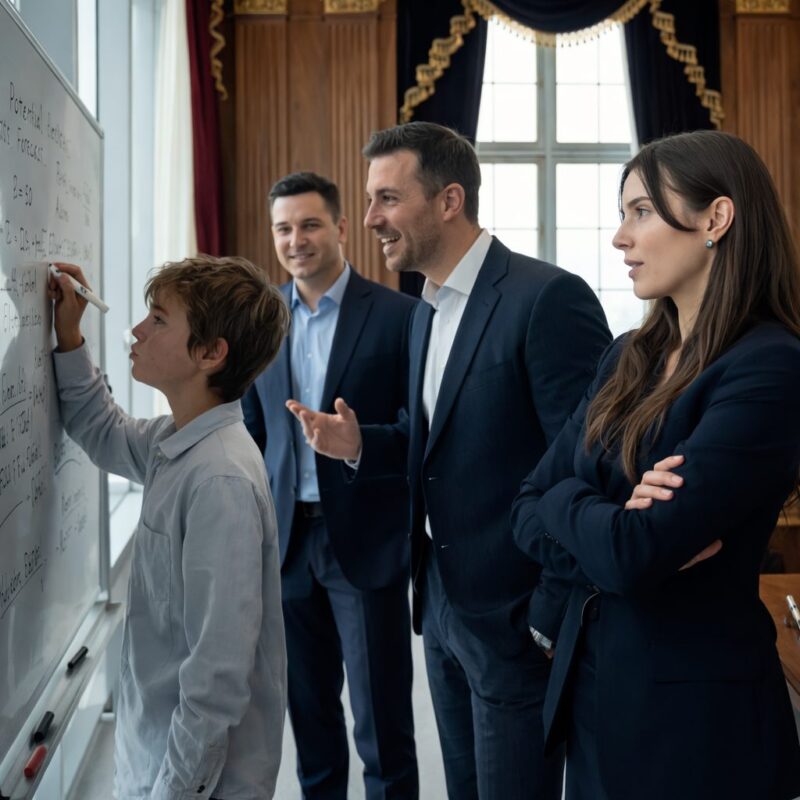
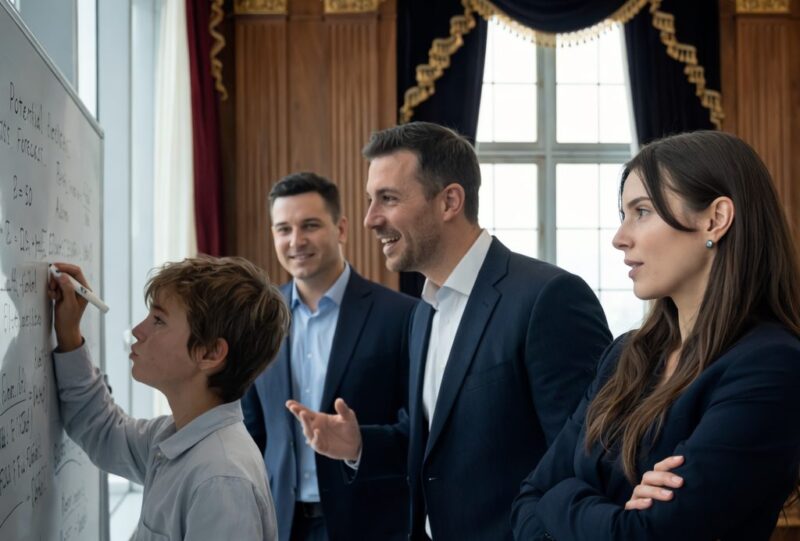
He took the marker.
What followed was unexpected. Instead of complicating the model like the consultants before him, Mateo dismantled it. He broke the structure into simpler layers, removed unnecessary constraints, and rebuilt the logic from the ground up.
Minutes passed.
The room slowly shifted from skepticism to disbelief.
When he finally stepped back, the solution stood complete.
A live connection to a specialist in Geneva confirmed it instantly: the correction was not only accurate, but more efficient than anything previously designed.
Nathaniel’s voice lowered. “How is this possible?”
Mateo explained. His father, Professor Daniel Rivera, had been a respected academic who exposed corruption in elite universities. After being blacklisted, he was forced into obscurity, tutoring privately while his wife worked cleaning jobs. When illness struck, lack of medical access cost him his life.
Before dying, he taught his son one principle: intelligence only matters when it is used honestly.
Mateo declined any reward. “I don’t want payment,” he said. “I want my mother treated with respect.”
Before the tension could settle, a competitor CEO, Samantha Lee, entered the room. Observing everything, she offered Elena a professional position with dignity and gave Mateo a place in a prestigious youth innovation program.
The atmosphere shifted again when Ethan Whitmore, Nathaniel’s son, challenged Mateo with a more advanced problem, attempting to expose him as a fraud.
Mateo solved it once more—calmly, without arrogance.
He added quietly, “Being intelligent doesn’t excuse being cruel.”
Ethan broke down under the pressure, realizing how much he had been shaped by expectations rather than understanding.
Nathaniel, witnessing the moment, admitted his failures—not only as a leader but as a father.
Soon after, the situation escalated beyond the room: footage of the encounter spread online, triggering public outrage and a sharp decline in the company’s value.
For a moment, Nathaniel considered resignation.
But Mateo stopped him.
“The world has seen your worst moment,” he said. “Now show them something better.”
For the first time, Nathaniel acted without strategy. He went live publicly, apologized for his behavior, and announced the creation of a foundation in Daniel Rivera’s name to fund education and emergency healthcare. He also committed to restructuring his company with fairness and transparency.
Over time, the changes became real.
Elena transitioned from cleaning staff to a respected role within Orion Systems, where her work was finally valued. Mateo joined an elite program for young innovators, collaborating on engineering solutions for underserved communities.
Later, Nathaniel returned to him with a small metal box recovered from an old university archive. Inside were Daniel Rivera’s belongings and a handwritten letter for his son.
It read:
If you are reading this, I am gone. I leave you no fortune—only what truly matters: your mind, your integrity, and your heart. Knowledge without compassion is dangerous. Real intelligence serves others. Never measure your worth by what you own, but by what you contribute.
Mateo held the letter tightly, silent.
Nathaniel placed a hand on his shoulder. “You didn’t just solve the problem in that room,” he said. “You changed everyone in it.”
And in that moment, surrounded by glass, steel, and silence, both understood that true value is never measured in numbers—but in humanity, dignity, and the courage to change.