She Stepped Into a Cage for Thirty Million—Then a Dead Man Spoke Her Name
The fighting pit was buried beneath the ruins of an old metalworks.
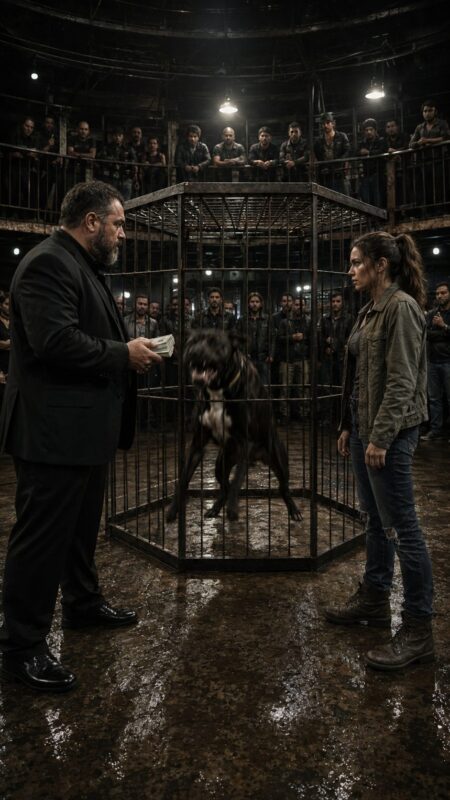
Aboveground, the factory had been abandoned for years. Below it, hundreds of people crowded into two levels of temporary stands, shouting over the sound of rattling steel and pounding music.
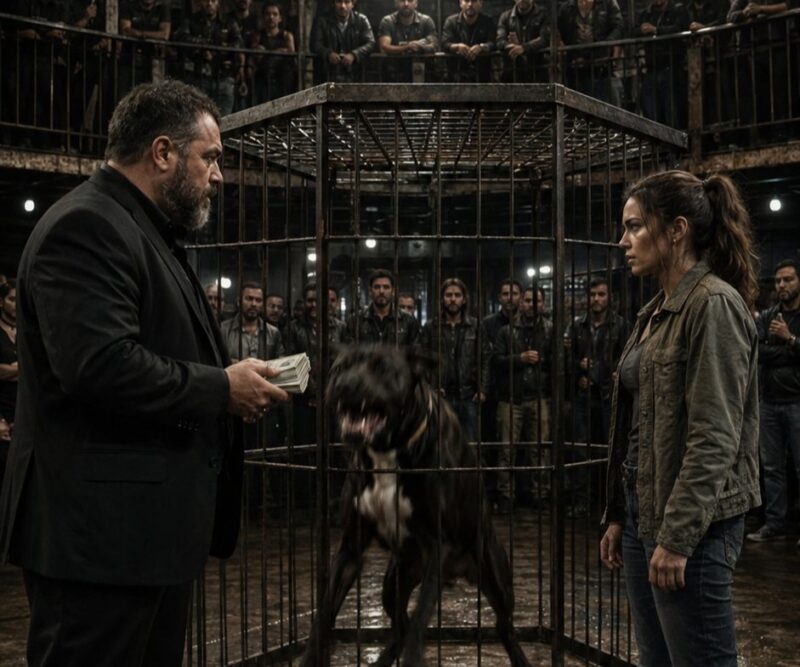
At the center of the underground hall stood an eight-sided cage.
Inside, a massive black dog paced in frantic circles. A white mark spread across his chest, nearly resembling a heart. Scars covered his muzzle and shoulders, and every time he struck the bars, the spectators roared.
They called him Monster.
Anna faced Viktor Gromov beside the cage entrance.
He controlled the fights, the betting, and nearly everyone in the room. A thick stack of banknotes rested in his hand.
“Thirty million,” he said. “All you have to do is stay inside until the timer ends.”
His smile made it clear that he did not expect her to survive.
“You can still leave.”
Anna felt the wooden whistle in her coat pocket and closed her hand around it.
“I didn’t come here to leave.”
The words seemed ordinary, but Gromov’s expression changed immediately.
Three years earlier, Anna’s brother Denis had said the same thing in that very room, shortly before he vanished.
Gromov studied her face.
“Who taught you that sentence?”
Anna took one step closer.
“Let’s see how expensive your bravery really is.”
That had been the next line in Denis’s final voice message.
Whispers moved through the crowd.
Gromov’s smile disappeared.
“Your brother entered this cage,” he said. “No one saw him walk out.”
Anna looked past him at the animal throwing himself against the steel.
“That is why I am here.”
The cage door opened.
She entered without looking back.
The lock slammed shut behind her.
Across the enclosure, the dog stopped moving.
His body remained low and rigid. His lips drew back from his teeth, and saliva fell onto the concrete beneath him.
The chanting began.
“Monster! Monster! Monster!”
Gromov raised his arm.
“Start!”
The dog lunged.
Anna remained where she was.
At the last possible moment, she pulled the whistle from her pocket and blew three quick notes.
The sound was soft, almost lost beneath the screaming crowd.
But the dog heard it.
He tried to stop so suddenly that his paws slid across the damp floor. He halted only a few feet from Anna, breathing heavily.
His growl continued, but his eyes had changed.
There was confusion in them now.
Anna slowly knelt.
“Do you remember that sound?” she whispered.
The dog tilted his head.
She blew again.
Two brief notes, followed by one long call.
Denis had used that signal years ago at the small animal shelter he ran behind their childhood home. Injured dogs, abandoned cats, even frightened birds had learned to associate it with food, safety, and his voice.
The dog’s growl weakened.
Then someone spoke from the shadows beyond the cage.
“They named him Monster after they stole him from me.”
The arena fell silent.
A thin man stepped into the light near the far wall.
He leaned on a cane. A scar crossed one side of his face, and every movement appeared painful.
Anna stared at him.
For several seconds, she could not breathe.
“Denis?”
Her brother looked at her.
“I’m sorry it took me so long.”
Gromov stumbled backward.
“No,” he muttered. “You died.”
The dog heard Denis’s voice and released a sound completely unlike a growl.
He whimpered.
Then he ran toward him.
The bars stopped him, but he pressed his entire body against them, whining and beating his tail against the metal.
Denis reached through carefully.
The enormous animal lowered his head and licked his fingers.
“He was never a monster,” Denis said.
His gaze shifted to Gromov.
“The monster was the man who buried him alive.”
Years earlier, Gromov had raised dogs for illegal fights. Puppies that appeared too gentle, too weak, or too difficult to train were discarded.
This one had been thrown into a shallow grave while still alive.
Denis had been twelve when he heard scratching beneath the soil near an empty field. He dug until his hands bled, pulled the puppy free, and carried him home beneath his jacket.
He nursed him back to health and gave him a name.
Hope.
Years later, Gromov discovered what had become of the dog. He had him stolen, starved, beaten, and trained to attack.
When Denis traced the animal to the underground arena and threatened to expose the operation, Gromov’s men nearly killed him.
They left him outside the city, believing he would not survive the night.
But Denis lived.
He spent the next three years recovering under another name and gathering evidence against Gromov’s network.
Gromov suddenly reached beneath his jacket.
Hope reacted before anyone else.
He moved between Anna and the bars, placing his body in front of hers.
He did not attack.
He simply stared at Gromov and gave one deep warning growl.
Then the factory doors exploded inward.
Police officers poured into the hall from every entrance.
The crowd erupted in panic.
Some spectators tried to run. Others climbed over seats or pushed toward narrow corridors, only to find officers waiting there.
Everything had already been recorded by a miniature camera concealed in one of Anna’s coat buttons.
Gromov was driven face-first onto the concrete.
The money slipped from his hand and scattered across the wet floor.
When the cage was opened, Hope did not charge toward freedom.
He walked directly to Denis.
The dog circled him once, lowered himself at his feet, and rested his head across his worn shoes.
Anna joined them, tears streaming down her face.
“What did you call him when you found him?” she asked, though she already knew.
Denis placed a hand on the scarred animal’s back.
“Hope.”
Months later, the underground arena was cleared out and rebuilt.
The cages were removed. The betting rooms became treatment areas, and the concrete chambers were turned into warm shelters for rescued animals.
Above the new entrance hung a sign:
NO MONSTERS LIVE HERE
Every morning, children arrived to help feed the animals.
Hope always waited for them by the gate.
He remained enormous, black, and marked by scars.
But no one who saw the white heart on his chest ever called him Monster again.