The Billionaire Tracked Down His Maid to Shame Her for Stealing Food, But What He Discovered in That Shack Shattered His Life
PART 1
Mateo Vargas was a man who had complete control over everything. At 45 years of age, he had built an empire in real estate in Monterrey, becoming one of the wealthiest and most feared individuals in northern Mexico. His life was a model of cold precision and efficiency. He wore tailored dark suits, a watch worth more than a whole house, and carried himself with an attitude that made it clear no one could rival him.

His wife, Sofía, was always by his side—a woman from Monterrey’s high society, who valued people by the brands they wore. To them, the world was divided into two kinds of people: those who commanded and those who obeyed.
When they moved temporarily to a luxurious estate on the outskirts of the city to oversee a massive construction project, Sofía insisted on hiring housekeeping staff. This is how Blanca entered their lives. A 38-year-old woman with a quiet demeanor, rough hands, and a pristine apron. Blanca arrived at 6 a.m. every day, cleaned, cooked, and left in silence. To Mateo, Blanca wasn’t a person; she was just another appliance in the house. Sofía treated her with barely disguised disdain, complaining about the desert dust she couldn’t remove or the food being too spicy. Blanca never argued, she simply nodded and worked harder.
For two weeks, everything seemed like routine. But then, during the third week, something changed. One afternoon, while Mateo was reviewing contracts in the living room, he heard an unusual noise coming from the kitchen.
He sneaked closer and saw Blanca standing by the stove, carefully wrapping the leftover food—half a roasted chicken, four tortillas, and some rice—in aluminum foil, then hiding it in an old plastic bag that she stuffed into her backpack. The next day, the same thing happened. Blanca was stealing leftovers just before leaving at 5 p.m.
Sofía was the first to lose her temper when she found out. She demanded that Mateo fire her immediately, accusing her of being a bold thief. Any other employer would have simply fired her on the spot, but Mateo wasn’t just any employer. His pride wouldn’t allow him to merely dismiss her; he needed to destroy her. He wanted to know exactly where she was taking the food, who was eating it, and how he could use this information to humiliate her in the worst way possible. He wanted to make her regret it.
On Friday afternoon, when Blanca hurried out with her bag, Mateo grabbed the keys to his black luxury truck and followed her discreetly. He watched as she boarded a rickety bus. Mateo trailed the bus for almost an hour, leaving the gleaming skyscrapers behind and venturing into the more run-down, dusty parts of the city. The paved roads disappeared, and the dirt paths of the harsh Mexican desert began.
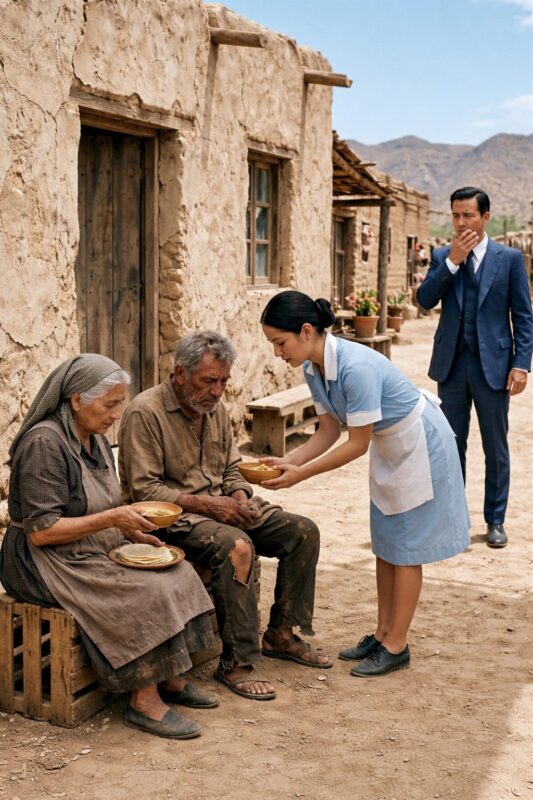
The bus eventually stopped in the middle of nowhere. Blanca got off and started walking under the searing heat toward a forgotten village. Mateo parked his truck 100 meters away, got out, and followed her on foot, hiding behind cacti and decaying walls. His suit was drenched in sweat, but his anger drove him forward. He watched as Blanca stopped in front of the most pitiful shack, an adobe house on the verge of collapse, with a rusted tin roof.
Inside, sitting on two wooden crates, were two frail old people, covered in dust and suffering. Blanca opened her bag and began feeding them the food she had taken from the mansion. Mateo’s blood boiled. This woman, his employee, was using his food, his money, to feed two homeless individuals. He clenched his fists and stepped forward, ready to confront them, shout, and call the police to have Blanca thrown in jail. But what happened next was beyond belief…
PART 2
Mateo moved forward, his footsteps heavy, raising clouds of dust. He was only 10 meters away, and an insult was already forming in his throat. But before he could say a word, the old man, slowly chewing a piece of tortilla, lifted his gaze. His left eye was clouded by a cataract, but his right eye locked onto Mateo. Mateo froze. The air seemed to leave his lungs as though he had been struck in the stomach.
The old man had a distinct scar on his chin and large, dark hands, gnarled from years of hard labor. Beside him, the elderly woman, trembling slightly under a gray shawl, tilted her head, a faint smile on her face as she murmured a lullaby that Mateo hadn’t heard in 23 years. His heart pounded so loudly, he thought it might burst from his chest. The insult died in his throat. His leather briefcase slipped from his hand and fell to the dusty ground.
These two elderly people were not just beggars. They were Don Ramón and Doña Josefina. They were his parents.
Reality hit Mateo like a collapsing building. 23 years ago, he had left his small hometown in Sonora with nothing but a backpack, promising to return and pull them out of poverty. For the first two years, he sent money and called, but as his success and greed consumed him, the calls became less frequent. Then he met Sofía, who despised poverty, and Mateo, ashamed of his humble roots, cut off all contact with his parents. He convinced himself they would be fine without him.
Now, dressed in a $4000 suit, he found his parents living in a mud shack, with no water, no electricity, surviving on the leftovers that a kind-hearted maid secretly brought them.
When Blanca heard the briefcase fall, she turned around. Seeing her boss there, terror crossed her face. She instinctively stepped in front of the elderly couple, acting as a human shield. “Please, sir,” Blanca begged, her voice trembling. “Take the food from my salary, fire me if you wish, but don’t harm them. They have no one. The government took their land five years ago, and no one in the village would help them.”
Mateo couldn’t speak. His knees wobbled. He took another step forward, his eyes filling with burning tears. “Mom…” he whispered, his voice cracking like a frightened child.
Doña Josefina looked at him. Her mind, worn down by dementia, didn’t recognize the face of the grown man standing before her. Instead, she looked at Blanca, gently patted her hand, and said, “Thank you for coming, dear. I knew you wouldn’t leave us alone.” His own mother didn’t recognize him. To her, Mateo no longer existed.
But Don Ramón did recognize him. The old man stood up painfully, leaning on the adobe wall. There was no joy in his only good eye. Only a cold, ancient anger, and a disappointment so deep that it cut sharper than any knife. “You don’t have a mother,” he said in a hoarse, firm voice. “My son died 20 years ago. He left and never came back. You’re just a stranger dressed in wealth, coming to mock our hunger. Get out of my house.”
Every word was like a bullet to Mateo’s heart. The billionaire, the man who made even the most powerful executives in Monterrey tremble, collapsed to his knees in the dirt, staining his designer pants. He cried. He sobbed, pounding the ground, pleading for forgiveness that he knew he didn’t deserve. But Don Ramón turned his back, took his wife’s arm, and walked into the dark shack, leaving him alone in the dust. Blanca looked at him from above, finally understanding the horrible truth: the ruthless boss she worked for was the son who had abandoned these poor souls.
That night, Mateo returned to the mansion like a ghost. Sofía was waiting for him in the living room with a glass of wine. “So, did you send that thieving maid to jail?” she asked with a malicious smile. Mateo looked up at her and truly saw her for the first time in 15 years of marriage. He saw the ugliness of her soul, the same ugliness he had become.
“Those old people… they’re my parents,” Mateo said in a hollow voice.
Sofía put the glass down, her face contorting in a genuine grimace of disgust. “Your parents? Those beggars? For heaven’s sake, Mateo. Give them 1000 pesos to keep them quiet and fire the maid first thing tomorrow. I’m not going to let your dirty past ruin my reputation. We’re leaving for the city in two days.”
Silence filled the grand house. Mateo took off his jacket, then his tie, and finally his expensive watch, leaving them on the glass table. “You can leave,” he replied with a chilling calm. “I’m staying. And I never want to see you again.”
The divorce cost Mateo half of his fortune, but for the first time in 23 years, he didn’t care about losing money. The next morning, he didn’t go to the office. He went to a hardware store. He bought wood, new tin sheets, cement, tools, and bottles of clean water. He drove back to the desert.
When he arrived at the shack, Blanca was there. She was surprised to see him in jeans and work boots. Mateo didn’t try to enter the house. He knew he had no right. In silence, under the 40-degree heat, he began repairing the rusted tin roof. Don Ramón came out when he heard the hammering. He stood in the doorway, watching him with suspicion, but didn’t tell him to leave.
Seven days passed. Mateo slept in the back of his truck. During the day, he worked, mixing cement, repairing walls, and cleaning up the trash around the land. His executive hands became calloused, cut, and muddy, as rough as his father’s. Blanca kept coming every afternoon, but no longer bringing leftovers; Mateo bought full grocery baskets, and together they cooked on an improvised grill.
On the 10th day, Mateo hit his hand with the hammer and cursed quietly. Suddenly, he felt a shadow beside him. It was Doña Josefina. The elderly woman took his injured hand with infinite tenderness. She looked him in the eyes, and for a brief moment, the fog in her mind seemed to clear. “You have your father’s hands, my boy,” she whispered. Then, she kissed his dirty knuckles.
Mateo broke down again, but this time, he wasn’t alone. He felt a heavy, calloused hand rest on his shoulder. It was Don Ramón. The old man didn’t say “I forgive you,” didn’t hug him, didn’t smile. But he pressed his shoulder for five long seconds before turning away. In the language of a wounded father, that brief touch meant the door that had been closed for more than two decades had opened just a crack.
Mateo didn’t return to his company. He left his partners in charge and decided to stay in the dusty town. He built a decent house out of brick and concrete on the same plot of land. Blanca was formally hired, not as a maid, but as a nurse and caregiver with a salary that allowed her to send her children to university.
One afternoon, the four of them sat in front of the new house, eating freshly made beans and hot flour tortillas. The desert sun set, painting the sky in deep orange. Mateo looked at his father, who ate in silence, and then at his mother, who smiled while Blanca combed her hair.
The billionaire had lost most of his crystal and steel empire, lost his high-society wife, and his extravagant luxuries. But sitting there in a plastic chair, with his hands full of scars and his heart finally beating for real, Mateo knew that for the first time in 45 years of life, he was truly rich. Because true success is not the money you accumulate while ignoring your roots, but having the courage and humility to return and rebuild the home you once destroyed with your neglect.