THE FALL ON REFORMA AND THE BOY WHO CHANGED EVERYTHING
The midday sun burned over Paseo de la Reforma, pressing down on Mexico City with relentless heat and noise. In the middle of it all, Arturo—a 58-year-old real estate tycoon—lay helpless on the pavement. His sleek wheelchair had tipped over nearby, useless now. Pain surged through his back, but the sting of being ignored cut deeper. People walked past him without a glance, stepping around him as if he were invisible.
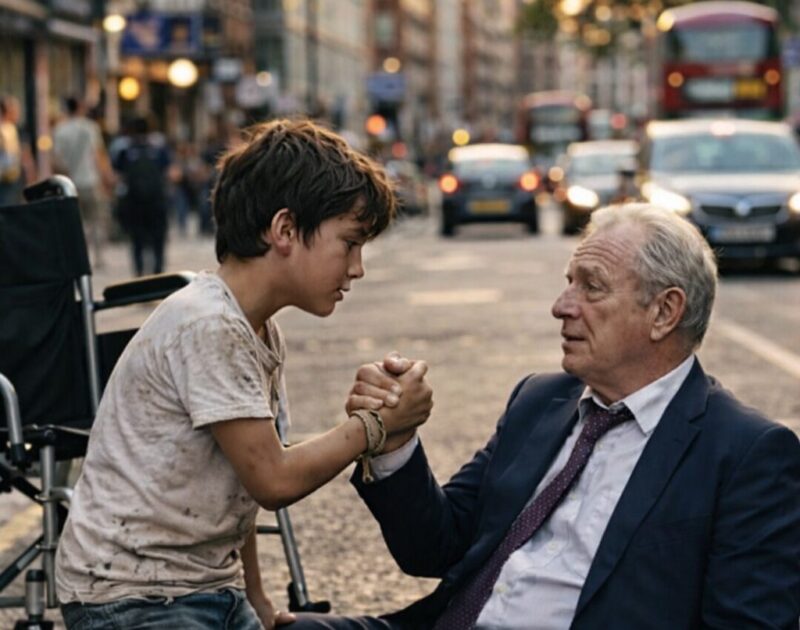
No one stopped.
No one—until a small figure stepped forward.
“Don’t worry, sir. I’ve got you,” said a rough, young voice.
Arturo lifted his head and saw a boy, no older than nine. His clothes were worn, his face dusty, and a small box of sweets hung from his neck. His name was Mateo. Despite his size, the boy’s grip was steady and strong. With visible effort, he helped Arturo sit up and then struggled to lift the fallen wheelchair back into place.
“All set,” the boy said, smiling shyly.
That moment broke something open inside Arturo. Instead of handing over a coin, he invited the boy to eat. At a modest café, Mateo ate quickly, as though he hadn’t seen food in days. Between bites, he shared his reality—he lived on the streets, alone, surviving on small tips from passing cars.
Arturo made a decision he couldn’t ignore. He brought Mateo home.

The mansion, vast and polished, felt overwhelming to the boy. He walked carefully across the floors, afraid to leave a mark, clutching a worn plastic bag—the only thing he owned.
But peace didn’t last long.
That evening, Arturo’s nephew Héctor arrived. Young, calculating, and hungry for power, he had long expected to inherit everything. The sight of Mateo sitting comfortably inside the house triggered instant fury.
“What is that kid doing here?” Héctor snapped.
Arturo stood his ground, but when he stepped away briefly, Héctor acted. He ripped the bag from Mateo’s hands and dumped its contents onto a table—small trinkets, a broken toy, and an old folded letter.
The moment Héctor opened it, his expression changed completely.
Fear.
Recognition.
Without hesitation, he reached for a lighter.
“Stop right there!” Arturo’s voice cut through the room.
Caught, Héctor froze. Arturo took the letter and carefully unfolded it. His breath caught the moment he recognized the handwriting.
Valeria.
The woman he had loved. The one who had vanished a decade ago.
The letter revealed the truth:
She had been forced to leave. Threatened by Arturo’s own family. And she hadn’t left alone—she had been carrying his child.
Mateo.
Time seemed to stand still.
Arturo looked at the boy again. The resemblance was undeniable.
“You knew,” he said quietly, turning to Héctor.
With no way out, Héctor confessed. His father had orchestrated everything to protect the family fortune.
Something inside Arturo snapped.
“Get out,” he said, his voice cold and final. “You’re done.”
Héctor was thrown out that night, and by morning, legal action was already underway.
Then Arturo turned back to Mateo, who sat silently, expecting the worst.
“Are you sending me away?” the boy asked.
Arturo felt his chest tighten. He reached out and pulled him into a firm embrace.
“No,” he said softly. “You belong here.”
A DNA test confirmed it soon after.
Mateo was his son.
From that day forward, everything changed. The house filled with life, laughter, and warmth. Arturo gave Mateo stability, care, and something he had never known before—love.
As for Héctor, his greed caught up with him. Investigations exposed his crimes, and he lost everything.
A year later, under a calm sky, Arturo and Mateo sat together in the garden. The boy, now healthy and confident, looked up with a smile.
“Thanks for finding me, Dad.”
Arturo smiled back, understanding at last what truly mattered.
It wasn’t wealth.
It was the second chance life had given him—and the family he thought he’d lost forever.