The first crack in my certainty came from four unexpected words glowing on my husband’s forgotten Apple Watch.
“Last night was amazing.”
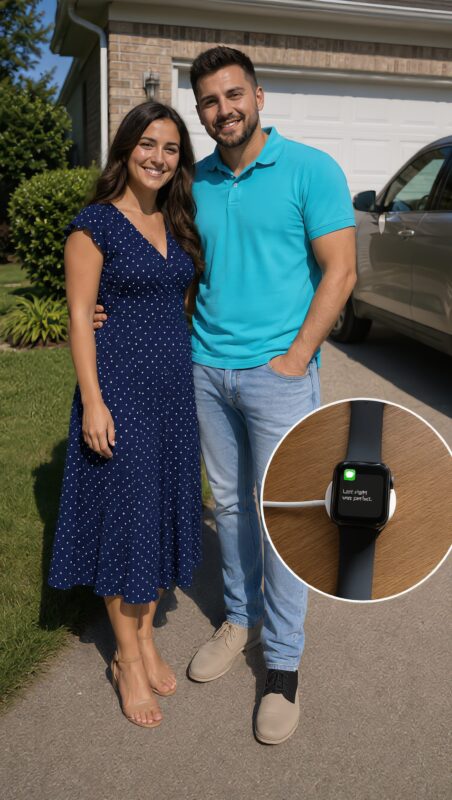
I stared at the screen, unable to breathe.
Cameron had spent the previous evening “working overtime.” That was the explanation he gave before leaving home, and I had accepted it without hesitation. Now those four words made every memory of the night before feel suspicious.
I didn’t confront him.
Instead, I put the watch back exactly where it had been, smiled as though nothing had happened, and made a decision that surprised even me.
I would find out the truth for myself.
Before that Thursday, I had never questioned Cameron’s honesty. Sure, he had his odd habits. He could never remember where we stored the flashlight batteries, believed every wrong turn was somehow a shortcut, and loaded dishes into the dishwasher with complete confidence despite making no logical use of space.
But deception?
That simply wasn’t part of who he was.
Our marriage had always been built on openness. We didn’t memorize each other’s passwords because there was no reason to. If his phone buzzed while he was driving, he’d casually ask me to read the message aloud. Nothing was hidden.
Just weeks earlier, several coworkers admitted they secretly checked their husbands’ phones whenever they felt uneasy.
I laughed.
“I’d rather ask directly than play detective,” I told them.
That evening I repeated the conversation to Cameron while we folded towels.
He smiled and answered, “If something ever worries you, promise you’ll ask me first. Silence creates bigger problems than honesty ever will.”
I believed every word.
Then came the forgotten watch.
It was charging beside the fruit bowl, something I’d never seen before because Cameron wore it everywhere. I picked it up to bring it upstairs.
The display lit up.
Last night was amazing.
No contact name.
No context.
Just a message capable of destroying my peace of mind.
A few seconds later it vanished from the screen.
When Cameron walked into the kitchen, I acted normally.
He kissed my forehead, slipped the watch onto his wrist, grabbed his coffee, and headed for the door.
“Love you.”
“Love you too.”
The exchange sounded exactly like every other morning.
Only I wasn’t the same person anymore.
After breakfast he mentioned he’d probably be home late again.
Those words echoed differently now.

The moment his car disappeared down the street, I picked up my keys and quietly followed.
For several miles, nothing unusual happened. He drove toward downtown exactly as expected, and I almost convinced myself I’d overreacted.
Then he drove past his office building.
My stomach tightened.
His first stop was a flower shop.
He walked out carrying a single white rose.
Every terrible possibility rushed through my mind.
The next stop was a tailor, where he collected a dark blue garment bag.
Flowers.
Dress clothes.
Late nights.
The pieces fit together far too easily.
Eventually he parked outside the Oakridge Community Center.
A colorful sign welcomed visitors to the weekly ballroom dance social.
Ballroom dancing?
That made no sense.
At our own wedding, Cameron had stumbled through every dance, stepping on my feet so often our guests couldn’t stop laughing.
Curiosity defeated fear.
After giving him a few minutes, I slipped inside.
Looking through a narrow window, I saw him on the dance floor.
A woman stood opposite him.
Their hands were joined.
They moved gracefully across the room.
My heart sank.
How many evenings had this been happening?
How many excuses had I believed?
I turned toward the exit before they could see me.
Then an elderly gentleman spoke from behind me.
“I don’t know if I’m brave enough.”
I glanced back.
Theolder man was holding the white rose Cameron had purchased.
Only then did I notice what I’d completely misunderstood.
The woman wasn’t Cameron’s partner.
She was the instructor.
And Cameron was volunteering.
The older gentleman looked nervous.
“I haven’t asked a woman to dance since high school,” he admitted. “What if she refuses?”
Cameron smiled reassuringly.
“The hardest thing isn’t hearing ‘no.’ It’s wondering forever what might have happened if you’d asked.”
Everything changed in that instant.
There had never been another woman.
There had only been a man helping someone else overcome decades of fear.
Cameron finally noticed me standing near the doorway.
“Mindy?”
His expression immediately turned concerned.
“You saw the notification, didn’t you?”
I nodded.
He didn’t become angry or defensive.
Instead, he looked genuinely disappointed.
“I should’ve explained,” he said quietly. “Arnold wanted everything to stay confidential until tonight. I kept my promise to him, but I never meant to make you doubt me.”
Then he introduced me to Arnold.
More than fifty years earlier, Arnold had been too shy to invite Irene—the girl he loved—to dance. After all those decades, he had finally decided to ask her.
Weeks of secret dance lessons had been leading to this one moment.
The mysterious notification?
It came from Grace, the instructor, who routinely texted every volunteer after practice with the same cheerful message thanking them for helping.
Suddenly the terrifying mystery became almost funny.
A forgotten smartwatch notification had created an entire story that existed only in my imagination.
A few moments later, Arnold slowly approached Irene.
His hand trembled as he offered her the white rose.
“I’ve owed you this question since 1968,” he said softly. “Would you share a dance with me?”
Irene smiled before tears filled her eyes.
“I thought you’d never ask.”
As music filled the room, they stepped onto the floor together.
Cameron reached for my hand.
“Next time,” he whispered, “I’ll warn you if I’m keeping someone else’s surprise.”
I smiled back.
“And next time, I’ll choose a conversation before I choose suspicion.”
That night reminded me that trust isn’t the absence of doubt.
It’s the willingness to replace assumptions with honesty.
Sometimes the message that seems ready to destroy your happiness is actually the beginning of a story that restores your faith in people.