The Half-Moon
For a drawn-out second, everything around him seemed to fall away.
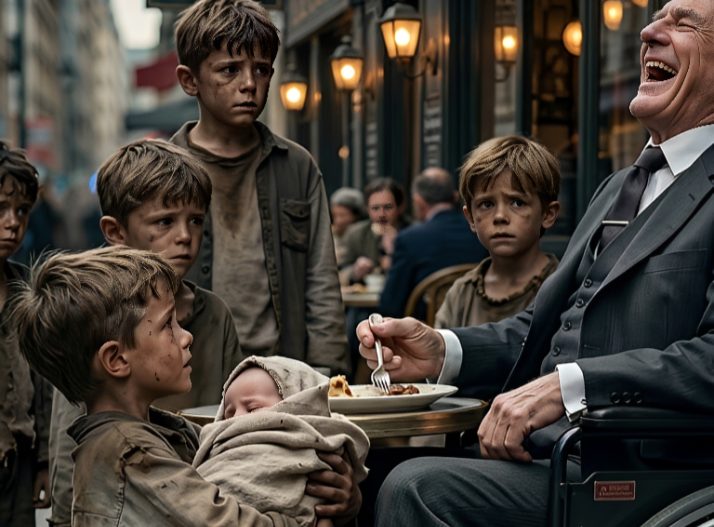
Cars continued to pass.
The café buzzed with conversation.
Faces lingered behind the windows, watching.
But none of it mattered.
There was only the infant—
and the small silver crescent resting against her chest.
The old man stared, unmoving, as if time had slipped between two heartbeats.
Because that piece of jewelry wasn’t ordinary.
He had it made himself many years ago—one half of a matched set, created the week his daughter entered the world. She wore hers every day until illness claimed her before her first birthday. When she was laid to rest, the pendant was buried with her.
At least, that was what he had believed.
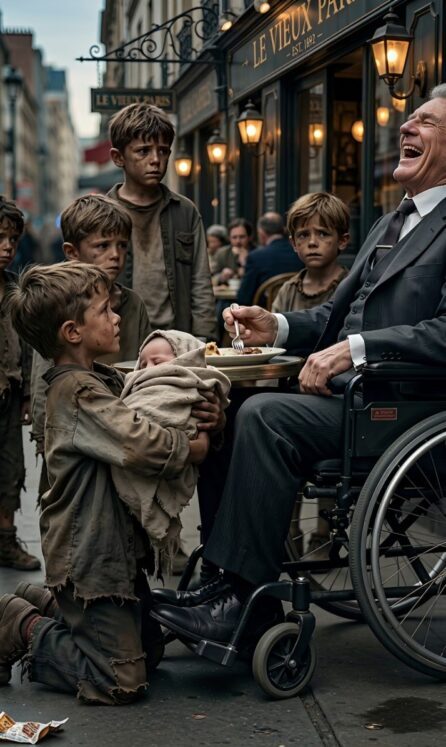
Yet now, that same crescent hung from the neck of a baby held by a worn, hungry child on the pavement.
His voice came out rough.
“Where did you get that?”
The boy glanced at the baby, then back at him.
“Our mom put it on her,” he said quietly.
He hesitated.
“Before she died.”
The words struck harder than anything else—the brief sensation he had felt in his leg no longer mattered.
Because this wasn’t chance.
It wasn’t some strange coincidence.
It was something undeniable.
It was blood.
He studied the baby again—carefully this time. Her features were still soft, unfinished, but something in them was unmistakable. The curve of her lips. The line of her brow. The same quiet stubbornness his daughter once had.
His hand rose slowly to his chest, pressing against the place where, hidden beneath his shirt, he still carried the other half of that moon.
The boy swallowed, his voice shaking.
“She said… if the baby made your foot move,” he whispered, “then you were the man she wrote about.”
The old man’s breath caught.
“What did she say?”
The boy reached into his torn pocket and pulled out a folded sheet of paper, worn from being handled too many times. He placed it carefully beside the untouched meal.
With trembling hands, the old man opened it.
He recognized the writing instantly.
His daughter’s.
Older. Less steady. But alive—proof that she had lived far longer than he had ever been told.
Years ago, she had left with a man he believed was beneath her. In anger, he cut her out of his life completely. Not long after, he was told both she and her child had died in a roadside fire. He never saw them. Never questioned it deeply. His pride had accepted the story before grief could challenge it.
Now the truth lay in front of him:
She had lived.
The man had abandoned her.
The child had survived.
And she had stayed away—certain her father valued control more than family.
But illness had changed her path.
In the final lines, she wrote:
*If she touches you and something in you remembers us, don’t let my children starve the way your anger left me starving.*
Something inside him cracked.
Not loudly.
Not for the world to see.
But enough.
Enough to shift the moment.
Enough for the children to feel it.
Enough for the city around them to soften, even if only slightly.
He looked at the food in front of him, then at the children—standing there, trying not to expect too much.
And that was the harshest part:
They hadn’t come searching for miracles.
They had come because they were hungry, alone, and holding the last proof that they belonged to him.
He pushed the plate toward the boy.
Then he reached out and gently lifted the baby into his arms.
And in that quiet instant, the man in the wheelchair finally understood:
The movement in his leg had never been the miracle.
The true miracle was that his family had found their way back to him—
before his pride had buried everything that mattered.