The House No One Could Heal
For almost a month, the Hawthorne mansion overlooking the rolling hills beyond San Diego had earned a reputation no staffing agency could ignore.
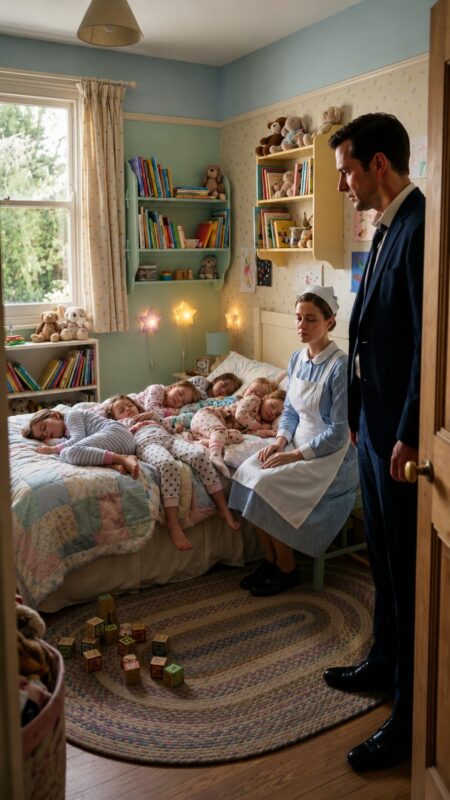
Caretakers arrived optimistic and left broken.
Some quit after only a few hours. One stormed off while yelling at the security cameras. Another locked herself inside a maintenance closet until guards persuaded her to come out.
The most recent nanny ran from the property before dawn, barefoot and in tears, convinced the estate was cursed.
From the window of his private office, thirty-eight-year-old entrepreneur Elliot Hawthorne watched her taxi disappear through the gates.
In the business world, Elliot was known for solving impossible problems. He had built a technology empire from nothing and navigated crises that would have destroyed most companies.
Yet nothing had prepared him for the silence inside his own home.
A framed photograph stood on his desk.
In it, his wife Lucía laughed as six young girls crowded around her on a sunny beach.
She had been gone for four years.
The pain had never left.
“I’m losing them,” Elliot whispered.
A call interrupted his thoughts.
“We’re out of candidates,” his chief of operations said. “No nanny wants to stay.”
“Then stop looking for nannies.”
“There is one applicant left. She’s a cleaner, not a childcare professional.”
Elliot looked toward the neglected garden outside.
“Bring her in.”
Across the city, twenty-seven-year-old Camila Reyes prepared for another exhausting day.
She spent her mornings cleaning homes and her evenings studying psychology.
Years earlier, a fire had taken her younger sister. The loss changed her forever and taught her a lesson few people understood:
Grief never affects only one person.
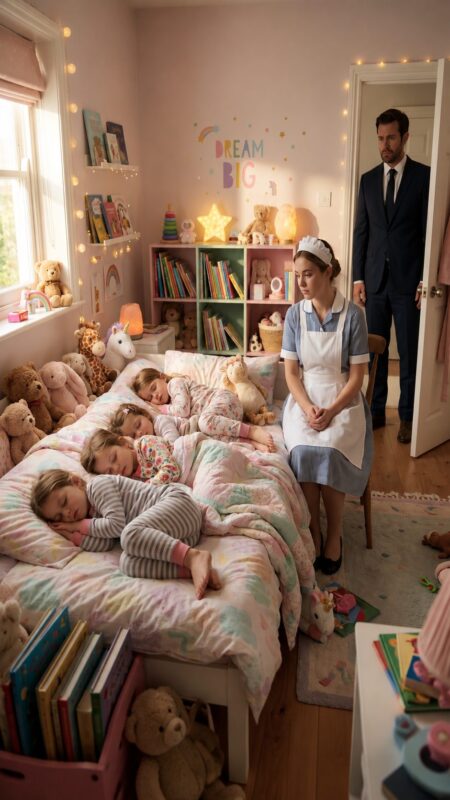
It spreads through an entire family.
When she was offered an emergency assignment with unusually high pay, she accepted immediately.
The Hawthorne residence was breathtaking from the outside.
Inside, it felt abandoned.
A security guard opened the front gate and offered a sympathetic smile.
“You’ll need some luck,” he said.
Elliot welcomed her personally.
The exhaustion in his eyes was impossible to miss.
“You’re here to help with the house,” he explained. “My daughters are having a difficult time.”
A loud crash echoed from upstairs.
Moments later came laughter that sounded more challenging than cheerful.
Camila nodded.
“I understand.”
The six girls stood together on the staircase, studying her.
Rowan, the oldest at thirteen, positioned herself in front of the others.
Mila nervously twisted her sleeves.
Elise watched quietly.
Noah avoided looking at anyone.
The twins, Piper and Wren, wore identical expressions of suspicion.
Little Sofia hugged a stuffed fox to her chest.
“You’re the thirty-ninth person Dad has hired,” Rowan said.
Camila smiled politely.
“Then I suppose I should get started.”
The kitchen revealed more than any conversation could.
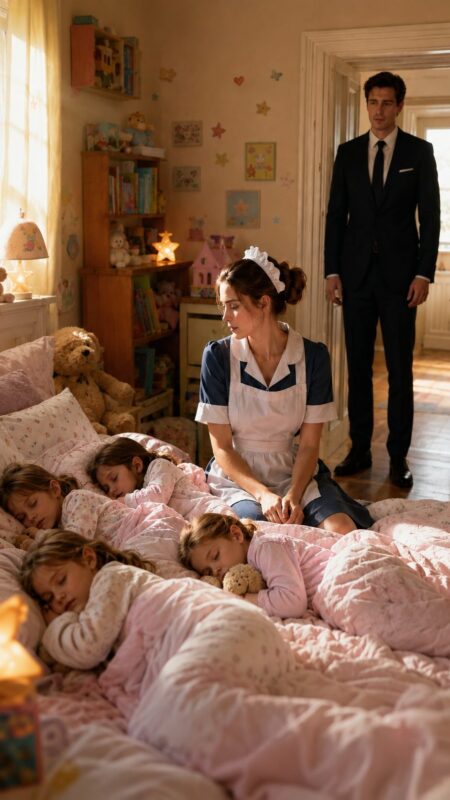
Photographs of Lucía filled the room.
Lucía cooking.
Lucía laughing.
Lucía holding her daughters.
The family had built a museum around their loss.
That evening, Camila prepared animal-shaped pancakes and left them on the table without explanation.
Hours later she returned to find Sofia quietly eating one by herself, as though she feared someone might take it away.
The twins soon launched their first prank.
They hid a fake insect among her cleaning supplies.
Camila picked it up, examined it, and smiled.
“That’s actually impressive.”
The girls exchanged confused looks.
They had expected screaming.
Not admiration.
Over the following weeks, Camila never forced conversations or demanded trust.
When Noah experienced an embarrassing accident, she handled it gently.
When Elise suffered a panic attack, Camila sat beside her and calmly guided her breathing until the fear passed.
“How do you always know what to do?” Elise asked.
Camila paused.
“Because someone once did the same thing for me.”
Little by little, the atmosphere inside the mansion began to shift.
The twins stopped acting out.
Mila returned to practicing piano.
Sofia laughed more often.
Even Rowan’s anger started to soften.
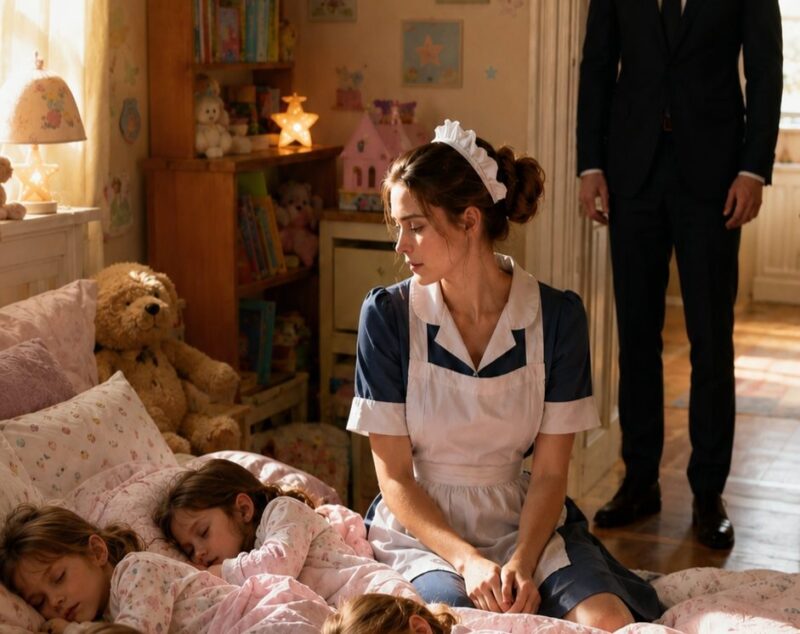
Elliot noticed the changes.
He began leaving work earlier.
Instead of hiding in his office, he joined family dinners.
For the first time since Lucía’s death, the house felt warm again.
One evening, he asked Camila the question that had been on his mind for months.
“What did you do differently?”
Camila glanced toward the dining room, where the girls were laughing together.
“Nothing extraordinary,” she answered.
“I didn’t try to repair them. I just refused to leave.”
Then everything changed.
One terrible night, Rowan swallowed a bottle of pills.
The sound of sirens shattered the darkness.
Doctors rushed through hospital corridors.
Elliot sat in the waiting room, his face buried in his hands.
Years of fear, guilt, and grief finally overwhelmed him.
For the first time, he cried openly.
Camila sat beside him.
She didn’t offer advice.
She didn’t search for the perfect words.
She simply remained there.
And somehow, that was enough.
It was the beginning of real healing.
Months later, Camila graduated at the top of her psychology class.
The entire Hawthorne family occupied the front row, cheering louder than anyone else.
Together, they later created a counseling center for children coping with loss, dedicating it to Lucía’s memory.
One spring afternoon, beneath the purple blossoms of a jacaranda tree, Rowan approached Camila.
“You never tried to become our mother,” she said quietly.
Camila smiled.
“That was never what you needed.”
Rowan nodded.
For the first time in years, there was peace in her eyes.
The family never forgot their loss.
Lucía would always be missed.
But they finally learned that healing does not mean letting go of love.
It means allowing love to stay, even after the pain.