The lunch in my dented metal container was nothing fancy—just rice, beans, and a small piece of chicken. As I sat beside the construction fence, I noticed a boy in a wheelchair parked on the opposite sidewalk, directly under the burning afternoon sun.
He wasn’t talking to anyone. He simply watched the excavators and cranes as if they were the most fascinating things in the world.
“Hey, kid, are you thirsty?” I called out.
He nodded.
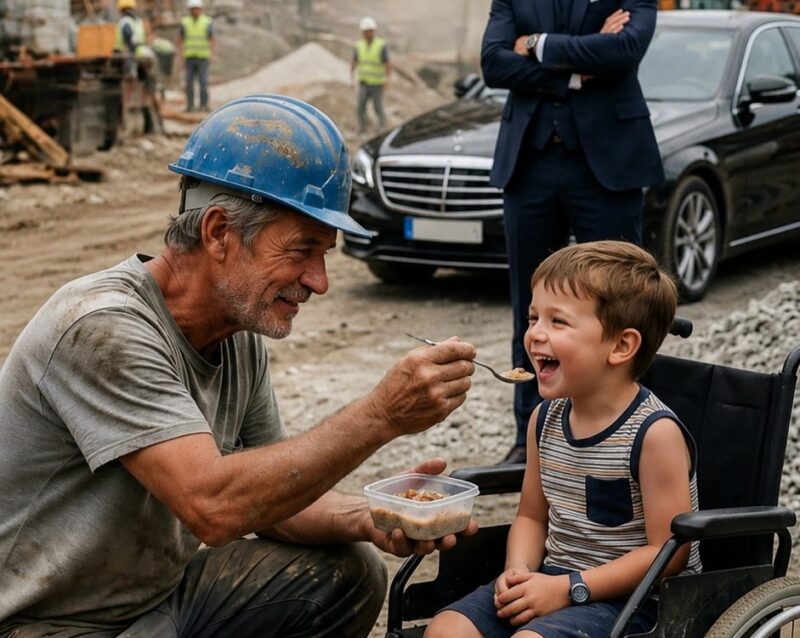
I handed him my water bottle and shared the little food I had.
A few workers chuckled and shook their heads.
But later that day, when a luxury black sedan pulled up outside the site, every joke came to an abrupt end.
For thirty-five years, Mateo Ruiz had earned his living on construction sites. His shoulders carried decades of hard labor, his hands were rough from concrete and steel, and his body reminded him every morning how long he had been doing the job.
Still, he never complained.
He believed a person’s worth was measured by what they did, not by what they said.
Every day, his wife Rosa packed him a simple lunch before dawn. One Tuesday afternoon, while eating beside the chain-link fence surrounding the project, he noticed the same boy he had seen several times before.
The child looked about ten years old.
He was thin, quiet, and confined to a wheelchair.
Most unusual of all, he was always alone.
No parent waited nearby.
No caretaker kept watch.
Yet he returned day after day, sitting in the same spot and staring at the construction site with endless curiosity.
Finally, Mateo walked over.
“You’ve been coming here for a while, haven’t you?”
The boy smiled shyly.
“I like watching them build things.”
Mateo handed him a bottle of water.
The child accepted it as though it were a treasure.
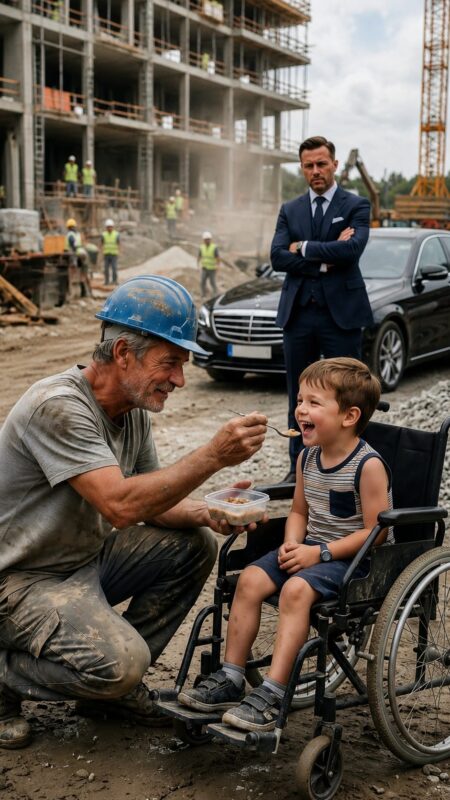
The next morning, Mateo asked Rosa to prepare an extra sandwich.
“Who’s it for?” she asked.
“A young friend,” he replied.
At lunch, the boy was waiting.
“My name is Leo,” he said.
“Leo,” Mateo repeated. “That sounds like the name of a fighter.”
The boy laughed.
From then on, lunch became their daily tradition.
They talked about construction equipment, school, dreams, and life. Leo asked hundreds of questions. Mateo answered every one of them with patience.
Soon, the workers began noticing.
“You adopting him, Mateo?” one of them joked.
Mateo calmly wiped his hands on a rag.
“Kindness costs nothing,” he said. “But it can mean everything to someone.”
No one had a response to that.
A week later, an intense heat wave swept through the city.
Leo arrived as usual, but he looked exhausted.
His face was pale.
Sweat covered his forehead.
Without saying a word, Mateo gathered discarded wood, spare metal brackets, and an old tarp from the site.
By late afternoon, he had built a small shaded shelter near the fence.
It wasn’t elegant.
It wasn’t permanent.
But it kept the sun off the boy.
Leo stared at it in disbelief.
“You made this for me?”
Mateo nodded.
“Every champion deserves a place in the shade.”
The boy reached forward and squeezed his hand.
That simple moment touched Mateo more deeply than he could explain.
Neither of them realized that elsewhere, a frantic search was underway.
Late that afternoon, the sound of screeching tires echoed through the street.
A glossy black sedan stopped abruptly outside the site.
A man in an expensive suit jumped out before the vehicle had fully stopped.
“Leo!”
The boy’s face lit up instantly.
“Dad!”
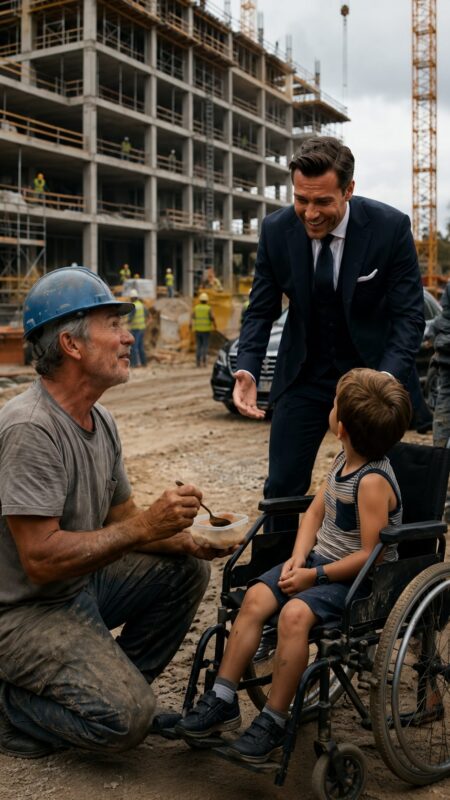
The man rushed forward and wrapped his arms around him.
Conversations stopped.
Machines seemed quieter.
Every worker watched.
After checking that his son was safe, the man noticed the shelter, the food containers, and the water bottle.
“Who did all this?” he asked.
Leo pointed at Mateo.
The man approached him.
“You built the shelter?”
Mateo shrugged.
“The boy was sitting in the sun.”
The stranger shook his head.
“No. What you gave him was much more important than shade.”
Then he introduced himself.
His name was Victor Almeida.
He was the developer behind the entire project—and the owner of the construction company.
Leo was his son.
Following medical complications and family difficulties, Leo’s supervision had become inconsistent. Drawn by his fascination with construction, he had repeatedly found his way back to the site.
Victor’s voice softened.
“I’ve spent a fortune trying to make my son happy,” he said. “But you gave him something money never could.”
Mateo looked confused.
“What’s that?”
“A person who genuinely cared about him.”
Victor pulled out a checkbook.
Mateo immediately shook his head.
“No, thank you.”
“You don’t want anything?”
“I already got something.”
“What?”
“A friend.”
Several weeks later, Victor made a surprising announcement.
The original plans for the project would be changed.
Part of the building would become a community center dedicated to children with disabilities and their families.
The center would offer therapy services, educational programs, accessible recreation areas, and family support resources—all free of charge.
Soon afterward, Victor offered Mateo a new role helping manage community outreach and operations.
“You understand what this place should stand for,” Victor told him.
Mateo accepted.
Not because of the paycheck.
Because the mission mattered.
Months later, the center opened its doors.
Children filled the hallways.
Families found support.
Laughter echoed through the gardens.
And Leo could often be found sitting beneath a young tree, sharing lunch with the man who had first noticed him.
One afternoon, he looked around the busy center.
“You know, this exists because of you.”
Mateo smiled and shook his head.
“No. Your father made this happen.”
Leo grinned.
“Maybe. But you’re the reason he did.”
Mateo looked across the courtyard and thought about that.
Everything had started with a thirsty boy, a shared meal, and a little patch of shade.
And in that moment, he realized something many people never learn:
The most valuable things in life are rarely the things money can buy.
Sometimes, changing a life begins with nothing more than noticing someone who feels invisible and choosing to care.