The operation started at exactly 11:27 a.m.
Moments before the procedure, Dr. Isabel Núñez, a pediatric neurosurgeon brought in from another medical center, requested one final review of Lucas’s brain scans. As she carefully examined the images, she spotted something every previous assessment had overlooked—a concealed blood clot tucked behind a tiny vascular abnormality deep inside his brain.
The blockage had been restricting circulation for weeks, causing unpredictable swelling that perfectly matched Lucas’s baffling symptoms. Removing it through a catheter represented his best chance, but after spending two months in intensive care, the surgery carried enormous risks.
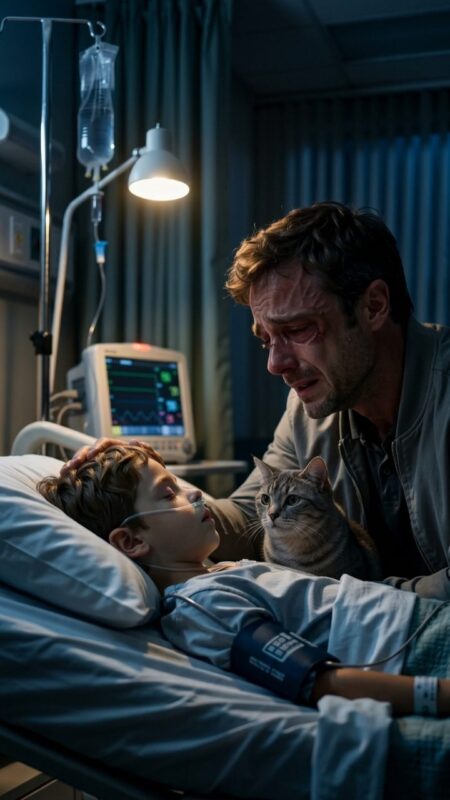
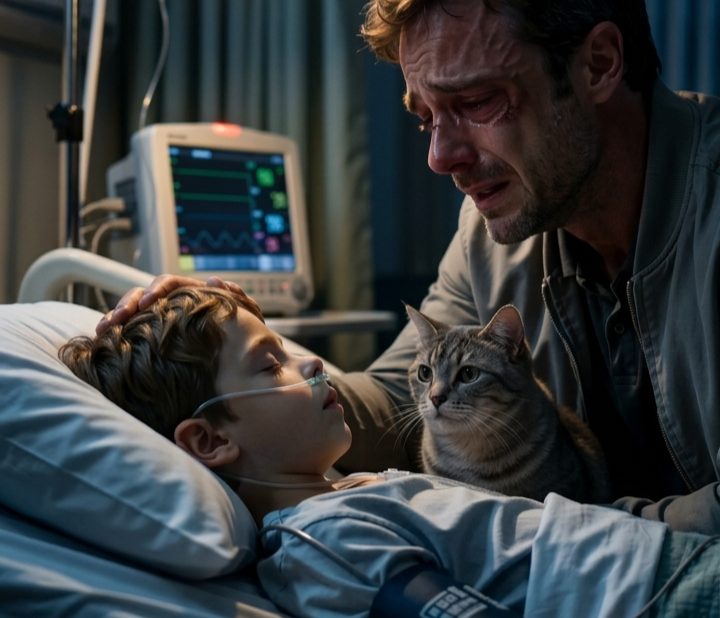
Outside the operating suite, Mariana, Gabriel, Clara, and the family’s orange cat, Simón, waited without speaking. Earlier that morning, they had begun preparing themselves for the heartbreaking possibility that Lucas might never regain consciousness. Simón, however, had refused to accept that outcome. Before the operation, he had climbed onto the hospital bed and rested his paw on the exact place where the hidden clot would later be found. His unusual behavior persuaded the medical team to examine the scans one last time.
The procedure continued for nearly six hours.
When Dr. Núñez finally walked into the waiting room, fatigue was visible in every step she took.
“We removed the clot,” she said. “Now we have to wait. We can’t yet say whether Lucas will wake up.”
It wasn’t the answer the family had prayed for, but it was enough to keep hope alive.
Lucas was returned to the intensive care unit, where specialists watched him around the clock. The first forty-eight hours passed without improvement. On the third day, one finger moved. The following day, he responded when Gabriel spoke to him. Every tiny sign of progress renewed the family’s determination.
Five days after the surgery, Simón was allowed back into the room.
Without hesitation, the cat jumped onto the bed, curled beside Lucas’s left hand, and began purring softly. As he brushed against the boy’s fingers, something remarkable happened.
Lucas slowly tightened his hand around the cat’s fur.
“This isn’t an automatic reflex,” Dr. Salvatierra said after examining him. “He’s making a conscious response.”
Two days later, Lucas opened his eyes.
His mother was the first person he recognized.
Simón was the second.
“Gato,” he whispered, smiling weakly.
Relief swept through the room. Tears, laughter, and joyful embraces replaced weeks of fear. Lucas’s memory remained incomplete. Speaking required tremendous effort, and the right side of his body was still weak. But he had survived.
The road back was long.
Day after day, Lucas attended rehabilitation sessions, learning once again how to walk, hold objects, and rebuild his strength. Whenever frustration threatened to overwhelm him, Simón quietly became his partner. The cat would sit a short distance away, patiently waiting as Lucas struggled through each exercise. Every new achievement, no matter how small, became another reason to celebrate.
Two months later, Lucas finally came home.
The moment Gabriel opened the car door, Simón raced across the yard. He rubbed against Lucas’s legs, purred loudly, and stayed close as the boy wrapped his arms around him.
“You never stopped waiting for me,” Lucas whispered.
News of the extraordinary recovery spread quickly throughout the community. Some described it as a miracle. Others insisted Simón had somehow detected the hidden clot before anyone else. Dr. Salvatierra rejected those claims.
“The cat didn’t diagnose a medical condition,” he explained. “What he did was encourage us to question our conclusions one final time.”
Researchers suggested several possibilities. Simón may have noticed subtle changes in Lucas’s body temperature, detected unfamiliar scents, or sensed tiny involuntary movements. None of those theories could be proven.
To Lucas’s family, the mystery itself no longer mattered.
The surgeons performed the lifesaving operation. The nurses cared for Lucas every hour of every day. The specialists refused to stop searching for answers. Simón never replaced science—he simply inspired one final investigation that changed the outcome.
One year later, Lucas returned for a routine follow-up appointment. He walked without assistance, had gone back to school, and carried a photograph of Simón in his backpack wherever he went.
Looking at Dr. Salvatierra, he quietly asked,
“Were you really going to turn off my machines?”
The doctor met his eyes before answering.
“We believed your body had reached the point where it couldn’t recover.”
Lucas smiled gently.
“But Simón believed I still could.”
Dr. Salvatierra returned the smile.
“No,” he replied. “Simón reminded us that sometimes the most important decision is to take one more look.”
Before leaving the hospital, Lucas handed the doctor a drawing. It showed a young boy lying in a hospital bed, surrounded by doctors and nurses, while an orange cat sat proudly beside his pillow. At the bottom of the page, he had written:
“Before giving up, look one more time.”
The drawing remained on the doctor’s office wall for years—not as evidence of a miracle, but as a reminder that medicine advances through skill, science, persistence, and the humility to question even the most confident conclusions.
No one ever discovered why Simón behaved the way he did. Perhaps it was instinct. Perhaps it was pure coincidence.
What everyone agreed on was something much simpler.
When hope was fading and everyone else was preparing for the worst, one loyal orange cat refused to walk away. Because of that final moment of curiosity, a hidden answer was found—and one little boy was given another chance to live.