The Owner in Disguise: The Lesson That Transformed My Restaurant Forever
Hello. If you came here from Facebook, still wondering what really happened when that rude waitress finally realized who I was, you’re exactly where you need to be. I promised to tell the full story—and I will. What took place inside that dining room went far beyond anything I expected, and it left everyone there in stunned silence. So sit back, take a breath, and follow me through this true story to the very end.
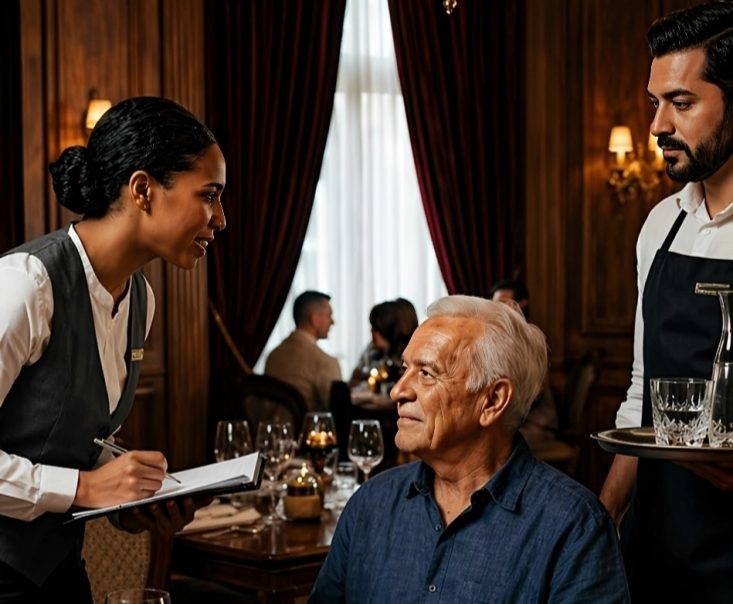
The Burden of Waiting and the Price of My Journey
I sat alone at a small corner table, chewing slowly, while a whirlwind of emotions churned inside me. The restaurant—my restaurant—was alive at its busiest hour. Laughter floated through the air, blending with the clatter of dishes and the soft chime of glasses raised in celebration. The scent of grilled meat, rich spices, and home-style cooking filled the room—flavors I had spent years perfecting. From the outside, everything looked flawless: a successful business, a dream realized.
But beneath that polished surface, something had begun to rot—an attitude I had never intended to allow.
I glanced down at my hands, rough and worn from years of hard work. I remembered the nights spent washing dishes, clearing tables, and cooking until sunrise back when I was just a man with a food cart and a dream. I knew what it meant to struggle. I knew what it felt like to be judged for worn clothes and a tired appearance. That’s why watching one of my own employees treat someone she thought was “poor” with open contempt cut deeper than anything. It wasn’t just disappointment—it felt like betrayal.
Across the room, I kept my eyes on Francisco—the waiter who had quietly stepped in to help me. He isn’t a man of wealth. In fact, he comes from very humble beginnings. Every day, he spends nearly two hours commuting by bus just to make it to work on time. His shoes, though always polished, are worn down at the edges—a silent record of the miles he walks to support his family. And yet, despite everything, he carries himself with dignity. He didn’t see an old cap or worn-out clothes. He saw a person—a guest deserving of respect and a warm meal.
My pulse quickened as I watched him approach the service counter where the waitress—the one who had humiliated me—stood. She was lazily wiping the surface, clearly uninterested. Francisco gently touched her shoulder and leaned in, whispering something while subtly pointing in my direction.
The Sound of Footsteps: Truth Revealed
From where I sat, I could read her reaction clearly. First came confusion—a slight crease in her brow. Then irritation twisted her face. Even from afar, it was obvious she wasn’t pleased. The thought of returning to the “poor man in the old cap” clearly offended her.

With visible annoyance, she dropped the cloth onto the counter. Straightening her apron, she lifted her chin—a gesture of quiet arrogance—and began walking toward me.
Each step echoed louder in my mind than the noise of the crowded room. Conversations continued, glasses clinked, but all I could hear was the sharp rhythm of her heels striking the tiled floor—a floor I had once helped lay with my own hands. She moved slowly, deliberately, as if granting me her time was a burden.
When she reached my table, she stopped. Arms crossed. Weight shifted to one hip. A sharp breath in—ready to speak.
“Well? What is it now?” she said, her voice cutting through the noise, loud enough to draw attention from nearby tables.
That was the moment.
I lifted my head calmly. Slowly, I removed the worn cap that had been hiding my face. I leaned back in my chair, placing my hands on the table, and met her eyes—steady, unblinking.
What happened next was instant.
Her expression didn’t change gradually—it shattered. Her eyes widened in shock, her confidence collapsing in a heartbeat. Her arms fell to her sides as if drained of strength. The color vanished from her face, leaving her pale and frozen. Her lips trembled, but no words came out.
In that silence, everything had already changed.
She finally recognized me. At last, it dawned on her that the “nobody” she had dismissed and sent away was the very man who signed her paycheck every two weeks.
A Silence That Said Everything
A heavy stillness fell over that section of the restaurant. Nearby diners, already drawn in by her earlier behavior, froze mid-bite, their utensils hovering in the air. The atmosphere grew so tense it felt almost suffocating.
She gulped, her breathing quick and uneven as panic set in. She tried to step back, but her legs betrayed her.
“Sir… boss… I… I didn’t know. I swear, I thought…” she stammered, her voice trembling, each word laced with desperation.
But I wasn’t willing to let it slide. This wasn’t just about me—it was about every modest guest who had ever walked through those doors and endured quiet disrespect. And then, in her panic, she revealed even more about herself.
In a last attempt to save her position, she chose to shift the blame onto someone who didn’t deserve it.
“It was Francisco,” she said abruptly, pointing with a shaking hand toward the waiter standing at a distance. “He told me you were a beggar and that I shouldn’t waste my time on you. I was just following his advice to protect the restaurant’s image!”
A cold anger settled inside me. She wasn’t only arrogant and prejudiced—she was dishonest and cowardly, ready to ruin a hardworking man like Francisco to protect herself. I had heard exactly how she treated me before Francisco had even come near my table. I knew perfectly well who was at fault.
I rose slowly. The scraping of my chair against the floor cut through the silence. I looked down at her, letting my authority—and my disappointment—speak without restraint.
“Do not dare to drag an honorable man through the mud to cover your own shortcomings,” I said calmly, yet firmly enough for the entire room to hear. “Francisco is the only one here who truly understands what real hospitality means.”
Arrogance Has a Price, Integrity Has a Reward
I gave her one final look, feeling more pity than anger at the emptiness behind her actions. Then I told her to remove the apron bearing my company’s logo—the symbol of everything I had worked for.
“You’re fired. Go to the office, gather your things, and do not return. This place serves meals, not humiliation,” I stated.
She didn’t argue. Head bowed, tears of frustration and shame slipping down her pale cheeks, she hurried toward the back exit and vanished from both my sight and my restaurant for good.
Slowly, the quiet hum of the dining room returned. I turned to the guests who had witnessed everything, offered a sincere apology for the disturbance, and announced that dessert would be complimentary that afternoon. A soft round of applause rose from the crowd.
Then I called Francisco over. He approached cautiously, still holding an empty tray against his chest, uncertainty written across his face. I placed a hand on his shoulder and looked at him with genuine respect.
That man, who struggled every day just to make ends meet, had given me one of the greatest lessons in empathy I had ever received. Right there, I told him that starting the next day, he would no longer be a waiter. I promoted him to customer service supervisor, along with a significant raise—enough to replace his worn shoes and ease the burden on his family.
Francisco covered his face with his hands and quietly wept, murmuring thanks for the unexpected blessing.
That day, my restaurant didn’t just lose a poor employee—it gained a leader with the right heart. Life has a way of revealing where true value lies. Never forget: worn clothes or humble appearances do not define wealth, and they certainly do not define dignity.
Treat everyone with equal respect—from the one sweeping the floors to the one signing the checks—because you never know when life will put your character to the test.
So tell me—would you have acted like Francisco, or like the waitress?