THEY TOLD YOU YOUR DAUGHTER WAS LOSING HER VISION—BUT A HOMELESS BOY IN ACCRA STEPPED FORWARD AND SAID, “SHE ISN’T ILL.”
The sentence didn’t sound like a warning. It felt sharper—like something precise slipping under your skin, impossible to ignore once it was there.
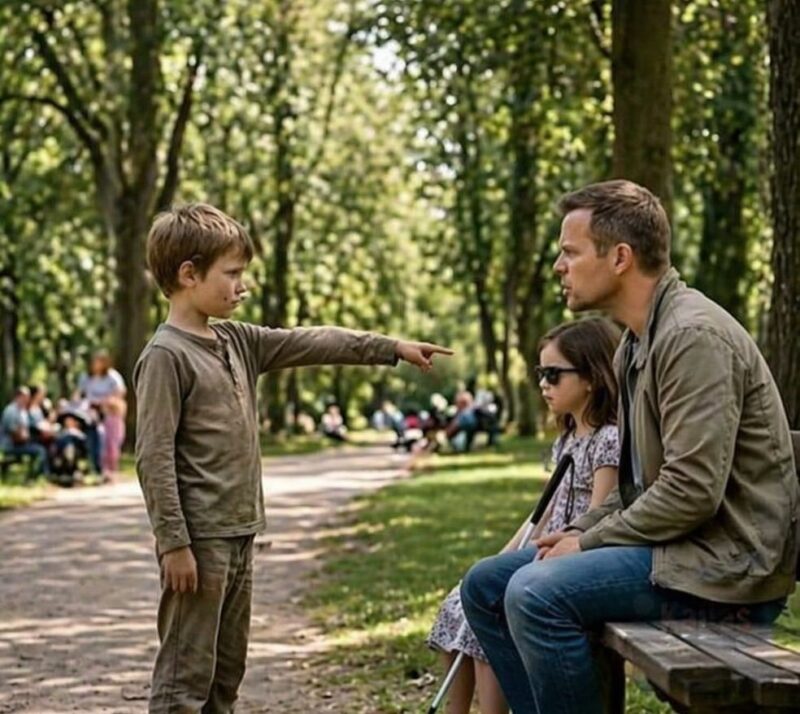
For a brief second, everything around you lost its balance. The park seemed to tilt, sunlight glaring too brightly across the gravel path, the air suddenly thin in your chest. Next to you, your daughter sat quietly, her small hands curled around her white cane, listening with the cautious stillness of a child who had learned to navigate a world fading too early. And now this boy—thin, dusty, and unsettlingly calm—stood in front of you, claiming that her darkness wasn’t real.
“What did you just say?” you asked. Your voice came out lower than expected, almost controlled. That frightened you more than if it had cracked.
The boy didn’t hesitate. There was something about him—too still, too observant for his age. His eyes shifted briefly toward Lila before returning to you.
“She isn’t going blind,” he said plainly. “The woman gives her something. In her food. In her sweet drink too.”
You stood so quickly that the bench scraped harshly against the stone beneath it. Lila startled, her small breath catching, and that sound pulled you back before your fear could spill over into anger. You dropped down instead, bringing yourself level with the boy, even though every instinct urged you to grab him and force every detail out at once.
“If this is some kind of scam,” you said tightly, “you’ve chosen the wrong person.”
“It’s not a scam,” he replied calmly. “And I don’t want your money.”
That answer stayed with you longer than it should have. In your world, nothing came without motive. Everything had a price, a hidden angle, something to gain. But there was none of that in him—no hesitation, no performance, no expectation. Just certainty. And that made it far more dangerous.
You turned slightly toward Lila. “Stay right here with me, okay?” you said, softening your voice.
She nodded, turning her face toward the sound of you, though her eyes drifted past, searching for shapes she could no longer see. “Are you upset, Daddy?” she asked quietly. “Your breathing sounds different.”
“No, sweetheart,” you said gently. “I’m just listening.”
The boy’s eyes swept across the park, quick and alert, as if measuring risk. Then he stepped closer and lowered his voice.
“Sometimes I sleep near your house,” he said. “Behind the wall, by the service road. I see the drivers going in and out.” He paused, then continued, “Three mornings ago, I saw her put drops into the girl’s porridge. Not medicine. A small brown bottle she keeps in her bag.”
A cold weight settled inside you.
Three mornings ago.
Recent. Not distant. Not imagined.
Your mind scrambled for something logical—some explanation that would make this fall apart the moment you examined it. But instead, memories surfaced, one after another, refusing to stay harmless.
Your wife, Evelyn, insisting on making Lila’s meals herself.
Correcting the nanny over something as small as yogurt.
Repeating that the specialists required strict routines—diet, supplements, structure.
Refusing to let anyone else handle the “vitamin drops” because “dosage matters.”
At the time, it had all seemed like care. Like devotion wrapped in control.
Now, it felt different.
“What else?” you asked, your voice quieter now.
The boy rubbed the frayed edge of his shirt between his fingers. “Last week,” he said, “the cook took her bowl away because she wouldn’t finish it. The driver poured some on the ground for a stray dog.” He paused.
Your chest tightened.

“The dog started stumbling,” he went on. “Like it was drunk. Then it got scared. The driver covered it with dirt.”
You froze.
A memory struck hard enough to make your jaw tense.
Two months ago, Lila had woken after breakfast disoriented, crying that everything looked like it was “disappearing.” Evelyn had called it progression—the illness getting worse faster than expected. That same afternoon, one of the security dogs had gotten sick behind the wall and needed urgent care.
At the time, grief had blurred everything together.
Now, it didn’t.
“What’s your name?” you asked.
“Kojo.”
You held his gaze for a moment, something uneasy settling deeper inside you. “And how can you be sure it was my wife?”
He finally turned his gaze on you, as if you were the one struggling to keep up. “Because I can see,” he said evenly. “And because she got irritated when the girl asked for the blue cup. People who are trying to hide anger never move the same way.” His expression hardened, and for a moment he looked much older. “I heard her on the phone too. She said, ‘Keep it subtle. Just enough to blur things, not enough to kill.’”
The impact of those words was sharper than any strike.
You took Lila’s hand. She smiled automatically, still believing that everything in her world would steady itself under your touch. That quiet faith nearly shattered you. The men who once feared you across polished boardroom tables—who admired your instincts, your precision, your ability to sense weakness—would not have recognized you now: a billionaire brought undone in a park in Accra because a barefoot boy had revealed a threat no fortune had ever taught you to expect—the one who feeds your child.
You chose not to confront Evelyn that afternoon. It was, perhaps, the first truly wise decision you had made all day.
Instead, you led Lila and Kojo to a small café a few streets away, one of the rare places where your presence didn’t draw attention. You ordered tea, bottled water, and simple plates of rice and chicken. When the food arrived, Kojo studied it cautiously, as if life had taught him that kindness often carried a hidden cost. Lila sat beside you, gently swinging her legs, asking whether the café still had the yellow lanterns she remembered. You told her it did, even though grief tightened your throat so much that speaking felt like forcing words through wire.
Kojo didn’t reach for his food until Lila leaned toward him. “You can have the extra plantains,” she said softly.
He looked at her then—truly looked—and something in his expression shifted. “You used to wave at me through the fence,” he said.
Lila frowned slightly. “Did I?”
“Yes. Before.” He glanced at you. “Before she got worse.”
That single word struck deeper than anything else. It meant your daughter had seen him, had acknowledged him—while you, with all your structure and protection and wealth, had never even realized he existed. The realization stung with quiet humiliation. Men like you expected danger to arrive polished and obvious. You forgot that truth often came barefoot.
You stepped away to make a call. Ama Mensah, your head of private security in Ghana, answered immediately—as she always did when you called twice in a row. A former detective, sharp and precise, untouched by wealth or influence, she was one of the few people whose loyalty you never questioned.
“I need you at Café Banyon. Now,” you said. “No attention, no noise, no extra people. And Ama—this stays with you.”
A short pause. “Understood.”
Fifteen minutes later, she arrived and assessed everything in a single glance: your daughter with her cane, the boy in worn clothes, your tense posture barely holding steady. She didn’t ask questions in front of them.
You asked Kojo to repeat his story. This time, he spoke more carefully. Ama didn’t write anything down—people spoke more freely when they didn’t feel recorded. He described the brown bottle, the cream-colored leather bag Evelyn carried, the service entrance where he slept, and the afternoon he overheard her call near the cracked wall covered in bougainvillea. The details were too specific to ignore: the scent of her perfume, the silver clip in her hair, the exact words she snapped at the cook when questioned.
“‘Don’t question me again unless you want to lose the salary my husband pays you.’”
Ama’s expression remained controlled, but you saw the shift in her focus—analyzing, connecting, building a picture. “Can anyone confirm he’s been there regularly?” she asked.
Kojo nodded. “The driver calls me Little Ghost. I sleep by the wall.”
It nearly made her smile, but she stayed professional. She asked about timelines, conditions, specifics—what he saw, what he didn’t, who else might have been nearby. When she finished, she looked at you. She didn’t need to speak. Either the boy was telling the truth, or he was the most convincing liar she had encountered in years.
You managed to get Lila home without Evelyn ever seeing Kojo. It required careful coordination, patience, and a level of deception you hated using around your daughter—but you were no longer in a situation where honesty was safe. Evelyn, according to her assistant, was at a charity meeting at the Mövenpick.
For now, that gave you something you desperately needed: time.
For a brief second, the message felt so ordinary it was almost laughable. In your world, refinement was always on display, while something far uglier pulsed quietly beneath it, hidden like wires behind a polished wall.
That night, after Lila drifted off to sleep in the guest suite—the room where you once sat with her through thunderstorms, reading stories to drown out the thunder—you remained by her bedside. You watched her chest rise and fall, counting each breath, unable to leave for nearly twenty minutes. The air was warm, yet she lay wrapped in blankets, insisting she was always cold now. Her cane leaned against the nightstand, a silent, cutting reminder of everything that had changed.
It struck you then: the pediatric neuro-ophthalmologist you trusted most in West Africa had never been included in the team Evelyn assembled. That alone should have unsettled you earlier. But you had let her take full control of Lila’s care. She had seemed tireless, capable, devoted to the point of heartbreak. And you had been too consumed by fear from the moment the words “degenerative condition” were first spoken. Evelyn had stepped into the role of calm, composed protector so seamlessly that you mistook it for love.
Dr. Hannah Ofori arrived at precisely 10:40 p.m., slipping into the house through the rear entrance. She had trained in Boston but chose to return to Ghana, carrying a quiet confidence that didn’t need to announce itself. You trusted her not because she catered to you, but because years ago she had once told you, bluntly and without apology, that wealthy men often confuse influence with insight. At the time, it had irritated you. Now, it felt like proof of her integrity.
You guided her upstairs. Ama remained outside Lila’s door while Hannah conducted her examination under dim lighting. She moved with deliberate care, speaking softly, asking simple, reassuring questions. Lila, half-awake and disoriented, answered as best she could. At one point, Hannah held a penlight before her eyes and watched in silence for so long that your pulse began to throb in your temples.
When she finished, Hannah stepped into the hallway and quietly shut the door behind her. She crossed her arms and studied you with measured caution.
“I need to be careful with how I say this,” she said. “Because if I’m right, tonight won’t end well for you.”
You said nothing, your gaze fixed on her.
“This doesn’t align with advanced retinal degeneration,” she continued. “Not consistently. Her optic nerves don’t match the expected presentation. There are irregularities in how her pupils respond and adjust. The symptoms you’ve described—the fluctuations, the episodes of haze after certain meals, confusion, sensitivity to light, fatigue, constant chills, even those unpredictable moments of improvement—point toward something external. Possibly repeated exposure to a substance.”
The terminology blurred in your mind. Only one word remained clear.
“Repeated.”
“You’re saying she’s being poisoned.”
Hannah met your eyes directly. “I’m saying someone may have been administering small amounts of something over time—something that interferes with both vision and neurological function. Yes. In simple terms, that’s what it means.”
The space around you seemed to tighten. From inside the room, Lila shifted and murmured your name in her sleep. The sound struck you like something collapsing inward.
“Is it reversible?” you asked, your voice barely steady.
Hannah hesitated, and that pause felt unbearable.
“If the exposure stops soon enough, much of the damage could be undone,” she said at last. “But we need testing—blood, urine, possibly hair samples. And Marcus, listen carefully: from this moment on, no one gives her anything unless it’s prepared and monitored by someone you trust completely. Not supplements. Not drinks. Nothing.”
The first person who came to mind wasn’t your wife.
It was yourself.
Because truth never arrives alone—it brings guilt with it. For six months, you had exhausted every resource at your disposal: assembling elite specialists, sending samples across continents, funding private diagnostics, calling in favors from powerful men. And yet, it had never occurred to you that the threat might be inside your own home—polished, composed, wearing a wedding ring. Power had trained you to suspect competitors, governments, criminals. Not the woman who kissed your daughter goodnight and reminded the staff to avoid allergens.
Once Hannah confirmed her suspicion, Ama moved quickly. By midnight, two trusted officers had quietly sealed off the kitchen, pantry, and service refrigerators under the pretext of a pest issue—just enough to avoid alerting Evelyn. By 12:30, the night cook surrendered three unlabeled supplement bottles that Evelyn had insisted be locked away separately. By 1:15, Ama retrieved footage from the rear corridor cameras—the ones Evelyn had overlooked, focusing instead on the main kitchen feeds she knew were monitored.
The footage wasn’t clear.
But it didn’t need to be.
At 1:42 a.m., you stood in the security room as the recording played: grainy, silent, timestamped. Evelyn stood at the counter in a silk blouse. The breakfast tray was already arranged. Her left hand held the bowl steady as she worked.
Her right hand dipped into her handbag and came out holding a small amber vial. One precise squeeze, followed by another. Then it vanished back into the bag without a trace.
No pause. No label. No staff nearby. No plausible explanation.
You didn’t crumble. Men like you don’t shatter in neat, cinematic ways. Instead, something inside you distorted—the boundary between rage and heartbeat dissolving until they became indistinguishable. Ama stopped the footage. Hannah turned her eyes away. In the frozen frame, your wife’s face angled slightly toward the camera, composed, almost detached, as if she were casually seasoning a meal.
That alone could have ended everything between you. But it didn’t explain the structure behind it. Acts like this aren’t random—they’re designed. You knew that from finance. Harm is rarely the goal itself; the real motive is buried deeper, layered beneath the surface.
Ama uncovered the next layer in Evelyn’s office.
Your wife kept her personal files locked inside a polished lacquer cabinet, hidden behind shelves filled with art books and curated reports on maternal health, literacy initiatives, and women-led enterprises. The contrast was so stark it felt almost theatrical. Inside were printed emails, legal notes, and three draft documents that turned your stomach far more than the video had.
The first proposed a durable power of attorney, granting Evelyn extensive temporary control over both your personal and business affairs “during periods of family medical crisis.” The second outlined a restructuring of your trust, quietly moving assets under the guise of “long-term care planning” should Lila be declared permanently disabled. The third detailed communication with a private Swiss clinic, describing a multi-year treatment plan that would channel tens of millions through a foundation—one she would control.
As you read, something cold and undeniable formed in your mind. This had never been solely about harming Lila. It was about engineering a crisis—and then capitalizing on it. Keep your daughter unwell. Keep you desperate. Keep you too emotionally broken to question the documents placed before you by the woman everyone praised for her grace under pressure.
Then came the detail that made even Ama mutter under her breath.
A sequence of messages between Evelyn and a specialist in Dubai—Dr. Rayan Saad—the same doctor who had delivered the most definitive diagnosis. The communication had been routed through a charity intermediary before moving into encrypted channels. Yet it remained in print—because people with money often assume that expensive secrecy is permanent.
One line stood out:
“He accepts finality when it comes from prestige. We only need the progression to appear irreversible by quarter end.”
Quarter end.
Not the voice of a mother. The language of a strategist.
What made it worse was that she hadn’t always been this person.
When Evelyn entered your life—four years after Lila’s mother passed—she felt like relief after suffocation. Refined, perceptive, and effortlessly composed, she moved through boardrooms in Geneva and charity events in Accra with equal ease. More importantly, she seemed to understand how to sit with a grieving child without forcing light into a dark room.
Or at least, that’s what you believed.
You remembered the first time Lila let her braid her hair. You remembered feeling grateful in a way that bordered on reverence. A widowed father with too much wealth and too little softness can start mistaking efficiency for salvation. Evelyn had been efficient. She had also been observant—studying you carefully, learning where every weakness lay.
By dawn, the preliminary toxicology results came back from Lila’s urine panel. Not legally definitive yet, but enough to confirm Hannah’s suspicion: anticholinergic compounds, consistent with repeated exposure. Substances capable of causing blurred vision, dilated pupils, confusion, sensitivity to light, and neurological disruption.
Put simply, enough to make a healthy child appear to be losing her sight—if administered carefully, and if the adults around her chose to trust diagnoses over instinct.
You were sitting beside Lila when the call came. Early morning light pressed softly against the curtains. She was awake but quiet, tracing the edge of the blanket with one finger—the way she did when trying to find her place in the world.
“Daddy,” she whispered, “why are there so many footsteps in the house?”
Because everything you believed in is being dismantled piece by piece, you thought. Because danger doesn’t announce itself—it dresses well, speaks gently, and lies beside you at night.
Instead, you leaned down and kissed her forehead.
“I’m fixing something,” you said.
Children sense the truth beneath words faster than adults. Her fingers curled tighter around your wrist.
“Am I really going blind?”
There was no space left to hesitate.
“No,” you said. The word fractured as it came out, and you made no effort to steady it. “No, sweetheart. I don’t think that’s true.”
She went completely still. Then her lips parted, releasing a faint, startled breath—something not quite hope, because hope had been too dangerous in your home for far too long.
“Then why can’t I see clearly?”
You had negotiated billion-dollar deals under pressure, stood firm against governments, survived threats and blackmail. None of it prepared you for this—explaining to your seven-year-old that the person she called Mommy had been dimming her world on purpose. So you didn’t say it. Not yet. Instead, you held her hand and made a promise, your voice rough in a way you hadn’t heard since your first wife passed away.
“I’m going to keep you safe now.”
Evelyn returned at exactly 8:12 a.m.
She stepped inside dressed in soft white linen, phone and sunglasses in hand, carrying the composed fatigue of someone who expected concern before coffee. Her first question to the house manager was whether Lila had taken her morning drops. That was the moment something inside you settled permanently. People like her always give themselves away in the details.
Ama met her in the foyer. That was intentional. Authority disrupts faster than silence, and you needed her slightly unbalanced before she could perform concern.
“Mrs. Bennett,” Ama said evenly, “Mr. Bennett would like to see you in the east sitting room.”
Evelyn’s smile was light, almost amused. “That sounds formal.”
“It is.”
You were already by the windows when she entered. No raised voices. No theatrics. The footage was ready on the screen behind you. Hannah sat quietly in one chair. Ama remained near the door. Two Child Protection officers waited just beyond sight in the hallway. You had seen courtroom setups that were less precise.
Evelyn stepped into the room and paused. Her eyes swept across everything—the faces, the laptop, the papers, the heavy silence. Then she did what people like her always do first. She smiled.
“What exactly is this?”
You pressed play.
Nine seconds. That was all it took. Nine seconds of her adding a clear liquid to your daughter’s breakfast while the house slept. Nine seconds that dismantled every lie she had constructed. When it ended, silence returned.
Her face didn’t collapse. That might have made her seem human. Instead, it adjusted in subtle increments, recalibrating—trying on expressions like masks. Confusion. Offense. Injured dignity. And when none of those worked, something colder settled in.
“You’re recording me in my own home now?” she asked.
Hannah spoke before you could answer.
“The toxicology results confirm repeated exposure.”
Evelyn turned toward her with a quiet, almost graceful laugh.
“Preliminary findings can imply many things. You know that.”
Ama set the amber bottle on the table, sealed in an evidence bag.
“This was recovered from your office drawer behind the red ledger. Your fingerprints are on it. We’ll know more soon.”
For the first time, Evelyn’s gaze snapped to yours—sharp, unfiltered. The performance was over.
“You brought police into my house because a child got sick?” she asked. “Do you hear yourself?”
“No,” you replied evenly. “I brought them because my wife poisoned my daughter.”
The words lingered in the air, heavy and undeniable.
She could have denied it outright. Someone less calculating would have. But Evelyn understood power too well to waste energy on denial that would collapse. Instead, she did something worse. She exhaled.
“You were drifting away again,” she said.
It took a moment to process it. There was no innocence in her tone. No regret. Only reasoning—cool, detached, like explaining a business decision after a failed quarter. She tilted her head slightly, almost curious whether you could follow.
“You only came back when she got worse,” she continued. “Before that, it was London, New York, Lagos, Dubai—calls during dinner, staff raising your child, everyone praising your success while I dealt with everything else.” Her jaw tightened. “When the symptoms began, you canceled trips. You stayed. You listened. You became a father again.”
Sometimes you hear something monstrous and still need a moment to accept what it is. That was where you were—caught in that pause. She wasn’t denying it. She wasn’t even pretending your daughter had been collateral damage. She was telling you, almost with resentment, that your child’s suffering had been intentional.
“You hurt her,” you said, each word stripped bare.
“I managed the dosage,” Evelyn replied calmly. “Carefully.”
An officer in the corridor finally broke rank, stepping forward as if he couldn’t restrain himself any longer. Ama lifted her hand, stopping him instantly and restoring order with a single gesture. You didn’t move. You stood rooted, staring at the woman who had shared your life—your travels, your grief, your celebrations—who had stood beside you at gravesides, birthdays, school performances, and quiet bedtime prayers.
“I never planned for it to cause lasting harm,” Evelyn said. “That would have destroyed everything.”
The fact that she thought those words could defend her would stay with you forever.
What she didn’t know was that Kojo had already given Ama one last piece of the truth before sunrise. Three nights earlier, he had overheard Evelyn speaking through the wall with a man whose voice he described as “deliberately foreign.” Security had aligned the timeline with the gate records. A late-night visitor had been logged: Julian Mercer, your regional chief operating officer—one of the few people close enough to take advantage of your distraction at the end of the quarter. While Evelyn stood in the sitting room trying to reframe cruelty as necessity, his call records were already under review.
Ama pushed another file across the table. “Before you continue,” she said calmly, “you should be aware that we’ve contacted Mr. Mercer’s office. Investigators are currently examining draft asset transfer documents recovered from your cabinet.”
That was the moment something in Evelyn shifted.
Not Lila. Not the evidence. Not the police.
The business.
Her shoulders tightened. “Julian has nothing to do with this.”
But the speed of her response betrayed her.
By midday, the affair had surfaced—as it always does. People like Julian and Evelyn believe intelligence and discretion make them invisible. They don’t. Not in a world run by assistants, drivers, hotel staff, flight manifests, deleted messages, and poorly timed alibis. They had been involved for nearly a year. More than that, they had been planning. Julian had positioned himself to influence a restructuring vote while you were consumed by Lila’s medical crisis. Evelyn’s power of attorney would have given her control over your personal assets. The proposed Swiss clinic would have quietly redirected funds.
To them, your grief wasn’t just a burden.
It was leverage.
That afternoon, Child Protection took Evelyn into custody. She didn’t shout or plead. She asked for a lawyer and her phone—both requests denied. As officers escorted her through a side exit to avoid the press, she paused once, glancing toward the staircase, as though she might still catch sight of Lila and reshape the narrative one last time—with a gentle smile, a soothing voice, a promise of something sweet.
Instead, she saw you.
You didn’t step forward. You didn’t speak. Some betrayals are too immense for language. She held your gaze for a few seconds before she was the first to look away. Then she disappeared into the glaring brightness of the driveway.
By evening, the house felt hollow—like a stage after disaster. Everything remained in place: the furniture, the artwork, the staff moving quietly through familiar routines. But something vital had burned away. Every room carried the sharp, lingering trace of truth exposed. Even Lila felt it, despite her limited vision.
“Is Mommy angry with me?” she asked softly as Hannah adjusted her treatment.
The question hit you like a blow.
“No,” you said gently. “None of this is your fault.”
Children shouldn’t carry the weight of adult failures.
She turned toward your voice, uncertain yet brave in that fragile way children are when honesty replaces illusion—and becomes frightening in its own right. “Will I be able to see again?”
This time, Hannah answered. She knelt beside the bed, holding Lila’s small hand between hers. “I think your eyes have been under strain for a long time,” she said softly. “We’re going to help them recover. It may take time, but I believe the world is still there, waiting for you.”
The first sign came two days later.
Not a dramatic breakthrough. Not a miracle. Just a quiet moment at breakfast. Lila turned slightly toward the window and asked, “Daddy… is something shining over there?”
You had to set your cup down—your hands were trembling too much to hold it.
It was sunlight catching on the jacaranda leaves.
“Yes,” you said, your voice unsteady. “Yes, there is.”
Healing came the way it usually does—slow, uneven, resistant. Some days showed progress; others slipped backward. Hannah warned you not to cling too tightly to improvement or fall into despair at setbacks. The body needed patience. The nervous system resisted being rushed. But week by week, Lila began to recognize more—light, shapes, fragments of color—as though the world was gradually returning to her, inch by inch, making quiet amends.
The press caught on by the fifth day.
They always do.
First, a quiet leak from Child Protection. Then a legal filing. Then a photograph—Evelyn entering a magistrate’s building, hidden behind dark glasses, silent and composed.
The story spread with relentless momentum—first through Accra, then London, then New York. When influential American figures abroad are exposed, especially through personal scandal, the narrative travels fast. What had once been contained behind private walls was now out in the open, impossible to suppress.
You could have buried it. Influence still carried weight; money still opened doors. But the moment you read the first report describing it as “alleged household misconduct,” something inside you hardened. That phrase reduced everything to something trivial—a minor incident, a careless mistake. It failed to capture the truth: a deliberate pattern of harm inflicted on a child to control her father’s focus and power.
So you spoke.
Your statement was brief and unpolished. You confirmed that your daughter had been repeatedly exposed to dangerous substances, that a false medical condition had been constructed through deception, and that authorities were actively investigating. You ended with a sentence that hadn’t been shaped by lawyers: “My daughter was not failing. She was being failed.”
That line carried further than anything else.
After that, silence began to crack. Scandal has a way of loosening fear. One of Evelyn’s former assistants reached out to Ama, providing recordings that revealed discussions about keeping you emotionally restrained. A nurse in Dubai flagged irregularities in medical consultations. A dismissed nanny admitted she had been let go after questioning why Lila’s symptoms seemed to worsen following meals prepared by Evelyn. Even the cook, hesitant at first, eventually gave a full account once he understood that silence would only shield wrongdoing.
Julian Mercer stepped down before you could remove him. The board framed it as a controlled exit, but no one believed the official version. Internal reviews uncovered enough to confirm your suspicions: while your attention was fixed on your daughter’s health, those around you had been quietly maneuvering for their own benefit, exploiting the gap your focus created.
Kojo disappeared the day after Evelyn was taken into custody.
It made sense. Children raised on the streets do not stay where attention gathers. Still, his absence lingered. He had appeared at a critical moment, offering clarity when everything else was obscured, and then vanished before gratitude could take form.
But Lila remembered him.
“The boy with the quiet steps,” she called him, having learned to recognize people by sound. As her vision slowly returned—first in soft outlines, then in clearer shapes—she asked about him often. Had he eaten? Was he still sleeping by the wall? Could he have the yellow blanket from the guest room?
So you went looking.
Not as a wealthy man chasing a gesture, but as a father honoring a debt. Ama followed his trail through markets, shelters, bus stations, and church kitchens—mapping the hidden paths children take when they have nowhere permanent to belong. It took nine days.
You found him near Jamestown, perched on an overturned crate behind a fish stall, carefully showing two younger boys how to tie fishing line. When he saw the car, he stiffened, ready to run. But Ama stepped out first, assuring him no one would force him anywhere. Then you stepped out as well—no suit, no entourage, just yourself.
Kojo studied you for a long moment. “Did she hurt the girl more?” he asked.
“No,” you said. “Because of you.”
He looked away, uneasy with the weight of that truth. Children like him understand survival—hunger, danger, unpredictability—but real gratitude is unfamiliar territory.
“She’s been asking about you,” you added. “She wants you to have a blanket.”
A small, uneven smile appeared. “She remembers me?”
“Yes.”
He wiped his nose with his wrist, trying to sound indifferent. “Can she see?”
“A little. More each week.”
The sound he made wasn’t quite happiness—it was relief. The kind that belongs to people who know how rare good news can be. You asked about his family. An aunt in Tema, sometimes. His mother gone. No father worth mentioning. When you offered help, he watched you closely, searching for the hidden condition—because there is almost always one.
In the end, it wasn’t money that changed his mind. It was Lila.
Three days later, he arrived at the house—clean, dressed in new clothes that still felt unfamiliar on him, like something untamed wrapped carefully and, for the first time, invited to stay.
Lila sat beneath the shaded trees in the garden, contrast cards scattered around her as Hannah had suggested, practicing shapes and light. When Kojo stopped a few steps away, she turned toward him and smiled before he had the chance to speak.
“You still walk in those quiet shoes,” she said.
He paused, caught off guard—then laughed, and the tension in his face dissolved.
By the end of the afternoon, she had drawn him into card games he claimed to dislike, proudly shown him a yellow blanket she insisted was his, and declared that once her vision was “completely better,” he would have to let her see his face before anyone else’s. It was, she said, only fair. Kojo agreed with the seriousness of someone making a promise he didn’t fully grasp but already intended to keep.
The legal process stretched far longer than the emotional truth. It always does. Attorneys dissected timelines. Experts debated dosage levels. Evelyn’s defense portrayed her as unstable, overwhelmed, isolated—neglected by a husband consumed by his work. Some of that wasn’t entirely untrue. Truth and wrongdoing are not opposites. Often, wrongdoing hides within fragments of truth.
But the central facts remained unshaken.
Footage. Toxicology reports. Witness accounts. Financial records. Communications with specialists. Kojo’s testimony—first given privately with a child advocate and later reinforced by independent evidence too substantial to dismiss. In the end, even the court could not ignore the disturbing design of it all: not a single lapse in judgment, but a deliberate, sustained scheme—to fabricate illness, manipulate a parent, and profit from the fallout.
Lila saw your face clearly again on a Thursday morning in late September.
You were in the kitchen, clumsily making coffee, your hands still stiff from sleep, when she walked in without her cane for the first time. Her fingers brushed the wall—not from necessity, but out of habit. You turned toward her. She stopped, squinted slightly, and then her expression opened, bright and sudden, like curtains catching wind.
“Your beard is bigger than I remember,” she said.
You set the mug down too fast, coffee spilling across the counter. Then you dropped to your knees, laughing and crying at once—a reaction that would have embarrassed the man you once were, but meant nothing to the one you had become. She reached up, touching your face with both hands, as if confirming it belonged to the same father whose voice had guided her through the dark.
“I knew your voice belonged to someone,” she said, delighted.
In that moment, you finally understood what had truly been taken—and what had been given back. Not only her sight. Not only trust. But routine. Safety. The quiet, everyday wonders of childhood. The simple certainty of recognizing your father when he enters the room.
You sold the house in Accra the following year.
Not out of bitterness—you didn’t hate the city. Accra had given you some of the most meaningful work of your life and, in an unexpected way, had helped return your daughter to you through a boy it had nearly lost. But some places hold too many echoes. The service entrance. The kitchen. The east sitting room where your marriage ended without a single raised voice. You refused to let those spaces become monuments to what you failed to see.
You kept your businesses, though you stepped back from many of them. There was still more money than you could ever need. Eventually, it stopped meaning much. Wealth, you realized, doesn’t change a person—it magnifies what is already there. It can protect or distort, numb or reveal, corrupt or support. But it cannot create love. And it cannot warn you when harm comes disguised as care—when the hand offering help wears your ring.
Kojo’s life did not transform overnight. Stories of sudden rescue make compelling headlines, but reality is more fragile. You found his aunt—real, exhausted, wary, and proud. She agreed to help, but only if everything centered on his schooling, stable housing, and her legal guardianship—not your control over the narrative. That was fine. You had grown tired of ownership anyway.
Once Lila’s vision improved enough for video calls, she spoke to him every Sunday. At first, he avoided the camera. Then he tolerated it. Eventually, he began to smile into it. He started sending her drawings he insisted weren’t good, though they were. She covered her walls with them until her room resembled a map built from survival.
Years later, people still asked how you hadn’t noticed.
At first, the question hurt. Then it faded into background noise. Eventually, it became something almost instructive. Because your failure to see wasn’t just personal—it reflected a larger pattern. Men like you are trained to scan the horizon, not the breakfast table. To expect danger from across the room, not beside you in bed. You are taught to trust polish over instinct, to delegate tenderness, and to overlook the quiet places where harm often begins.
And so danger rarely announces itself.
It enters quietly—through the door you never thought to guard.
In the end, your answer came without effort. “I believed what was easiest,” you admitted. “And my daughter carried the consequences.”
That kind of truth cost you admiration—and you welcomed that. Admiration had always been too easy to earn in your world.
When Lila turned ten, she chose to celebrate her birthday in Ghana.
Not London. Not New York. Not aboard a yacht or inside some artificial luxury retreat built for the wealthy to pretend at simplicity. Ghana—specifically Accra, and more precisely, the same park where Kojo had first spoken to you.
He was no longer the quiet boy lingering by the wall. Time had reshaped him into a tall, perceptive teenager, sharp in conversation and quick to laugh—a laugh that could fill any space. He complained that the park was too hot, too crowded, too plain to hold a proper birthday memory, and Lila brushed him off, amused by his theatrics.
You found yourself on that same worn bench again while they argued about whether the mango ice pops had always tasted so terrible. Sunlight slipped through the leaves in fractured ribbons of gold. Traffic murmured beyond the wall. Somewhere, a radio played an old highlife tune that seemed untouched by time.
Lila rested her head against your shoulder and looked out at the late afternoon—not vaguely, but with full awareness. No cane. No heavy layers. No hesitation darkening her curiosity about the sky. Just a girl narrowing her eyes in the brightness because she could.
“Dad,” she said softly, “is this where he told you?”
“Yes.”
She was quiet for a moment. Then, “Were you scared?”
A quiet laugh escaped you—not from humor, but because the truth had settled into something unmistakably clear. “Terrified,” you said. “More than I had ever been.”
She nodded, as though that answer fit perfectly into the story she had imagined. Then she leaned past you and bumped Kojo lightly with her shoulder. “Good thing he’s bossy,” she said.
Kojo rolled his eyes. “I stopped your rich father from making a mistake. That’s not the same thing.”
But he was smiling, and for the first time in years, that memory no longer felt only painful. It had become something else—a pivot point. Harsh, yet meaningful. The instant when the illusion finally shattered.
Later, as the sky over Accra deepened into shades of violet and copper and the city settled into its evening rhythm, you watched your daughter run ahead along the path beside a boy who had once slept outside your wall. He had grasped something so simple it should have humbled every expert, every financier, every well-spoken deceiver around you. He saw clearly because he had nothing to gain from pretending otherwise.
In the end, the greatest force in your life had not been your wealth, your name, or your influence.
It had been a child no one important would have noticed—speaking the truth before it was too late.
And that truth, once spoken, restored the light to your daughter’s world.