They Mocked the Old Woman at the Checkout—When I Helped Her, I Never Expected What Would Happen Next
My name is Lily. I’m twenty-nine and raising three kids on my own.
If you ask what my life looks like, I won’t call it “beautiful chaos” like people do online. My reality is lunchboxes at dawn, bills that always seem overdue, laundry that multiplies overnight, and a house filled with constant cries of “Mom! MOM!”
Some mornings it feels like I’m running a marathon with a backpack full of stones.
That Thursday began like most days—only harder.
Emma, my youngest, burst into tears because her cereal was “too crunchy.” Mason couldn’t find his math folder and swore someone had taken it. Noah, my middle child, tried to help by feeding the dog a sock.
Meanwhile, my phone buzzed nonstop with messages from the diner where I worked and reminders from the school. A rent notice glared at me from my inbox. I had barely slept after a late closing shift because my manager, Lisa, had called out sick and I had to stay longer.
By the time I dropped the kids off at school, my hands were trembling—not from coffee, but from exhaustion and worry.
At home we had run out of bread and milk. It was a small problem, yet when life already feels overwhelming, even little things seem huge.
So after school drop-off, I hurried to the grocery store, hoping to grab a few essentials and leave quickly.
I didn’t realize that within minutes I would meet someone who would change the way I think about kindness—and about what it really means to be rich.
The Woman in Front of Me
The store was busy for a weekday morning. Shoppers pushed carts piled high with groceries while chatting or scrolling on their phones as if no one else existed.
I grabbed bread, milk, and some bananas—Noah’s favorite—and joined the shortest line I could find.
That’s when I noticed her.
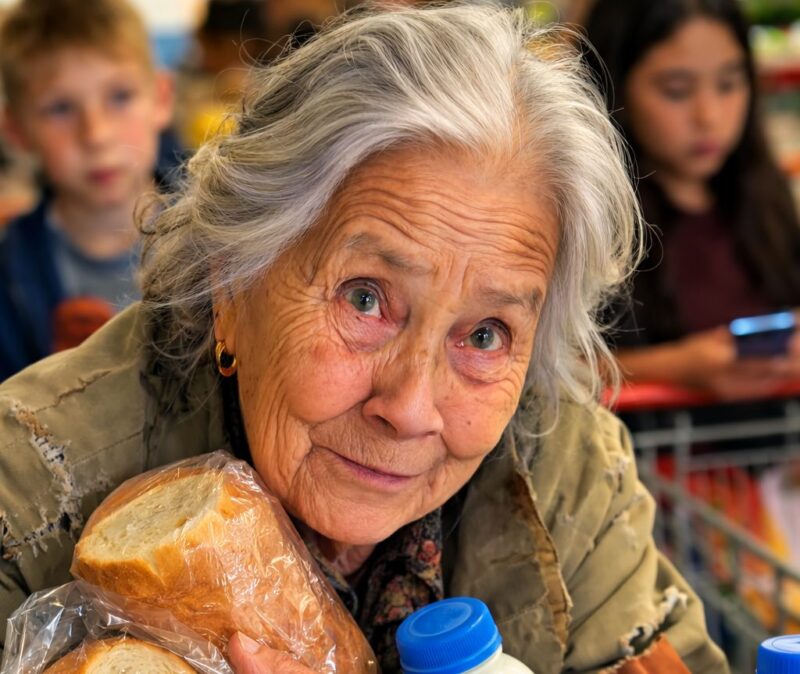
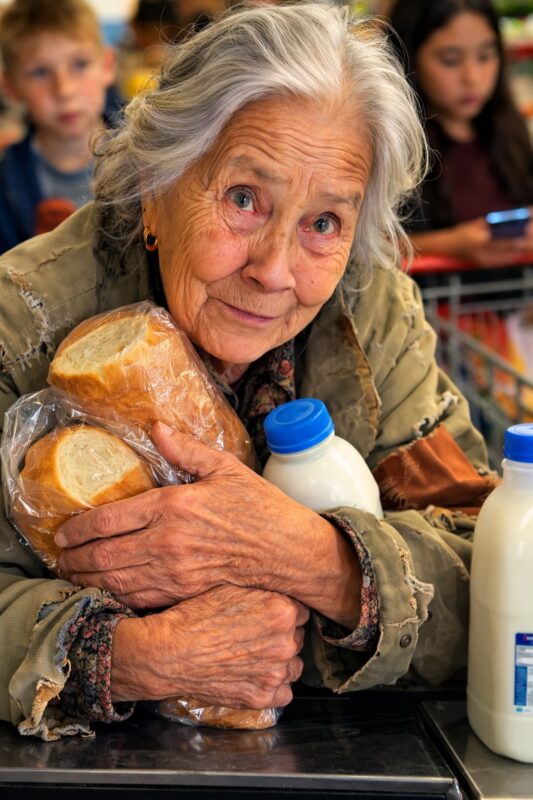
An elderly woman stood at the register ahead of me. She was tiny and slightly bent, as though life itself had weighed her down. Her coat was thin and worn, clearly patched many times.
With shaking hands she placed two items on the conveyor belt: bread and milk.
Nothing more.
Just the basics.
She opened an old coin purse and slowly began counting—pennies, nickels, and a few crumpled bills. She counted once, then again, as if hoping the total might somehow change.
The register beeped.
Her shoulders stiffened.
“I’m… a little short,” she said quietly.
Her voice wasn’t begging. It carried the quiet embarrassment of someone used to being judged.
People behind us began whispering.
“Are you serious?” someone muttered.
“She can’t even afford that?” another scoffed.
“Just move already.”
“Pathetic,” a man said loudly.
The air filled with irritation and cruelty.
The woman’s cheeks turned red. Her eyes shimmered, but she didn’t cry. She simply stared at the bread as if it were wrong for her to want it.
Something inside me tightened.
I knew that feeling.
I had counted coins before.
I had stood at registers praying my card wouldn’t be declined.
Before I could talk myself out of it, I stepped forward.
“I’ll take care of it,” I said, pulling out my wallet.
The cashier blinked in surprise.
The woman turned toward me. Her eyes were wet but alert—eyes of someone who had endured more than most.
She shook her head gently.
“No… you have children,” she said softly. “Save your money.”
“I do,” I answered. “But I still want to help.”
“You’re not taking anything,” I added. “I’m simply giving.”
I handed my card to the cashier.
The machine beeped.
Approved.
The woman held the bread and milk as if they were something precious.
“No one has ever done that for me,” she whispered.
“My name is Margaret Hargrove.”
“I’m Lily,” I said.
Her thin hand squeezed mine for a moment.
“Thank you,” she said quietly. “Not just for the food.”
Then she slowly walked away.
I believed that would be the end of it—a small moment of kindness in an ordinary day.
But three days later, a knock on my door—and Margaret’s final wish—would prove that even the smallest act can change a life forever.