They Said His Son Would Never Walk Again… Until a Boy with Nothing Changed Everything
Roberto Cavalcante gripped his son’s hand as though he could keep him tethered to the world by sheer force. Pedro lay motionless in the hospital bed, his small body unnaturally still, his gaze lost somewhere far beyond the ceiling. The air smelled sterile, but underneath it lingered a quiet, suffocating dread.
The doctors chose their words carefully, yet each one struck like a hammer:
“Severe spinal trauma.”
“Irreversible damage.”
“Permanent paralysis.”
Then came the verdict that shattered whatever hope remained:
“He will never walk again.”
Pedro was only four years old.
Not long ago, he had been unstoppable—racing through the house, laughing loudly, hiding behind furniture before leaping into his father’s arms. Now he lay silent, as if part of him had never returned from the pool where everything had gone wrong.
Roberto had built his life from nothing. He was a man who solved problems, who fixed what was broken. But this… this was something he could not rebuild.
That day, he couldn’t even face his son.
Instead, he sat in a quiet corner of the hospital hallway, surrounded by the distant rhythm of normal life—people walking, talking, living. Meanwhile, his world had come to a halt. All he could see in his mind were Pedro’s lifeless legs—and the crushing guilt that refused to loosen its grip.
Then he felt it—a small tug on his sleeve.
“Sir… you’re the father of the boy in room 312, right?”
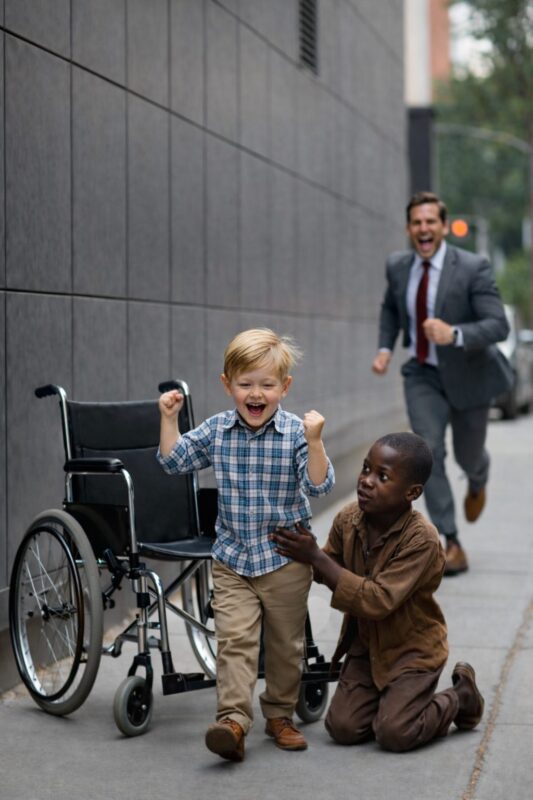
Roberto turned, expecting polite sympathy. Instead, he found a barefoot child standing before him. The boy was thin, sunburned, dressed in worn clothes, carrying a faded cloth bag that looked like his only possession.
He couldn’t have been more than seven.
“How do you know that?” Roberto asked, his voice heavy.
“I sell candy at the traffic light outside,” the boy replied calmly. “I see you come here every day. My name is Lucas.” He hesitated, then added with quiet certainty, “I can help your son walk again.”
The statement was so unexpected it felt almost offensive.
“Go away,” Roberto said sharply. “This isn’t the time for games.”
But Lucas didn’t move. His expression didn’t waver.
“I’m not joking,” he said. “My grandfather taught me. He helped people when no one else believed they could recover.”
Roberto let out a dry, bitter laugh. “Do you even understand what my son is going through?”
Lucas nodded. “It means his body can’t send signals to his legs anymore. But sometimes the body can relearn—like when a baby takes its first steps.”
Roberto was ready to call for security when Lucas spoke again:
“Your son hit his head in the pool… and stayed underwater longer than anyone realized.”
Everything inside Roberto froze.
That detail had never been shared publicly.
“How do you know that?”
“I listen,” Lucas replied simply. “People talk.”
He opened his bag. Inside were simple objects—ropes, small bottles filled with stones, bits of wood, and cloth balls.
“They don’t look like much,” Lucas said, “but if you use them every day, they can help.”
Roberto hesitated.
Maybe it was exhaustion. Maybe it was desperation. But for the first time in weeks, someone wasn’t speaking about limits—they were speaking about hope.
“Come tomorrow,” Roberto said quietly. “I’ll leave the address.”
Lucas arrived the next day exactly on time.
The guards hesitated, but Roberto had already given instructions. Inside the mansion, Pedro lay in a specialized bed by the window. Machines hummed softly nearby. Standing beside him was Patrícia—Roberto’s wife and a respected neurologist—her arms crossed, her expression cold.
“So this is the one who claims to perform miracles?” she said.
“Just give him a chance,” Roberto replied.
Lucas approached gently.
“Hi, Pedro. I’m Lucas.”
He placed a soft cloth ball in the boy’s hand.
“Try to squeeze it.”
Nothing happened.
Lucas smiled kindly. “That’s okay. We’ll try again tomorrow.”
And he kept coming back.
Every day.
The exercises seemed almost meaningless—moving legs, guiding motion with ropes, balancing objects. But Lucas never rushed. He talked constantly, telling stories about everyday things—birds, games, clouds drifting in the sky.
Little by little, something began to change.
Pedro smiled again.
Then he laughed.
The silence that had taken over the house began to disappear.
Patrícia remained skeptical—the medical scans showed no change—but she couldn’t ignore what she saw. Pedro was becoming stronger. More present. More determined.
Weeks passed.
One afternoon, Lucas said quietly, “Today, we try something different.”
They helped Pedro sit up, his feet touching the ground. His legs trembled violently.
“I can’t,” he whispered.
Lucas knelt in front of him. “You can. Your body remembers how.”
Seconds stretched into eternity.
Then—movement.
Small, barely noticeable.
But real.
Pedro pressed his foot into the floor.
“I felt it!” he shouted.
Patrícia gasped. “That’s impossible…”
Roberto’s vision blurred with tears.
Lucas simply smiled.
“Sometimes,” he said softly, “the body just needs to be reminded.”
From that moment, progress continued.
Slowly, but surely.
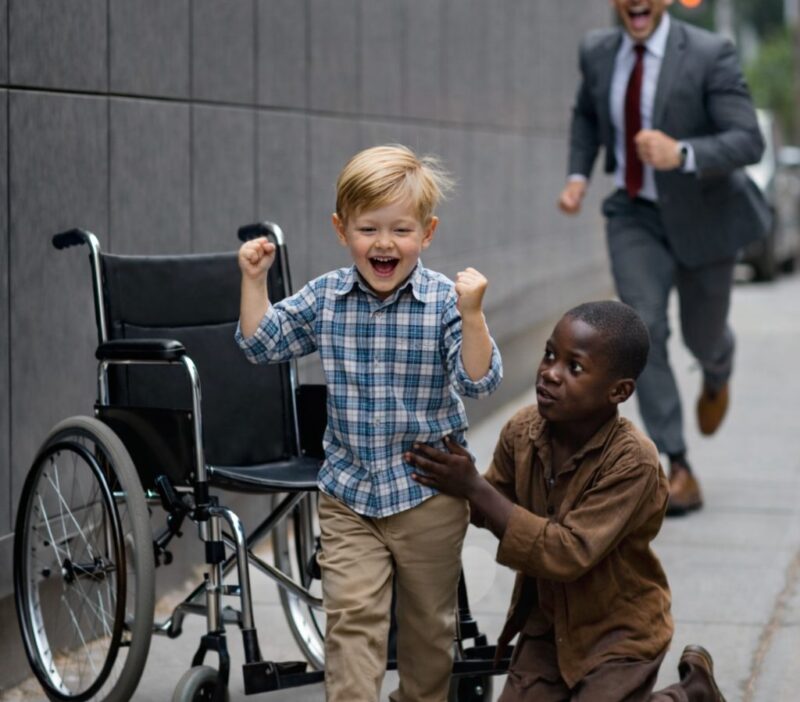
Weeks later, Pedro stood on his own.
Months later, he took his first steps.
Doctors called it an unexplained recovery, writing reports in search of answers. But Roberto didn’t need explanations.
Everything had changed the day a barefoot boy refused to give up on his son.
Nearly a year later, Pedro ran freely across the garden, laughter filling the air.
Lucas sat nearby, watching quietly, his worn bag resting beside him.
“You changed everything for us,” Roberto said.
Lucas shrugged. “My grandfather always said something.”
“What was it?”
Lucas looked at Pedro, smiling.
“Sometimes the body forgets how to move… but hope teaches it again.”
Roberto placed a hand on his shoulder.
“Where do you live, Lucas?”
The boy hesitated. “Wherever I can.”
Roberto smiled.
“Not anymore. From now on, you belong here.”
And in that moment, Roberto realized a truth he had never fully understood:
Miracles don’t always come from hospitals, money, or science.
Sometimes, they arrive barefoot—carrying nothing but belief… and the power to bring hope back to life.