Three times, I asked the man living above me to stop tossing his used tea bags over his balcony railing.
The first conversation ended with an apology.
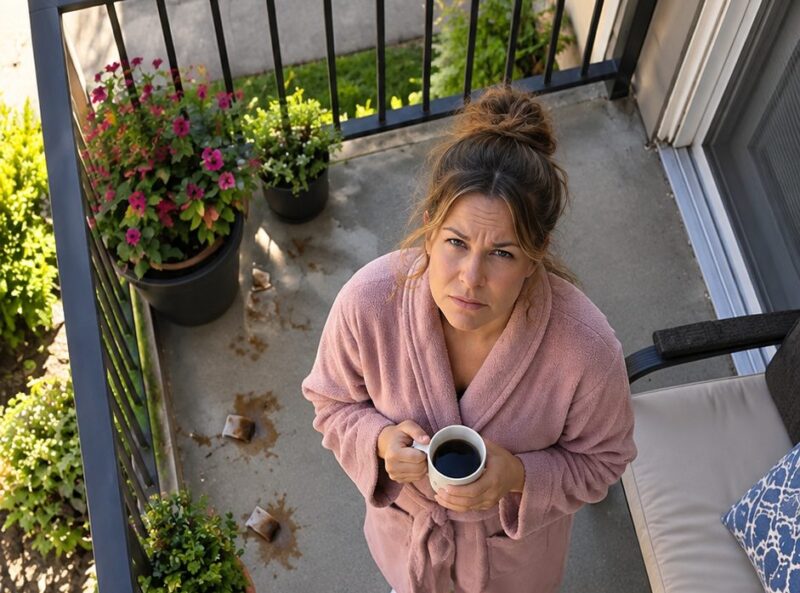
The second ended with an indifferent shrug.
The third time, he laughed as though I were complaining about something ridiculous.
After that, I stopped knocking on his door.
By then, his habit had become almost clockwork. Around seven every morning, something damp would drop onto my balcony. Another usually followed sometime after nine in the evening.
At first, I’d assumed the whole thing was careless rather than intentional.
Then a dripping tea bag landed on a white towel I’d washed that morning and left hanging over the back of a chair.
By the time I noticed it, a dark brown mark had soaked into the fabric.
I picked up the bag, walked upstairs, and knocked on 4B.
When my neighbor answered, I held it out.
“Recognize this?”
He frowned, then looked embarrassed.
“Did that come from my balcony?”
“And several others before it.”
He apologized and explained that he liked drinking tea outside. When he finished, he sometimes tossed the bag away without thinking about where it would land.
He promised to stop.
Less than twenty-four hours later, another one appeared.
For almost three weeks, I kept quiet.
I’d lived in the building for eleven years without having serious trouble with anyone. I signed for neighbors’ deliveries, fed their pets when they traveled, watered their plants, and collected packages left in the hallway.
I’d even done favors for the man in 4B.
I wasn’t interested in starting a feud over tea.
Then, one evening, I heard the unmistakable soft thud from outside.
I opened the balcony door.
A freshly used tea bag was sitting in the middle of my favorite chair cushion, slowly spreading a brown stain through the fabric.
That was my limit.
I went upstairs.
“You’re still throwing things onto my balcony.”
He leaned against his doorway.
“It’s a tea bag.”
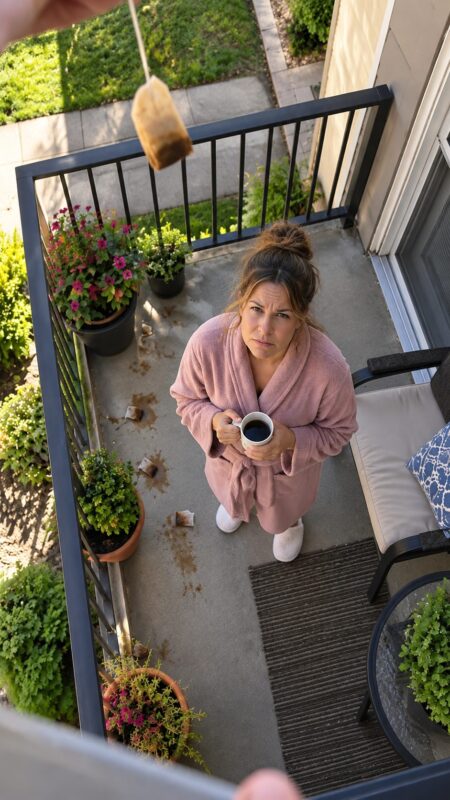
“It’s already stained a towel. Now it’s ruined my cushion.”
He gave another shrug.
“You chose an apartment underneath mine. Stuff falls.”
“Except you’re deliberately tossing it over the railing.”
He smiled.
“Look on the bright side. At least it’s only tea.”
I stared at him.
“What’s that supposed to mean?”
“It could be something worse.”
Then he closed the door.
I stood there for a moment, furious.
What bothered me wasn’t even the mess anymore. It was the fact that he knew exactly what he was doing and simply didn’t care because he wasn’t the one cleaning it up.
I considered confronting him again.
Then I realized that would accomplish nothing.
He could easily turn the situation around and make me sound unreasonable—the downstairs neighbor starting arguments over a handful of tea bags.
So I decided to stop arguing.
The next morning, at 7:04, I heard the familiar sound.
Plop.
There was another tea bag beside my flowerpots.
This time, instead of getting angry, I picked it up and smiled.
An idea had occurred to me.
I didn’t want revenge. I wasn’t going to damage anything or cause trouble.
I just wanted him to see his habit from my side of the railing.
The following morning, I went outside shortly before seven.
At 7:03, I heard the balcony door above me slide open.
I waited.
About a minute later, his arm appeared over the railing.
He released another tea bag.
But instead of letting it hit the floor, I caught it inside a large plastic tub.
“Perfect!” I shouted.
A second later, his face appeared above me.
“What are you doing?”
I pointed across my balcony.
I’d set up a small folding table.
On top sat a transparent container packed with the tea bags I’d gathered during the previous weeks.
Next to it were my stained towel and damaged cushion.
I’d also made a simple cardboard sign:
ONE SMALL HABIT FOR YOU.
ONE MESS EVERY DAY FOR ME.
He stared down at the display.
His amused expression disappeared.
“You actually saved all those?”
“Every one I found.”
He didn’t answer.
A moment later, he stepped away from the railing.
I assumed that was the end of it.
Then someone knocked on my apartment door.
It was him.
His whole attitude had changed.
“I honestly didn’t realize I’d thrown that many,” he said.
“That’s why I kept them.”
He rubbed the back of his neck.
“I thought you were making a bigger deal out of it than necessary.”
“Of course it seemed unimportant to you. You weren’t the one dealing with it every day.”
He became quiet.
Then he surprised me.
“My mom used to tell me that respect matters most when being respectful costs you almost nothing.”
He looked toward the balcony.
“She’d be embarrassed if she saw this.”
After another pause, he nodded toward my chair.
“I’ll replace the cushion.”
I hadn’t expected an apology, much less an offer to fix what he’d damaged.
Two days later, there was a package outside my door.
Inside, I found a new chair cushion.
Beside it was a small potted lavender plant.
There was also a note.
I SHOULD HAVE RESPECTED YOUR SPACE THE FIRST TIME YOU ASKED. SORRY.
From that day forward, my balcony remained tea-bag-free.
But that wasn’t the only difference.
Several weeks later, I came home carrying too many grocery bags. He happened to be walking through the lobby and, without making a big deal of it, took two bags from my hands and carried them upstairs.
We didn’t suddenly become close friends.
We became something simpler—and probably more useful.
Good neighbors.
We exchanged hellos in the hallway. We collected packages for each other. If one of us needed a small favor, the other usually helped.
The hostility disappeared.
Then, months later, I opened my front door one spring morning and noticed a small package sitting on the mat.
Inside was a box of tea.
On top was a handwritten message:
THOUGHT I’D TRY DELIVERING TEA TO YOUR APARTMENT THE RIGHT WAY THIS TIME.
I laughed harder than I expected.
That afternoon, I made myself a cup and sat outside beside the lavender plant he’d given me.
For a while, I’d imagined that the perfect ending to our little neighbor war would involve getting even.
I was wrong.
Watching someone finally understand the effect of their behavior felt far more satisfying.
A single tea bag had always looked insignificant from his balcony.
A month’s worth sitting together in one container looked completely different.
Sometimes that’s all people need.
They don’t recognize the burden they’re creating because they experience their actions one tiny piece at a time.
Show them the entire pile, though, and suddenly the problem becomes impossible to dismiss.
And every once in a while, that realization is enough to make someone do better.