When I arrived at my son Daniel’s wedding reception, I expected to find my name among the guests inside the beautifully decorated ballroom. Instead, my place card directed me outside the entrance, where a single folding chair had been placed beneath a security light beside two large trash bins. Through the glass doors, everyone else celebrated beneath glittering chandeliers while I was treated like someone who didn’t belong.
Vanessa, Daniel’s new wife, noticed me staring at the chair and smiled without a trace of embarrassment.
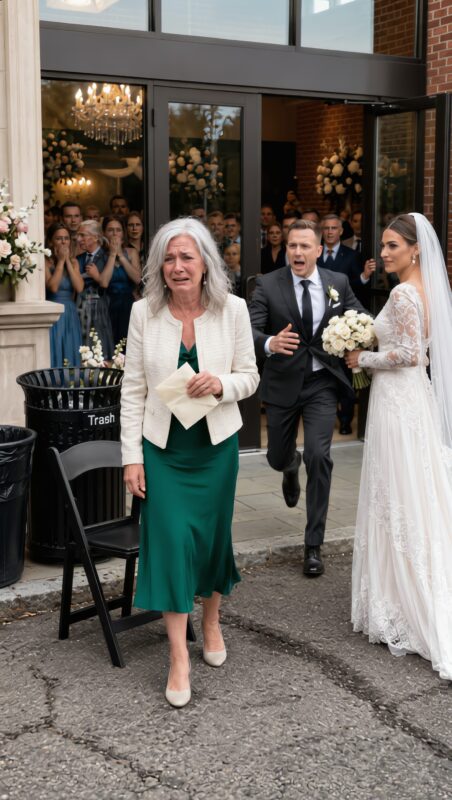
“I figured you’d be more comfortable out here,” she said. “After all, you aren’t exactly part of the celebration.”
I refused to give her the satisfaction of an argument.
Without saying another word, I slipped my wedding gift back into my handbag, turned around, and headed toward the parking lot.
The envelope I carried wasn’t filled with cash or diamonds.
Inside was the signed deed to my parents’ lake house—the place where Daniel had spent nearly every childhood summer. He had learned to swim from the old dock, caught his first fish with his grandfather, and shared his final embrace with his grandmother there. I had decided that, on his wedding day, the house would become his.
Before I reached my car, I heard someone shouting.
“Mom! Please don’t leave!”
Daniel hurried toward me with Vanessa following close behind.
“Ask your wife,” I said quietly. “She already knows.”
Vanessa laughed nervously.
“It was only a seating error. Someone mixed up the cards.”
Instead of answering, I handed Daniel the place card.
He looked from the card to the lonely chair beside the garbage bins. His expression changed instantly.
“What was in the gift?” he asked.
“The deed to the lake house.”
The parking lot became painfully quiet.
Daniel stared at me as though he couldn’t believe what he had just heard.
Vanessa’s confidence disappeared in an instant.
“I came here to celebrate your future,” I told my son. “I wanted to give you the home that holds some of the happiest memories of your life.”
My voice remained calm.
“Instead, I was intentionally made to feel unwelcome.”
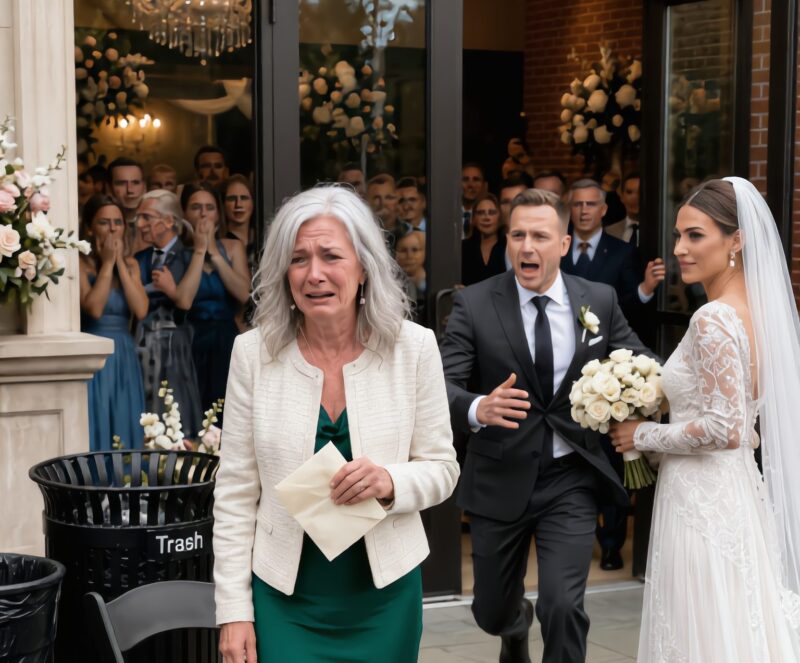
“I honestly didn’t know,” Daniel whispered.
“You never thought to check,” I replied before getting into my car.
During the drive home, my phone wouldn’t stop ringing.
Eventually, I answered when my sister Caroline called.
She told me the reception had descended into chaos after I left.
Daniel confronted Vanessa in front of both families. The wedding coordinator admitted that Vanessa herself had requested the seating change the previous day.
Vanessa defended her decision without remorse.
“She always wants attention,” she insisted.
But everything changed when guests learned what my wedding present had been.
Within minutes, everyone was talking about the lake house.
Members of Vanessa’s family suddenly urged Daniel to smooth things over and convince me to change my mind.
He refused.
The music stopped, conversations turned into arguments, and what should have been a joyful celebration fell apart before the evening was over.
The following morning, Daniel knocked on my front door wearing yesterday’s wrinkled wedding clothes.
He looked as though he hadn’t slept.
“I trusted Vanessa to handle everything,” he admitted. “I never even wondered where you were sitting.”
He lowered his head.
“Over time, I stopped questioning her decisions. I visited you less often. I let the distance between us grow because it seemed easier.”
Then he sighed.
“She admitted she wanted to prove that my loyalty belonged only to her.”
“And what did you tell her?” I asked.
“I told her that choosing my wife should never have meant humiliating my mother.”
I believed he regretted what had happened.
Still, one question remained.
“Did you come because you missed me,” I asked softly, “or because you lost the lake house?”
He didn’t argue.
“I deserved that,” he said. “When you mentioned the house, every memory came flooding back. Then I realized you came to give me something priceless, and I never even made sure you had a seat inside my own wedding.”
He admitted there had been warning signs long before the ceremony.
Vanessa checked his phone, discouraged visits with my side of the family, and constantly reminded him that his priorities should begin and end with her.
“I thought I was keeping the peace,” he confessed.
“But really, I was giving away pieces of myself.”
I nodded.
“Love should never require you to abandon the people who loved you first.”
After a long silence, he quietly asked about the lake house.
“It stays with me,” I answered.
He accepted the answer without complaint.
“I haven’t earned it.”
Only three weeks later, Daniel called to tell me he and Vanessa had separated and had already filed for divorce.
Not long afterward, Vanessa phoned me herself.
She blamed the pressure of planning a wedding, insisting everything had been misunderstood, and begged me to persuade Daniel to give her another chance.
“It wasn’t an accident,” I said. “You planned every detail.”
When she accused me of ruining her marriage, I calmly answered,
“No. Your own choices did that.”
The divorce was finalized far sooner than anyone expected.
Six months later, I drove to the lake house to prepare it for summer.
As I swept the porch, a pickup truck rolled into the driveway.
Daniel climbed out carrying a toolbox and a paper bag filled with lunch.
“You mentioned the porch needed fixing,” he said with a tentative smile.
We spent the afternoon repairing loose boards, replacing old railings, and talking about everything except the wedding.
Instead, we spoke about missed birthdays, unanswered phone calls, and the years we could never recover.
That day reminded me that trust isn’t rebuilt through apologies alone.
It grows back through patience, honesty, and choices repeated day after day.
As evening settled over the lake, Daniel looked across the calm water.
“I’ve missed this place,” he said.
“So have I.”
Then he smiled sadly.
“But I’ve missed you even more.”
I told him he would always be welcome there.
There was only one condition.
“The house stays in my name.”
He nodded without hesitation.
“That’s exactly where it belongs.”
Maybe one day the property will become his.
But an inheritance should never be motivated by guilt or expected as a reward. It should be passed on only after someone has earned what matters most—love, respect, and a trust so strong that no humiliation, not even a chair beside the trash, can ever break it.