When Laughter Found Its Way Back to the Whitaker Home
Graham Whitaker eased his car into the long gravel driveway, his body heavy with fatigue and his mind clouded with worry. The meeting in Manhattan had drained him—partners were hesitant, investors skeptical, and the future of his company felt uncertain. Yet none of that compared to the emptiness waiting for him at home.
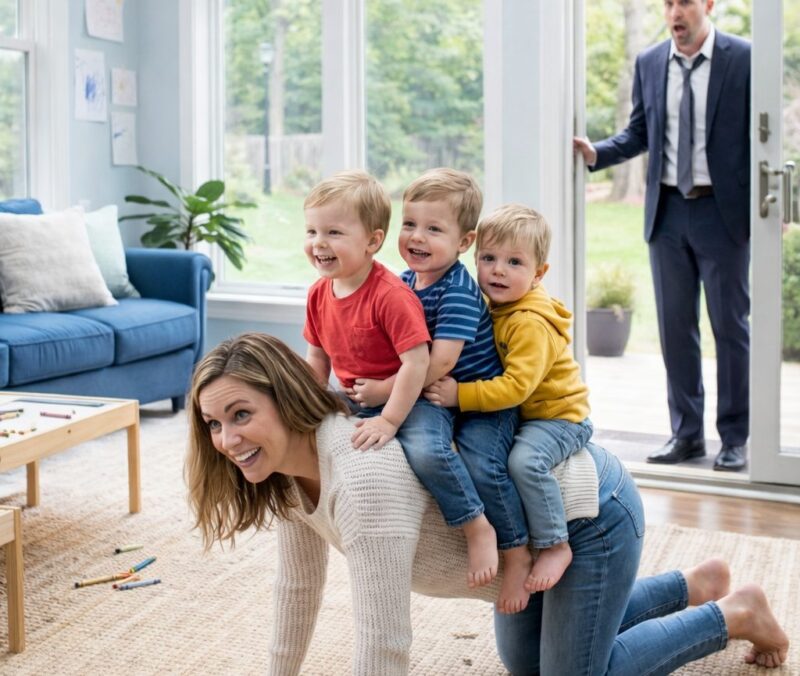
Since his wife Claire passed away eight months earlier, the house had lost its soul. Once alive with warmth and laughter, it had become quiet, almost frozen in time. His three sons—Tyler, Owen, and Lucas—had changed in ways that troubled him deeply. Their playful energy had faded, replaced by a fragile calm. The sound of laughter had disappeared completely.
That evening, he expected more of the same silence.
But the moment he stepped inside, something stopped him.
Laughter.
Clear, bright, and unmistakably real.
Graham stood still, stunned. He hadn’t heard that sound in months—not like this. It wasn’t polite or restrained. It was full, unfiltered joy.
His pulse quickened as he moved down the hallway, drawn toward the source. The sound led him to the sunroom—the one place Claire had loved most.
At the doorway, he paused.
What he saw took his breath away.
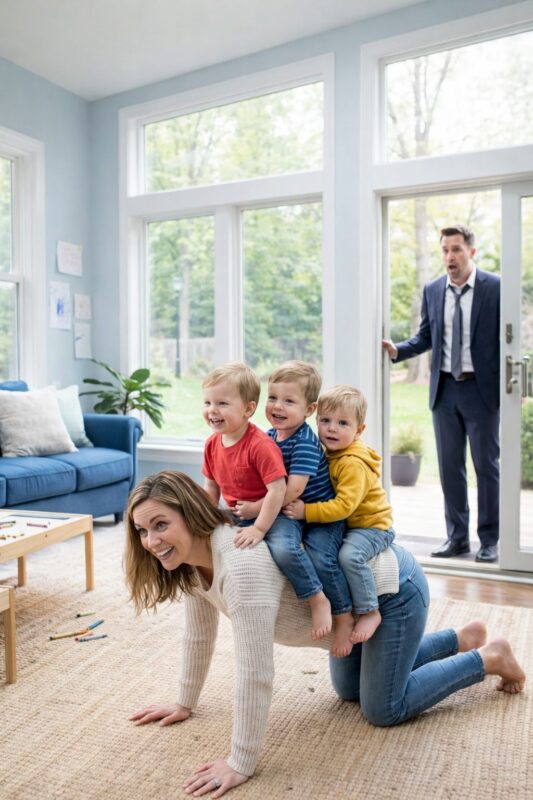
A young woman was on the floor, playfully crawling across the rug while the boys clung to her back, laughing without restraint. Their faces glowed with excitement, their laughter echoing through the room. She joked about being a tired horse while they cheered her on, urging her to go faster.
In that moment, they didn’t look like children weighed down by loss.
They looked alive again.
The woman was Hannah Price, a new assistant his sister had recommended. She had arrived only days ago, and Graham had hardly paid attention to her presence.
Until now.
As Hannah noticed him, everything went quiet. The boys instinctively shifted closer to her, their expressions uncertain—as if bracing for him to end the moment.
Graham stepped forward slowly.
“What’s happening here?” he asked.
The boys hesitated, then explained they were just playing. Hannah had suggested it, saying games might help them feel a little lighter—just like their mother used to do.
The memory struck him deeply.
Claire had always filled the house with that kind of joy. And after she was gone, that joy had vanished with her.
Until this moment.
Hannah stood, slightly nervous, and explained gently that she hadn’t tried to distract the boys from their loss. She had simply reminded them that it was okay to hold on to happy memories too.
Then Lucas tugged softly at Graham’s sleeve.
“Dad,” he said quietly, “laughing doesn’t mean we forgot Mom.”
The words settled heavily—and then, unexpectedly, they softened something inside him.
Graham knelt beside his sons, pulling them close.
“It feels like this house finally remembers what happiness sounds like,” he said.
The boys smiled, their tension fading.
Hannah stepped back, giving them space, but Graham looked up at her.
“Thank you,” he said sincerely.
She shook her head with a gentle smile.
“They didn’t lose it,” she replied. “They just needed someone to share it with again.”
And in that quiet moment, the house felt different.
Not free of grief—but no longer defined by it.
Because healing doesn’t always arrive in grand, dramatic ways. Sometimes, it begins with something simple—a shared laugh, a small act of kindness, a reminder that joy and sorrow can exist side by side.
And sometimes, all it takes to begin again… is the sound of children laughing.