For the first eighteen years of my life, I never knew my own face.
My father made sure of that.
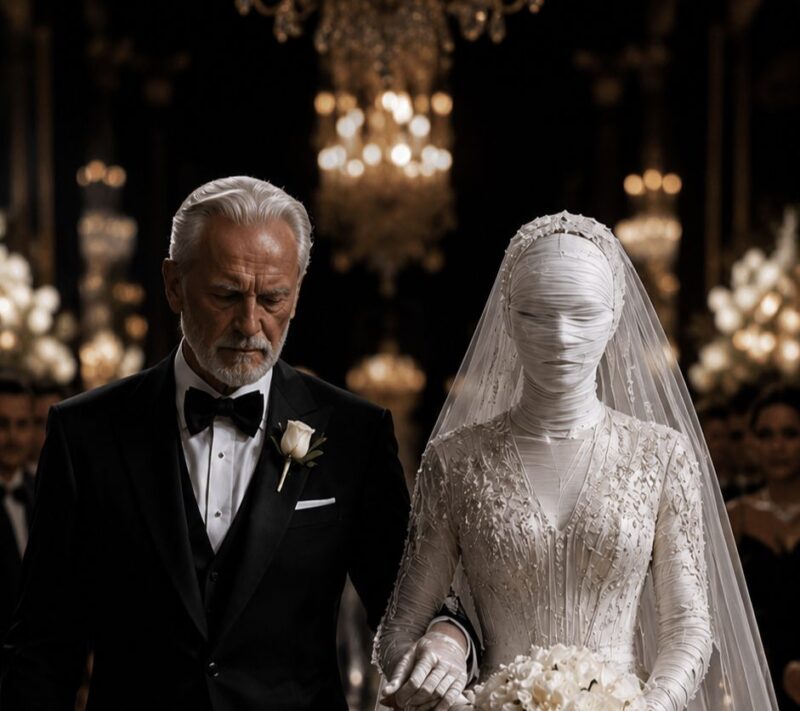
Before I was old enough to speak, layers of white cloth had already become part of my identity. They covered my face every hour of every day, and there was one rule I was never permitted to break:
Never take them off.
I obeyed until the night I became someone’s wife.
That was the night I finally stood before a mirror, removed the last strip of fabric, and discovered that everything I had believed about myself was a lie.
I was born into a family wealthy enough to make almost anything possible. We lived behind towering gates on an enormous estate, with servants tending to every room and guards watching every entrance.
There were marble floors beneath my feet, chandeliers above my head, and gardens stretching farther than I was allowed to walk.
People probably imagined I lived like royalty.
They were wrong.
Luxury can still be a prison when every door is controlled by someone else.
My prison had been built by my father.
The story of my birth was repeated to me so often that I could almost hear his voice giving the order.
“Cover her face immediately. No one must see her.”
And so they did.
My face was wrapped in white bandages, with only enough space left uncovered for me to see, breathe, speak, and eat.
As a child, I accepted it because I knew no other life.
But children eventually begin asking questions.
“Why am I the only person who has to hide her face?”
Father’s answer was always delivered with the same grave expression.
“You were born different.”
“Different how?”
He would pause before answering.
“Your face is severely deformed. Some people might be frightened if they saw you.”
Then his voice would soften.
“I’m doing this because I love you. I’m protecting you from a cruel world.”
I believed him completely.
Why wouldn’t I?
He was my father.
I thought the bandages were proof of his love.
Only much later did I understand that they were proof of his control.
I rarely saw the world beyond our estate.
Other children went to school, made friends, attended parties, and discovered who they wanted to become.
I had tutors.
I had governesses.
And I had rules.
My education seemed designed around one purpose: preparing me for marriage.
“A respectable woman obeys her husband.”
“A good wife puts her family before herself.”
“A woman’s greatest achievement is building a proper home.”
No one ever asked what interested me.
No one asked where I wanted to go.
No one asked who I wanted to become.
But there was one question I asked myself almost every night.
What does my face actually look like?
When I was nine, curiosity finally defeated fear.
I discovered an old mirror hidden beneath a sheet in one of the estate’s unused rooms.
For several minutes, I simply stared at my reflection—or what little of it I could see.
Then I reached for the bandages.
My fingers trembled.
I loosened the first layer.
Then the second.
My heart was beating so loudly that I could hear it.
I was about to remove another layer when the door burst open.
Two guards rushed toward me.
Before I could react, they pulled my hands away and quickly covered my face again.
They took me straight to Father.
His reaction terrified me more than anything I imagined might be beneath the bandages.
He wasn’t concerned.
He was furious.
I was locked in my room for two days.
After that, I understood the message.
My face didn’t belong to me.
Years later, I tried again.
By then, I was a teenager and much more careful. I secretly obtained a small mirror and waited until I believed everyone was asleep.
I had barely begun unwrapping the fabric when someone entered my room.
Once again, I was stopped.
Afterward, additional guards appeared outside my door.
That was when I began wondering how they always knew.
Eventually, I surrendered.
But one question remained.
“If I’m really so disfigured,” I once asked Father, “why can’t a doctor help me?”
“No.”
The answer came immediately.
“What if surgery could fix my face?”
“No.”
“But why?”
His expression hardened.
“Because I have made my decision.”
There was nothing more to discuss.
Then, on my eighteenth birthday, Father threw one of the grandest celebrations our estate had ever hosted.
The mansion filled with powerful businessmen, politicians, and wealthy families.
I thought the celebration was for me.
I was mistaken.
After the guests left, Father called me into his study.
He was sitting behind his enormous desk when I entered.
“I’ve arranged your marriage.”
For a moment, I thought I had misunderstood him.
“My marriage?”
“The wedding will take place next month.”
“But I don’t know anyone I’m going to marry.”
“You’ll meet him.”
“And if I don’t want to marry him?”
Father looked at me as though the question itself were absurd.
“Your wishes are not part of the arrangement.”
My future husband came from another influential family.
He was handsome, well educated, and perfectly polite.
He was also completely uninterested in me.
Whenever we met, he spent more time speaking with Father than with me.
Their conversations revolved around companies, investments, property, and contracts.
Then one day, I overheard him talking privately to a friend.
“The marriage is just a formality. Once her father signs the final papers, everything is settled.”
I walked away before they noticed me.
For the first time, I understood exactly what I was worth to them.
I wasn’t a daughter preparing to begin a new life.
I wasn’t a woman about to marry.
I was a signature on a contract.
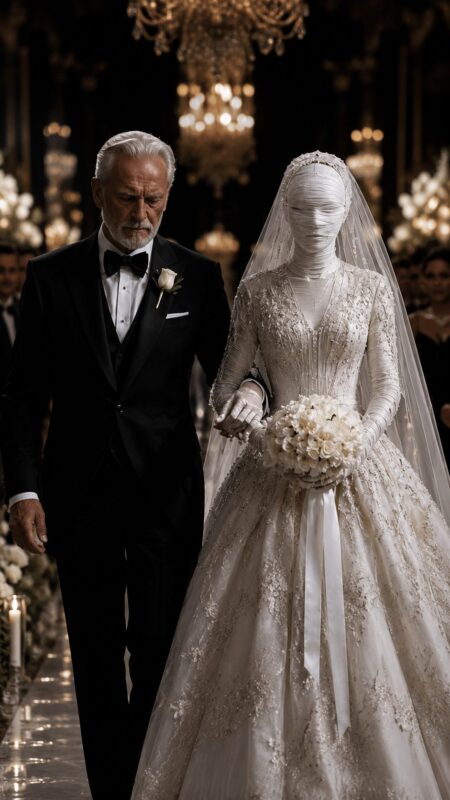
A month later, I stood before hundreds of guests and became his wife.
Whispers followed me throughout the ceremony.
Everyone wanted to know what was hidden beneath the bandages.
No one had the courage to ask.
That evening, my husband and I were driven to the mansion Father had purchased for us.
The moment I stepped inside, I noticed something unfamiliar.
Silence.
No guards followed me.
No servants reported my movements.
For the first time in my life, Father wasn’t there to stop me.
My husband removed his jacket and looked at me.
“Let’s be honest with each other,” he said. “Our families wanted this marriage. I wanted the business arrangement. You probably wanted none of it.”
I said nothing.
He continued.
“I don’t care what’s beneath those bandages. You can live your life however you want. I’ll live mine.”
Then he walked out onto the balcony.
I remained frozen in the bedroom.
Across the room stood a large mirror.
I stared at it.
Eighteen years of warnings echoed inside my head.
People will be frightened.
You must stay hidden.
Never remove them.
I walked toward the mirror anyway.
My hands rose to my face.
This time, there were no guards.
I removed the first layer.
Then another.
And another.
White fabric fell around my feet.
My heart pounded harder with every piece I removed.
Finally, I reached the last strip.
I closed my eyes.
Then I pulled it away.
For several seconds, I couldn’t move.
Slowly, I opened my eyes.
The person in the mirror was a stranger.
I touched my face.
She did the same.
I searched desperately for the deformity I had feared my entire life.
There wasn’t one.
My skin was healthy.
My features were ordinary.
There was nothing frightening about me.
Nothing monstrous.
Nothing to hide.
My legs weakened, and I gripped the edge of the dresser.
The truth was more devastating than any deformity could have been.
My father had lied to me for eighteen years.
My husband returned from the balcony and stopped when he saw me.
For once, his calm expression disappeared.
“Now I understand.”
I turned toward him.
“Understand what?”
“Why your father made me sign that agreement.”
“What agreement?”
He hesitated.
“Before the wedding, he required me to promise that I wouldn’t ask to see your face until we were officially married. He said it was a family custom.”
“You believed him?”
He shrugged.
“I didn’t care enough to question it.”
His honesty hurt.
But Father’s betrayal hurt far more.
A few days later, I returned to the estate where I had spent my entire childhood.
I wore no bandages.
The servants stared.
The guards didn’t know where to look.
I walked past all of them and entered Father’s study.
He looked up from his desk.
His eyes rested on my uncovered face.
Yet he didn’t appear shocked.
That was when I knew.
“You knew,” I whispered.
He slowly stood.
“Of course I knew.”
“Then tell me why.”
He walked toward the window, turning his back to me.
“Because you were beautiful.”
I almost laughed.
The answer was too ridiculous to understand.
“You destroyed my childhood because you thought I was beautiful?”
“When you were born, everyone commented on your appearance. Everywhere I went, people wanted to see you. I knew what beauty could attract.”
“Attention?”
“Envy. Desire. Obsession.”
“So you hid me?”
“I protected you.”
“No.”
My voice shook.
“You made me afraid of myself.”
He remained silent.
“You made me believe that my own face was something horrible. You kept me away from the world. You punished me whenever I tried to discover the truth.”
“I did what I believed was necessary.”
“Necessary for whom?”
He finally turned toward me.
“If you had known the truth, you would eventually have wanted others to see you. You would have wanted freedom.”
The word hung between us.
Freedom.
That was when I finally understood.
This had never been about protecting me.
It had always been about controlling me.
“Why couldn’t you let me live my own life?”
Father looked directly into my eyes.
“Because I believed that only your husband should ever see your face.”
I stared at him.
For eighteen years, I had wondered what terrible secret lay beneath those layers of white fabric.
Now I finally had my answer.
There had never been anything wrong with the face beneath the bandages.
The real ugliness had always belonged to the man who forced me to wear them.