I Promised to Care for My Fiancée’s Ten Children After She Vanished — Seven Years Later, Her Eldest Daughter Exposed a Secret That Changed Everything
For years, I believed our family’s greatest struggle was learning how to live with loss.

After my fiancée disappeared, I dedicated myself to raising the ten children she left behind. I thought the hardest part was accepting that she was gone forever. I believed we were all victims of a tragedy no one could explain.
I was wrong.
One quiet evening, seven years after her disappearance, my oldest daughter looked me in the eye and said something that turned my world upside down.
“Dad, I can’t keep the secret anymore.”
Those words unraveled everything.
My mornings usually began in chaos.
On that particular day, I had already ruined a batch of pancakes, signed school forms for half the kids, searched every room for a missing backpack, and stopped an argument that somehow started over a cereal box.
At forty-four, I was responsible for ten children who were not mine by blood.
Some people considered it impossible. Others considered it foolish.
To me, it was simply my life.
A demanding, exhausting, beautiful life.
Their mother, Calla, was supposed to become my wife.
She had a gift for bringing calm into the middle of any storm. Whether it was a crying toddler or a heated disagreement between siblings, she always knew exactly what to do.
Then, without warning, she disappeared.
Her vehicle was discovered beside a riverbank. Her purse remained inside. Her coat was found nearby, carefully placed where investigators could easily see it.
The only witness was her eleven-year-old daughter, Mara.
When rescuers found the girl, she was barefoot, trembling, and unable to explain what had happened.
Later, she insisted she remembered nothing.
Despite extensive searches, Calla was never found.
With no answers and no body, we held a memorial service and tried to move forward.
The children lost their mother.
And overnight, I became the person holding their world together.
Many people questioned my decision to seek legal guardianship.
Even members of my own family warned me that I was taking on too much.
Ten children. One adult.
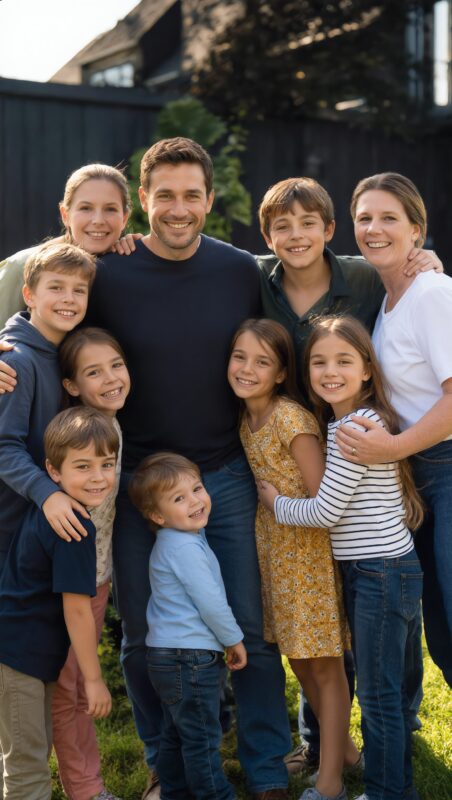
The numbers alone sounded impossible.
But walking away never felt like an option.
The kids had already lost enough.
So I stayed.
I learned how to style hair before school. I memorized allergies, favorite foods, bedtime routines, and doctor appointments. I attended recitals, sporting events, parent-teacher conferences, and countless late-night conversations.
I wasn’t trying to replace their mother.
I was simply determined not to abandon them.
One morning, while I was preparing lunches, Mara asked if we could talk privately later.
Something about her expression unsettled me.
All day, I couldn’t stop thinking about it.
That evening, after the younger children were asleep, she finally sat down across from me.
Her hands trembled.
Then she told me the truth.
She had never lost her memory.
Not the day her mother disappeared.
Not the years afterward.
She remembered everything.
According to Mara, Calla never entered the river.
The disappearance had been staged from the beginning.
Before leaving, Calla told her daughter that she had accumulated serious debts and made mistakes she couldn’t escape. She said she had found someone willing to help her start over in another place.
She also convinced an eleven-year-old girl that the younger children would be better off without her.
Then she demanded secrecy.
Terrified and confused, Mara obeyed.
For seven years, she carried a burden no child should ever have to bear.
Listening to her confession felt like being hit by a wave.
I could barely breathe.
The pain wasn’t only that Calla had left.
It was knowing she had placed the responsibility for her lie on the shoulders of a child.
When I finally gathered myself, I asked the obvious question.
“How do you know she’s alive?”
Mara revealed that three weeks earlier, her mother had contacted her.
She showed me a hidden box containing a recent photograph.
In the picture, Calla stood beside an unfamiliar man.
She looked older and noticeably frailer.
There was also a letter.
In it, Calla claimed she was ill and wanted an opportunity to explain her actions before it was too late.
The next morning, I contacted a family attorney.
As the children’s legal guardian, protecting them came first.
If Calla wished to communicate, she would do so through proper legal channels—not through a young woman she had already burdened enough.
Within days, formal notice was delivered.
Any future contact would go through the attorney’s office.
Shortly afterward, I agreed to meet Calla.
We met in a quiet church parking lot.
Time had changed her.
She looked tired, worn, and fragile.
But none of that erased what she had done.
She tried to justify her decision.
She insisted she believed the children would eventually recover. She claimed she thought I could provide a better future than she ever could.
She described her departure as a sacrifice.
I disagreed.
A sacrifice is something you endure for others.
Abandonment is something others endure because of you.
She had not only left ten children behind.
She had forced one of them to protect her deception for nearly a decade.
When I asked why she had contacted Mara instead of another adult, her answer was simple.
She knew Mara would answer.
She knew her daughter would still feel responsible for her.
That was all I needed to hear.
When I returned home, I sat with Mara for a long time.
I told her she was no longer responsible for protecting her mother’s decisions.
For the first time, she seemed lighter.
As though seven years of weight had finally begun to lift.
With professional guidance, I eventually told the other children the truth.
I explained that adults are capable of making terrible choices.
I explained that parents are imperfect.
Most importantly, I made sure they understood that none of this was their fault.
And that Mara was a victim of the situation—not its cause.
Their reactions varied.
Some cried.
Some became angry.
Others withdrew into silence.
But none of them blamed their sister.
Instead, they gathered around her.
They comforted her.
They reminded her that she was loved.
That she belonged.
That she would never have to face the truth alone again.
Several weeks later, Mara asked me a question I will never forget.
“If Mom comes back and wants to be part of our lives again, what should I do?”
I considered the question carefully.
Then I answered honestly.
“Your mother brought you into this world,” I said. “That will always be true.”
I paused.
“But being a parent isn’t defined by a single moment. It’s defined by every day that follows.”
By then, all eleven of us understood exactly what that meant.
Because family isn’t built by promises.
It’s built by the people who stay.