My Husband Banished Our Son—One Year Later, He Returned with a Baby and the Truth About His Father
PART 1: THE MORNING EVERYTHING BROKE
For most of my marriage, I believed keeping quiet was an act of love.
I told myself that avoiding arguments protected our family. I thought peace meant speaking softly, giving in quickly, and never challenging my husband for too long.
It took me twenty-three years to understand that silence could hurt someone just as deeply as cruelty.
The morning after our son Ethan turned eighteen, Richard came downstairs carrying a duffel bag.
He placed it beside the front door.
“Ethan leaves by noon,” he said. “He is old enough to take care of himself.”
For a moment, I thought he was trying to frighten him into becoming more responsible.
Then I noticed that the bag was already packed.
“You cannot send him away like this,” I said. “He has nowhere to go.”
Richard poured himself coffee.
“That is no longer my problem.”
Ethan had never been the son Richard imagined raising.
He did not care about sports, business, or competition. He was quiet, compassionate, and happiest with a pencil in his hand. He drew birds, trees, and strangers he noticed on the bus. He volunteered at food drives and avoided arguments because shouting made him shut down.
Richard called him weak.
I called him gentle, although I rarely defended that gentleness when it mattered.
I begged Richard to give Ethan time to find work and save some money.
Richard refused.
When Ethan came downstairs and saw the bag, he stopped halfway down the steps.
“Are those my things?”
“You have until noon,” Richard replied.
Ethan looked at me.
I began to speak, but the familiar fear closed around my throat.
He had seen this happen countless times. I would object. Richard would become angry. Then I would surrender and pretend compromise had been impossible.
Ethan’s expression changed from shock to understanding.
“I expected this from him,” he said.
Then he looked directly at me.
“But you always know he is wrong, and you still choose him.”
I wanted to tell him that I loved him.
The words felt meaningless while his belongings sat beside the door.
“You let him do this,” Ethan said. “I do not think I can forgive you.”
He picked up the bag and left.
I remained in the hallway, listening to his footsteps disappear.
For months, I called and sent messages. I checked every social media account I could find and contacted several of his friends.
Ethan never replied.
Richard ordered me to stop searching.
“He walked away from us,” he said.
But that was another lie I allowed to stand.
Ethan had not walked away.
We had driven him out.
Nearly a year passed.
During those months, Richard became more guarded. He took calls outside, kept his laptop locked, and returned home late with explanations that changed whenever I questioned them.
I found receipts from restaurants I had never visited and payments to an apartment across town.
My sister Margaret urged me to speak with a lawyer.
I wrote down the number of a divorce attorney and hid it inside an old recipe book.
Every few days, I opened the book, stared at the number, and closed it again.
Then, on a cold afternoon filled with heavy rain, someone knocked at the door.
Ethan stood on the porch.
He looked exhausted. His clothes were damp, his cheeks were hollow, and a worn suitcase rested beside his feet.
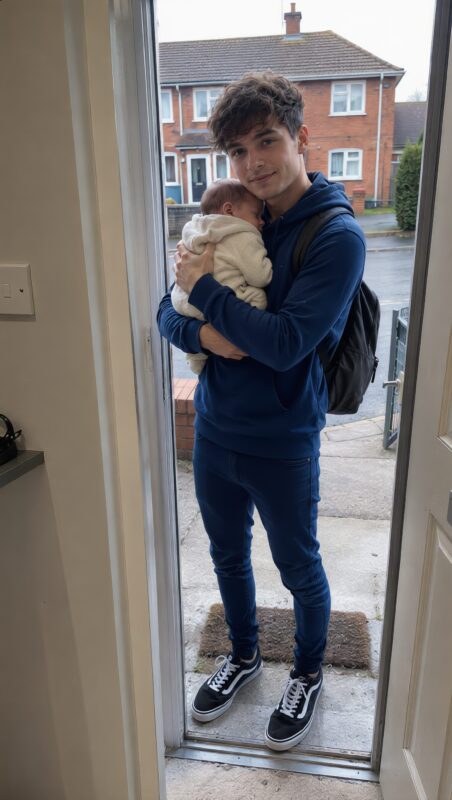
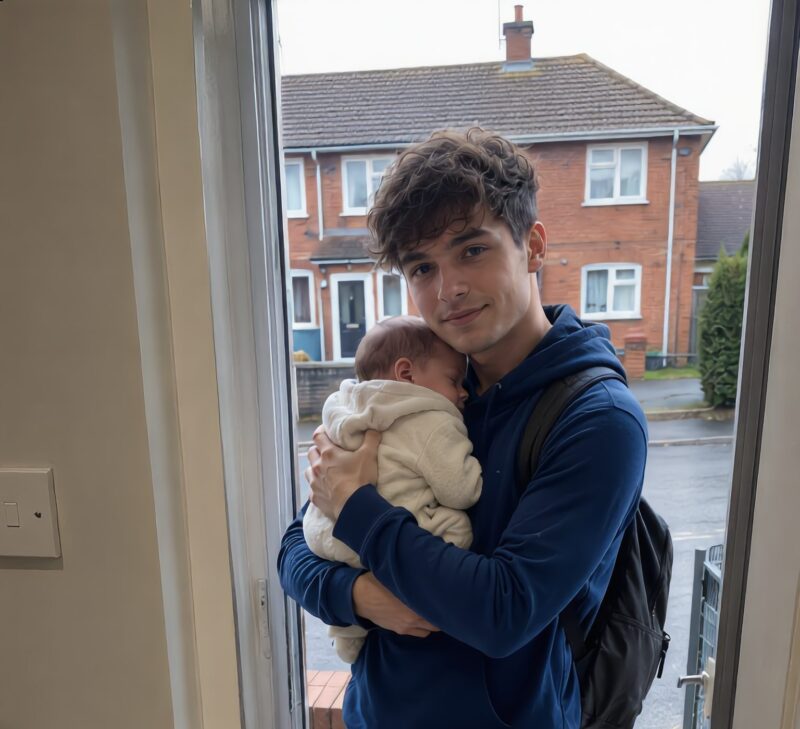
In his arms was a newborn wrapped in a pale hospital blanket.
“Mom,” he whispered, “please let me inside.”
Then he looked toward the street.
“Dad cannot know I am here.”
PART 2: THE LIFE RICHARD HID
I pulled Ethan into the house and locked the door.
The baby slept against his chest, one tiny hand visible beneath the blanket.
I reached for her carefully.
“Who is she?”
“Her name is Helen,” he said. “She is safe for now, but we do not have much time.”
He carried the suitcase into the dining room and opened it.
There were no clothes inside.
The case was packed with photographs, bank records, rental contracts, tuition invoices, letters, and copies of legal documents.
I picked up the first photograph.
Richard stood beside a dark-haired woman with one arm around her waist.
Another picture showed him at a birthday celebration with the same woman and a young girl.
There were vacations, school events, restaurant dinners, and holiday photographs stretching back more than a decade.
The woman was Diane.
Richard had been having an affair with her for twelve years.
The girl was their daughter.
While he questioned me over small household expenses and criticized every unnecessary purchase, he had been paying Diane’s rent, school fees, vacations, and medical bills.
He had maintained a second family while ruling ours through financial control.
I sat down because my knees would no longer hold me.
“What does the baby have to do with this?”
“Helen is Hannah’s daughter,” Ethan replied. “Hannah is Diane’s older child.”
After Richard threw Ethan out, he spent several weeks moving between a shelter and train stations. Eventually, the shelter offered him work in exchange for a small room.
Hannah volunteered there while studying nursing.
They became friends.
One afternoon, Ethan showed her a photograph from his childhood. Hannah recognized Richard immediately.
She knew him as the generous family friend who visited Diane, paid bills, and attended her younger sister’s important events.
At first, neither of them understood why.
Then Hannah searched through her mother’s documents.
She discovered Richard’s letters, payments, insurance papers, and records proving that he was her sister’s father.
Ethan and Hannah spent months copying the evidence.
They feared that Richard would erase everything if he suspected they knew.
Hannah had given birth two days earlier and was still in the hospital. She no longer trusted Diane, who had been pressuring her to remain silent about Richard.
So Hannah asked Ethan to take Helen somewhere Richard could not reach her.
“I thought about calling you many times,” Ethan said. “But Dad would have said I invented everything because I hated him.”
He met my eyes.
“And I was afraid you would believe him.”
The truth hurt because he had every reason to think so.
Before I could answer, headlights swept across the curtains.
Richard’s car turned into the driveway.
Ethan stood abruptly.
I placed Helen in the small bassinet we still kept in storage, then arranged the evidence across the dining table.
Richard entered moments later.
He removed his coat, took two steps into the room, and stopped.
His eyes moved from Ethan to the baby and finally to the papers.
“What is this?” he demanded.
I pulled out a chair.
“Sit down.”
He ignored me.
First, he claimed the documents were fake.
Then he accused Ethan of stealing private records.
Finally, when denial became impossible, he said he had kept the affair secret to preserve our family.
I nearly laughed.
“You threw your own son out with nowhere to sleep,” I said, “while paying for another household in secret.”
Richard reached toward the photographs.
I moved between him and Ethan.
A year earlier, I had stood behind Richard while he forced our son out.
This time, I stood in front of Ethan.
Richard ordered me to move.
I did not.
“You are ruining this family,” he said.
“No,” I replied. “You ruined it years ago. I am only refusing to hide it anymore.”
For the first time, I saw our marriage without the excuses I had built around it.
There had never been real peace.
There had been Richard’s authority and everyone else’s fear of challenging it.
“I am leaving you,” I said.
He smirked, waiting for me to weaken.
I did not.
PART 3: A HOME WITHOUT FEAR
Six weeks later, Ethan, Hannah, Helen, and I were living in a small apartment on the other side of town.
We had secondhand chairs, thin walls, and barely enough room around the kitchen table.
Still, the apartment felt larger than the house I had left.
Hannah returned to her nursing program once she had recovered from the birth.
I began working at a local bookstore.
Ethan started drawing again.
At first, he sketched only when he thought no one was watching. Soon, pages covered the table—sparrows, crows, hawks, and birds with their wings stretched toward open skies.
Our lives were not easy, but they were honest.
No one demanded receipts.
No one searched through bags.
No one used anger to end every conversation.
No one treated obedience as proof of loyalty.
Ethan and I spoke about the year he had spent without us.
I apologized without asking him to comfort me.
I did not expect forgiveness simply because I had finally admitted what I had done.
He had slept in a shelter.
He had believed his mother had chosen fear over him.
Those facts did not disappear because I was sorry.
So I listened.
When he was angry, I did not defend myself.
When he needed distance, I gave it to him.
Trust returned slowly, not through promises but through ordinary moments in which I stayed, listened, and chose differently.
One morning, I stood by the window with Helen sleeping in my arms.
Ethan was sitting at the kitchen table, drawing a bird lifting from a broken branch.
He glanced up.
“Mom?”
“Yes?”
“Thank you for letting me come home.”
I looked around the small apartment.
Opening the door to him had taken only a second.
The harder task had been closing the door on the life I once called a family.
For years, I thought protecting the people I loved meant preventing conflict and keeping everyone under one roof.
I was wrong.
A house is not safe simply because no one leaves it.
Protection means standing in the path of the person causing harm.
It means telling the truth even when the truth destroys everything familiar.
It means choosing your child when silence would be easier.
Richard had taught me to fear the sound of a door closing.
Ethan taught me that sometimes closing the right door is the only way to open another