Minutes After Our Divorce, My Husband Abandoned Our Daughters for an Unborn Son—Then a Secret About His Mother Changed Everything
“Take the girls, Lauren. Madeline is expecting my boy. I’m finally going to have the family I deserve.”’
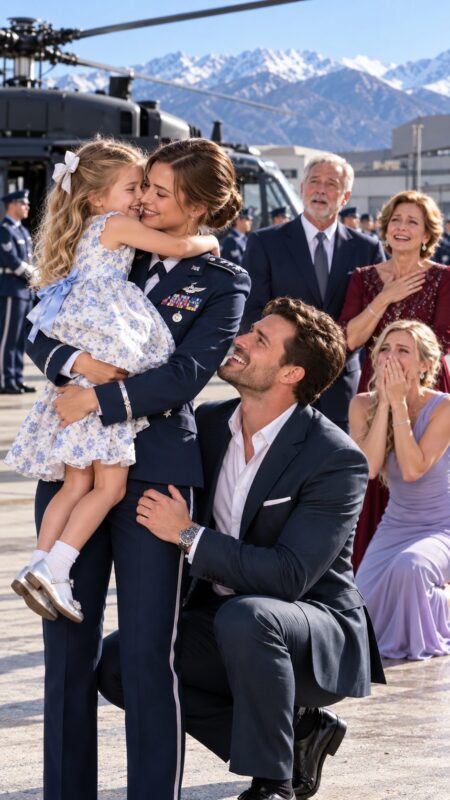
Those were my husband’s first words after our divorce was finalized.
Twelve years together, two beautiful daughters, and countless sacrifices meant nothing to Grant Whitmore anymore.
He was smiling as though he’d just won a prize.
Our daughters, ten-year-old Hailey and eight-year-old June, had spent hours preparing a handmade farewell card.
“Will you at least see them before you go?” I asked.
“Another time. Madeline needs me right now.”
He turned and disappeared down the courthouse steps.
Grant had always believed I was an ordinary administrative employee at a military installation. He never bothered to understand my responsibilities or ask about my promotions.
If he had, he would have known he had just walked away from Colonel Lauren Bennett.
And he certainly wouldn’t have guessed that our daughters and I were boarding an international military flight that afternoon.
The relocation was completely authorized. Grant had signed the custody agreement himself, too distracted by his new life to examine the provisions.
Hours later, my phone vibrated inside the departure terminal.
Grant’s name appeared.
“Lauren, I think I’ve made a terrible mistake.”
“What happened?”
“Madeline had another appointment. The doctor says she’s been pregnant longer than she admitted. The timeline is impossible. I might not even be the father.”
Before I could respond, a uniformed officer approached.
“Colonel Bennett, your transportation is ready, ma’am.”
“Thank you, Captain.”
Grant went silent.
“Did he just call you Colonel?”
“Yes.”
“Since when?”
“For several years.”
“But you always said you had an office job!”
“I never said that was my rank. You simply never showed any interest.”
“Wait. Transportation? Where are you going?”
“To my new assignment overseas.”
“With Hailey and June?”
“Of course.”
“You can’t do that without asking me!”
“I did, Grant. You signed the authorization.”
His voice suddenly changed.
“Lauren, please. Everything is falling apart. I need someone I can trust.”
“You should contact your attorney.”
Then he asked to speak to our daughters.
June took the phone eagerly.
“Daddy! Did you like our goodbye card?”
A pause.
“I haven’t opened it yet, sweetheart.”
Her smile faded.
Hailey quietly took the phone.
“Will you come see us before we leave?”
“I can’t today, honey.”
She handed it back and walked toward the window.
That night, June asked a question no child should ever have to ask.
“Mom, when Daddy gets his son, does that mean he won’t want us anymore?”
I pulled both girls close.
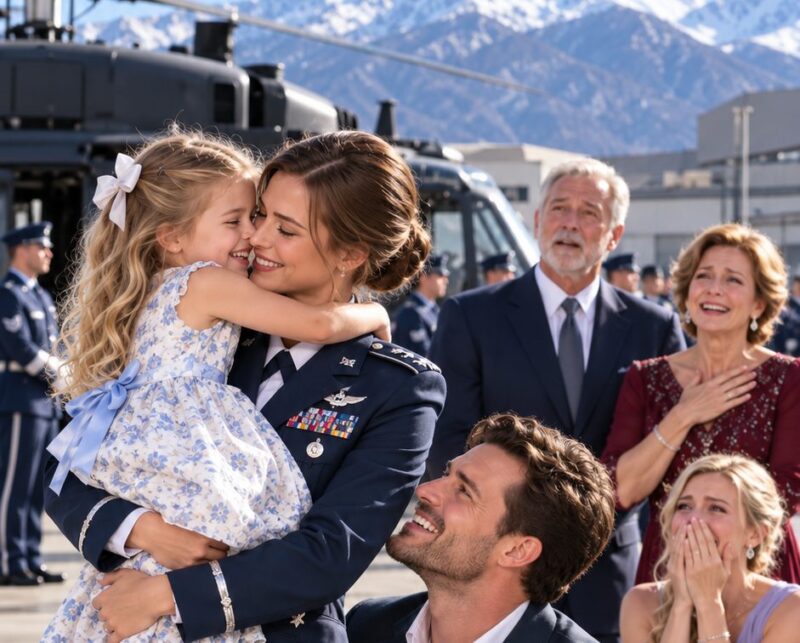
“Listen to me. You never have to compete for someone’s love. Being yourselves is more than enough.”
I wanted to believe the worst was behind us.
Instead, we were about to uncover something none of us could have imagined.
While our plane was in transit, Grant sent me a photograph of Madeline outside a medical facility.
He wanted me to look at the date displayed in the picture.
February 12.
According to Grant, he hadn’t even started dating Madeline until months afterward.
Then I noticed the lettering on the building.
**REPRODUCTIVE MEDICINE AND FERTILITY CENTER.**
I called him as soon as I could.
“Grant, why was Madeline visiting a fertility clinic before you two were together?”
His answer came slowly.
“She told me the pregnancy came from a frozen embryo.”
“Whose embryo?”
“She won’t explain.”
“Then you need actual documentation, not another argument.”
Two days later, Grant contacted me again.
This time, he sounded genuinely frightened.
“Lauren, remember when my mother arranged those medical tests for our family?”
I remembered perfectly.
Three years earlier, Patricia Whitmore had insisted that several relatives undergo genetic screening because of a possible hereditary disorder.
Grant had signed forms authorizing the collection and storage of biological material.
“Why are you bringing that up?” I asked.
“Because the clinic may have used material collected back then.”
“Did you keep copies of those forms?”
“No. Mom handled everything.”
I felt a growing uneasiness.
“Grant, remind me how you met Madeline.”
“My mother introduced us at a charity event.”
That answer made everything worse.
Patricia had never hidden her disappointment that we had two daughters.
She spoke endlessly about preserving the Whitmore surname, producing a male heir, and giving the family the grandson it supposedly deserved.
When June was born, Patricia had even remarked that perhaps the third attempt would finally be successful.
Now the same woman had introduced Grant to someone carrying a child conceived through a fertility procedure.
The coincidences were becoming impossible to ignore.
The following morning, my attorney contacted me.
“Lauren, Grant’s legal team has received some medical documentation. You need to know what’s in it.”
Madeline had consented to a limited disclosure of her fertility records.
Most personal information remained concealed, but several entries were visible.
The embryo transfer date was February 12.
Grant Whitmore was named in connection with the genetic material.
And beside the authorization entry appeared an unexpected signature.
**PATRICIA WHITMORE.**
I stared at the name.
His mother had apparently signed paperwork connected to the procedure.
But why?
And under what authority?
My attorney cautioned me that the document alone couldn’t establish whether Patricia had legal permission or whether the clinic had acted improperly.
Still, it raised questions that demanded answers.
Minutes later, Grant called.
“I never authorized an embryo transfer,” he said.
“Have you asked your mother about it?”
“She keeps telling me to stop asking questions.”
“Then let your lawyer handle it.”
“What if those papers from three years ago gave her access to my genetic samples?”
“That’s exactly what needs to be investigated.”
His breathing became uneven.
“All this time, I thought Madeline and I were starting a new family. What if Mom arranged the entire thing?”
I had no answer.
Neither did he.
For twelve years, Grant had dismissed my concerns about Patricia’s interference.
Now he was beginning to understand how dangerous it could be to surrender every important decision to someone else.
“Lauren,” he said quietly, “I know I’ve hurt the girls.”
“Yes, you have.”
“Could you tell them I’m sorry?”
Across the room, Hailey was teaching June how to stitch a loose seam on her beloved stuffed rabbit.
They were laughing together, completely unaware of the strange revelations unfolding thousands of miles away.
“You need to apologize to them yourself, Grant. And you need to show them through your actions that they matter.”
He didn’t argue.
I ended the conversation.
For years, I had been the person who solved every problem, remembered every appointment, protected Grant’s reputation, and held our family together.
He mistook my patience for weakness.
He mistook my silence for ignorance.
And he mistook my love for something he could discard whenever it became inconvenient.
But our new life would be different.
My daughters had a peaceful home, a mother who believed in them, and a future that didn’t depend on anyone’s obsession with producing a male heir.
Meanwhile, Grant’s attorneys were examining the old genetic-testing documents, the fertility clinic’s authorization procedures, and Patricia’s unexplained role in Madeline’s pregnancy.
No one yet knew whether the signature represented legitimate permission, a misunderstanding, or something far more serious.
That evening, I watched the sunset spread across the mountains beyond our windows.
June rested against my shoulder while Hailey read beside us.
For the first time in a long while, I wasn’t afraid of tomorrow.
Grant had chosen to abandon his daughters because he believed a son would make his life complete.
Now he was facing the possibility that the future he’d celebrated had been designed by someone else.
And one question continued to haunt everyone involved.
**Had Patricia Whitmore merely encouraged her son’s betrayal—or had she been secretly planning the birth of her long-awaited grandson for years, using a medical procedure Grant never knowingly approved?**