On a busy city sidewalk, a small girl stepped in front of me and asked for a pair of school shoes. They cost just forty-five dollars.
At the time, I thought it was a simple encounter—nothing more than a passing moment. I had no idea that her quiet promise to repay me one day would pull me into a story I could never have imagined: a hidden illness, a struggling mother, and a truth that would quietly reshape everything I believed about life.
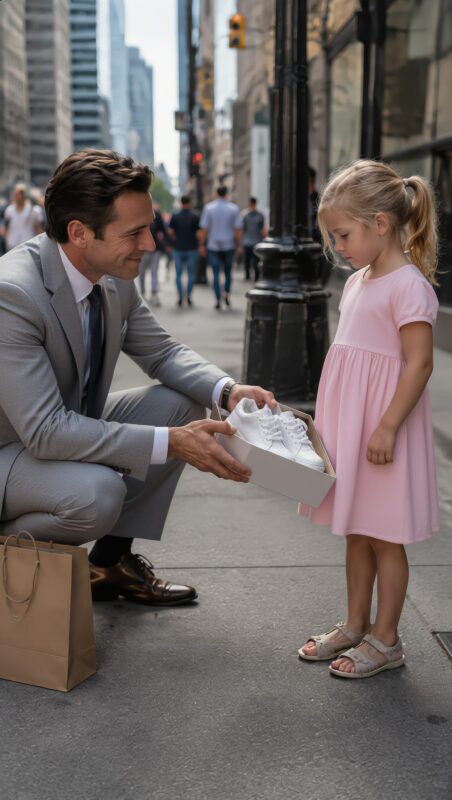
If you think this is a story about kindness, you’re mistaken. It is about how a child with almost nothing gave a wealthy man something no fortune could ever replace.
My name is Michael Harrison, and everything changed on what should have been an ordinary Thursday in Chicago.
At least, that’s what I believed.
I had just walked out of another long board meeting—another glass-walled room filled with polished voices talking about growth, profits, and expansion. Another round of praise for the life I had built.
Success.
That word followed me everywhere.
But at forty-two, success felt strangely empty.
I owned multiple apartments, luxury cars, private investments, and a company worth hundreds of millions. Yet every evening I returned to silence—an apartment so still I could hear the faint hum of appliances in the dark.
No family.
No children.
No one waiting for me.
As I left my office that afternoon, I loosened my tie and glanced at my watch.
3:30 p.m.
For once, I didn’t call my driver. I chose to walk instead.
Maybe I needed air. Maybe I was simply tired of moving between places that no longer felt like home.
I hadn’t gone far when a small voice stopped me.
“Excuse me, sir?”
I turned, expecting a routine interruption.
Instead, I saw her.
A child—no older than five—standing nervously at the edge of the sidewalk. Her blond hair was tied into uneven pigtails. She wore a faded blue dress and carried a worn backpack hanging from one shoulder.
But it was her shoes that caught my attention.
They were falling apart.
The fabric had split, the soles were separating, and her tiny toes pressed through the gaps as if the shoes had long since surrendered.
“Can you help me?” she asked quietly.
I hesitated. “With what?”
“They laugh at me,” she said, lowering her gaze. “I just need proper shoes for school.”
There was no exaggeration in her voice. No attempt to persuade me. Just honesty.
She lifted one foot slightly. “These hurt.”
Something in me tightened—an unfamiliar feeling I couldn’t name.
“What’s your name?” I asked.
“Sophie.”
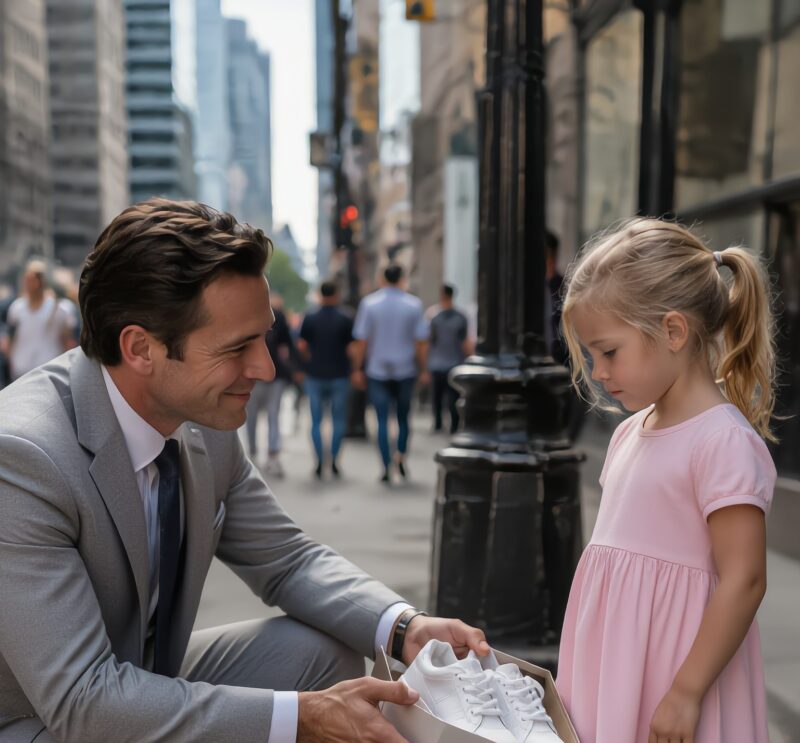
A faint smile crossed my face. “Alright, Sophie. Let’s fix this.”
Her eyes widened. “Really?”
“Yes.”
A small shoe shop stood across the street.
Inside, she sat very still while an employee measured her feet, as though afraid the moment might vanish if she moved. She tried on a few pairs, but only one seemed right—white sneakers with a soft pink stripe.
The change was immediate.
“It doesn’t hurt anymore,” she whispered.
She stood cautiously, then took a step… and another.
Within seconds, she was moving across the store, then laughing as she broke into a joyful run.
The sound was light, unguarded—something pure cutting through the air.
And strangely, it reached something inside me I hadn’t realized was missing.
“I’ll take them,” I said.
Outside, she looked down at her new shoes as sunlight spilled across the pavement.
“They’re so pretty,” she said with quiet awe.
Then she looked up at me, suddenly serious.
“When I grow up, I’ll pay you back.”
I gave a small laugh. “You don’t have to.”
“But I want to,” she insisted. “My mom says promises are important.”
Before I could respond, she wrapped her arms tightly around my leg.
“Thank you, kind man.”
And just as quickly, she ran off down the street.
“Sophie!” I called after her.
She turned only long enough to wave, then disappeared around the corner.
Gone.
But something about the city had changed. It felt lighter. Less cold.
Then my phone vibrated.
An unknown number.
A photo appeared.
Sophie.
Standing beside a hospital bed, holding the hand of a woman connected to oxygen tubes.
A message followed:
You met my daughter today. She needed those shoes so she could come see me without feeling ashamed.
Then another:
Please don’t tell her I reached out. She believes I’m recovering.
And finally:
The doctors say I don’t have much time.
That was the moment everything shifted.
The next morning, I went to the hospital.
The room was quiet except for the steady rhythm of machines measuring time against a fading life. Sophie’s mother looked fragile, but when she saw me, she still managed a gentle smile.
“You came,” she said softly.
“I promised I would,” I replied.
A weak laugh escaped her. “They fit her perfectly, you know.”
She reached for my hand. “Thank you… for noticing her when no one else did.”
I stayed until evening, listening to stories that no business empire could ever quantify.
When I finally left, Sophie hugged her shoes to her chest and said quietly, “You kept your promise too.”
And for the first time in years, I didn’t feel like a man defined by wealth walking away.
I felt like someone who had finally found something real.