She Returned a Homeless Man’s Lost Wallet… Days Later, an Attorney Arrived with an Extraordinary Proposal
Morning had settled over the city with its usual energy. Office workers filled the sidewalks, buses rumbled through crowded streets, and merchants welcomed customers from their market stalls. On a weathered bench near the square sat an elderly man dressed in threadbare clothing, an old backpack resting at his feet. To nearly everyone passing by, he was invisible.
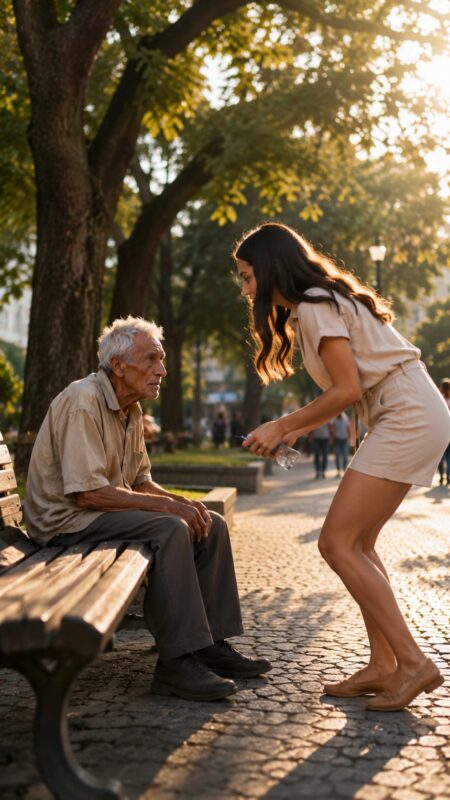
As Camila made her way to work, something caught her attention on the sidewalk—a worn leather wallet lying a few steps behind the bench. She looked ahead and noticed the elderly man walking away at an unhurried pace, unaware he had lost it.
Without hesitating, she picked it up and hurried after him.
“Excuse me, sir,” she called.
The man stopped and turned around with a puzzled expression.
Camila held out the wallet.
“I think this belongs to you.”
For a moment he simply looked at it, almost unable to believe what he was seeing. When he carefully opened it, he found a few identification cards, a faded photograph, and several small bills exactly where he had left them. His trembling fingers lingered on the old picture as tears gathered in his eyes.
He thanked her over and over, explaining that the photograph was the last remaining connection to the family he had lost years before.
Camila smiled warmly.
“I’m just happy it found its way back to you,” she replied. “Anyone would have done the same.”
Believing the encounter was over, she continued on her way.
She had no idea that one simple act of honesty had already changed the course of her life.
Three days later, someone knocked on her front door.
Standing outside was a sharply dressed attorney carrying a dark leather briefcase. After politely introducing himself, he asked whether they could speak privately for a few minutes.
Curious, Camila invited him inside.
The attorney opened his case, removed a photograph, and placed it on the table.
It was the same elderly man.
“His name was Augusto Sampaio,” the lawyer explained. “Years ago, he founded one of Brazil’s largest construction companies.”
Everything unraveled after a tragic accident took the lives of his wife and only child.
Unable to bear the loss, Augusto walked away from his business empire and disappeared from public view. Although his fortune remained intact, he chose to live among the homeless, convinced that wealth no longer held any meaning.
From park benches and street corners, he quietly observed the people around him.
One question stayed in his mind.
Did genuine kindness still exist?
Would anyone help someone who appeared to have nothing, expecting absolutely nothing in return?
Most people ignored him.
Some treated him with distrust.
Only a handful acknowledged that he was even there.
“But you were different,” the attorney said. “You ran after a stranger simply to return his wallet. You didn’t know who he was, and you weren’t looking for recognition or a reward.”
That single moment touched Augusto more deeply than anyone realized.
Later that evening, he rewrote his final instructions.
The attorney unfolded a handwritten letter.
In it, Augusto revealed that he had recently learned he was terminally ill and had little time left. He wrote that Camila’s honesty had restored something he thought he had lost forever—his belief that compassion still existed in the world.
For the first time in many years, someone had seen him as a human being instead of judging him by his appearance.
The letter contained an unexpected request.
Rather than leaving Camila a fortune, Augusto entrusted her with something far greater.
He asked her to lead the charitable foundation he had established, an organization dedicated to helping people escape homelessness through housing assistance, education, job training, counseling, and long-term support.
He believed that a person willing to perform a simple act of kindness without expecting anything in return possessed the integrity needed to carry his mission forward.
Camila was stunned.
“I’ve never run a foundation,” she admitted. “There are surely people far more qualified than I am.”
The attorney smiled and pointed to the closing lines of Augusto’s letter.
“I knew you would say that,” it read.
“Those who deserve responsibility most are usually the ones humble enough to question whether they are worthy of it. Those who seek power for its own sake rarely are.”
The words stayed with her.
In the months that followed, Camila devoted herself to honoring Augusto’s final wish. She spent time in shelters, met with outreach workers, listened to people living on the streets, partnered with local organizations, and encouraged volunteers to become part of the mission.
Slowly, the foundation grew stronger.
Families found permanent homes.
People secured stable employment.
Young students returned to classrooms they had once believed were beyond reach.
Lives that had seemed trapped in hopelessness began moving toward new beginnings.
Whenever journalists praised Camila for the foundation’s success, she redirected the attention.
She insisted the real inspiration was Augusto—a man whose personal heartbreak became the reason thousands of others found hope.
Every year, on the anniversary of the day they first met, Camila returned to the same park bench where she had found the lost wallet.
She brought hot meals, fresh flowers, and, most importantly, her time. She sat with people who were often overlooked, listening to their stories and reminding them that someone cared.
As the years passed, the exact size of Augusto’s fortune became little more than a forgotten detail.
What people remembered instead was a young woman who refused to ignore a stranger.
Her small act of honesty created a ripple that transformed countless lives, proving that true riches are never measured by money alone, but by compassion freely given when no one is watching.