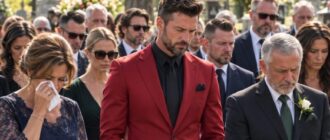
The cemetery workers were lowering my father’s casket into the ground when an elderly gravedigger caught my sleeve and pulled me aside.
His voice was barely above a whisper.

“Your father paid me to bury an empty box.”
For a moment, I thought grief had made me mishear him.
“What?”
Before I could ask another question, he pressed a tarnished brass key into my hand. The metal was cold despite the summer heat.
“Listen carefully,” he said. “Do not go home. Not today. Not until you’ve been to Unit 17 on Route 9.”
I stared at him.
“My father was just buried.”
The old man’s eyes remained fixed on mine.
“That’s what you’re supposed to believe.”
Then my phone buzzed.
A message from my mother appeared on the screen.
**Come home alone.**
I looked up immediately.
She was standing near the funeral limousine only a short distance away, dressed in black, accepting condolences from relatives.
Why would she text me instead of simply walking over?
And why did the message feel so wrong?
My father, Theodore Mercer, had supposedly died three days earlier from a sudden heart attack. Since then, I had been operating on autopilot—meeting with funeral directors, signing paperwork, comforting family members, and trying not to think about the fact that the strongest man I had ever known was gone.
Now a stranger was telling me the coffin beneath six feet of earth contained nothing at all.
The final notes of the funeral service drifted across the cemetery as guests slowly made their way toward the exit.
My wife, Celeste, stood with our children near a row of white flowers.
My mother remained beside the hearse.
Everything looked normal.
Yet suddenly none of it felt real.
The gravedigger glanced at my phone and saw the text message.
His expression tightened.
“Don’t answer her,” he said.
My pulse quickened.
“What is going on?”
Instead of replying, he reached inside his coat and removed a sealed envelope.
My name was written across the front.
The handwriting was unmistakable.
It belonged to my father.
“He gave me this nineteen years ago,” the old man said. “Told me to wait for this exact day.”
Nineteen years.
The number hit me harder than anything else.
My father had planned something nearly two decades in advance.
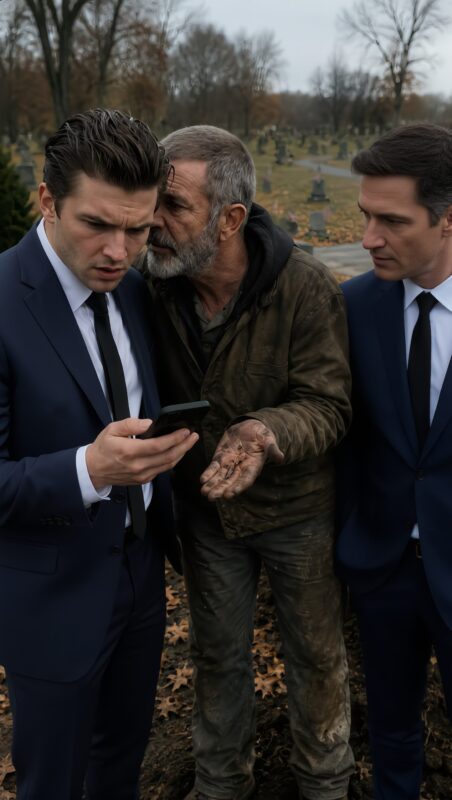
Before I could question him further, he turned and walked away between the gravestones, leaving me alone with the key and the envelope.
I sat in my car for almost ten minutes before opening it.
Inside was a single sheet of paper.
The message contained only one sentence.
**Go to Unit 17. Trust no one until you hear the recording.**
No explanation.
No goodbye.
Nothing else.
As dusk settled over New Jersey, I drove north along Route 9.
The storage facility stood behind a chain-link fence surrounded by aging warehouses and abandoned storefronts.
Floodlights illuminated rows of metal doors.
Unit 17 sat near the back.
And someone was already waiting for me.
A woman in a dark coat stepped forward as I parked.
She raised a badge.
Federal Bureau of Investigation.
The sight instantly turned my stomach.
“Mr. Mercer?” she asked.
I nodded.
“Your father believed you would come.”
The brass key suddenly felt heavier in my pocket.
“What exactly is in that unit?”
The agent hesitated.
“Answers.”
Together we approached the door.
My hands trembled as I inserted the key.
The lock clicked.
The metal door rolled upward.
Inside were dozens of storage boxes, filing cabinets, and computer drives arranged with military precision.
Then a red light began flashing on a small digital recorder sitting on a folding table.
A moment later, my father’s voice filled the room.
“Julian, if you’re hearing this, then my contingency plan has failed.”
I froze.
The voice sounded so alive that for a second I expected him to walk through the door.
“I know you’re confused,” the recording continued. “But understand this: I did not disappear because I stopped loving my family. I disappeared because someone wanted us all dead.”
The next several hours changed everything.
The documents inside Unit 17 exposed a criminal network that had operated for decades. Hidden financial records, witness statements, surveillance photographs, and encrypted files revealed that my father had spent years gathering evidence against people powerful enough to destroy anyone who threatened them.
Including our family.
His death certificate.
The hospital records.
Even the funeral.
All of it had been part of a carefully constructed deception.
Near midnight, after reviewing the final file, I finally answered the calls I had ignored all evening.
My mother picked up immediately.
She was crying.
For several seconds neither of us spoke.
Then she whispered, “Your father never stopped protecting us.”
I looked down at an old photograph resting on the table.
It showed the four of us smiling on a beach years earlier.
For the first time since the funeral, I felt something other than grief.
Hope.
The grave we had stood beside that morning was empty.
But my father’s final act had not been to leave us behind.
It had been to ensure that we survived long enough to learn the truth.