The Man in the Pink Crown
The first time a towering 6-foot-6 biker entered Walmart wearing a crooked pink plastic crown, glittery wings, and bright hand-painted boots, the aisle erupted in quiet laughter. I was on register seven in Lubbock, Texas, and I believed I had already seen every kind of customer—until Troy “Mountain” Bridger walked in.
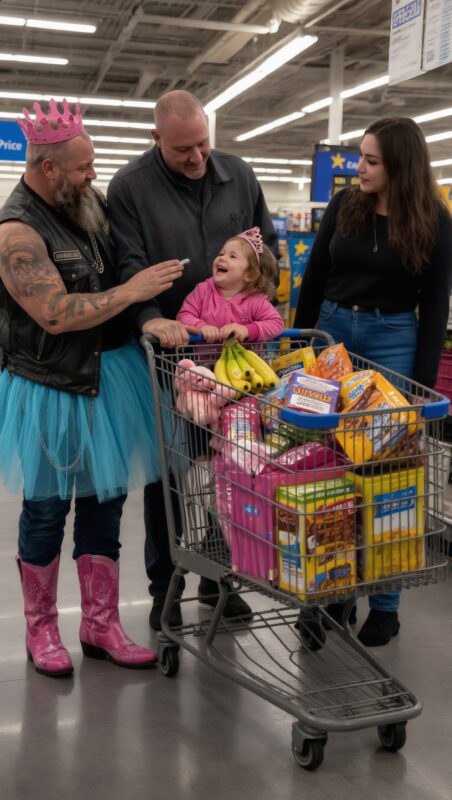
He was massive, heavily bearded, inked from arms to neck, and carried a kind of steady calm that made people unconsciously step aside. In his cart sat a small child—his daughter Ava, three years old—small enough to disappear inside the seat, but alive with an energy that made everything around her feel lighter.
“Royal bananas for today?” he asked her with exaggerated seriousness.
Ava giggled and clapped. “Daddy’s pink boots!”
He glanced down at his feet as if reassessing a serious matter. “These are ceremonial shopping boots.”
People watched. Some tried to hide smiles. Others filmed. Troy acted as if none of it existed, guiding the cart with complete ease, as though a biker king in a princess crown belonged naturally in fluorescent-lit aisles.
When they reached my register, Ava announced with pride, “I chose everything!” Troy nodded without hesitation. “She’s in charge of wardrobe and strategy,” he said.
I scanned their items—fruit pouches, bananas, yogurt, stickers, nail polish. Ava handed each product forward with careful concentration, treating the task like something important. When she placed the nail polish on the belt, she leaned closer and whispered, “For Daddy’s boots.”
Troy exhaled. “That explains the second coat requirement.”
At first, it looked like playful roleplay between father and daughter. Then they returned the following week. And again after that. Each visit added something new—tulle skirts over jeans, feather boas, novelty glasses, stickers in his beard declaring “PRINCESS CHAMPION.”
Over time, the store began to adjust itself around them. Employees played along. The greeter performed small bows. The bakery started saving stickers. Aisle seven slowly became their unofficial kingdom.
But subtle changes began to appear. Ava was carried more often. Her laughter sometimes faded into silence. Troy’s expression softened only when she was looking at him, and tightened when she wasn’t.
One afternoon, Ava dozed off in the cart while Troy placed medicine and groceries on the conveyor belt. I commented casually, “She really enjoys dressing you up.”
He paused longer than usual.
Then quietly said, “Her muscles don’t always follow her intentions. Some days are harder than others.”
His eyes stayed on her. “I just promised I’d give her reasons to smile every day.”
The crown suddenly stopped feeling humorous. It felt like something necessary for survival.
After that, register seven changed. A small box appeared beneath the counter—filled with donated toys, stickers, and crowns left by customers who had learned their story. Troy never asked for anything beyond what could make Ava happy.
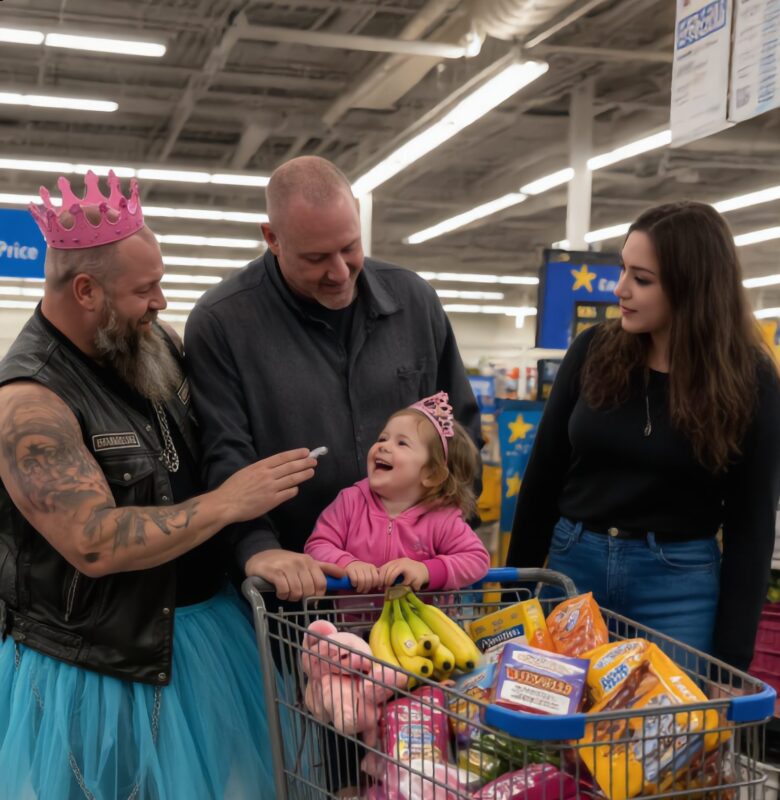
On difficult days, when she barely reacted, strangers stepped in without being told: a sunhat placed on Troy’s head once triggered a sudden burst of joy from her. He quietly broke down when she smiled.
Ava’s condition required constant care—doctors, therapy sessions, routines that drained both parents. Her mother sometimes joined them. Though the relationship between the adults had changed, they remained united in one purpose.
Ava learned to speak in fragments of behavior—blinks, tiny squeezes, slight shifts of gaze. Troy learned to read her fluently. One blink meant yes. Two meant more. A look at his boots meant: *be silly again.*
So he performed. He bowed to doors. Talked to cereal boxes. Turned shopping carts into royal processions. He built an entire playful universe around the weight of her reality.
Eventually, a specialist introduced a possible treatment—uncertain, but hopeful.
Troy came through my line afterward, crown still on his head. “We’ve got a plan,” he said softly. “Princess Ava says we’re not stopping.”
Progress didn’t come suddenly. It arrived in fragments—better weeks followed by difficult ones. But slowly, change appeared. Strength returned in pieces. Words reemerged step by step.
Then, almost two years after the first crown appeared, the automatic doors opened again—and everything inside the store seemed to freeze.
Ava was standing.
Holding Troy’s hand.
And wearing a tiny crown of her own.
Her steps were careful but real.
Someone in the front quietly began to cry. I couldn’t speak.
At my register, she whispered, “Royal bananas, Daddy.”
Troy lowered his head as if receiving a title. “Yes, ma’am.”
No one rushed. No one broke the moment. Even strangers stayed still, as if instinctively understanding its weight.
Later, Troy created something called the Pink Boots Project, a small initiative aimed at helping families with sick or recovering children find moments of light—costumes, toys, blankets, anything that could soften hard days.
“Medicine works on the body,” he once told me. “Joy keeps the child present inside themselves.”
Ava simply added, “And pink boots.”
Years passed.
Ava grew stronger—walking more steadily, speaking more freely, laughing without hesitation. Therapy remained, but life widened again.
Troy’s beard turned more silver than black. The crown never disappeared.
And every year, Ava still teased him. “Dad, you’re ridiculous.”
He always answered the same way. “Exactly, Your Majesty.”
Now, whenever I see parents worried about being judged, afraid of looking strange, I think back to Troy in that crown.
Because love rarely looks neat from the outside. Sometimes it looks like a giant biker in glitter wings in a grocery aisle.
But inside a child’s difficult world, that kind of “strange” can become the thing that keeps everything from falling apart.
Not all bravery is loud. Some of it simply pushes a shopping cart under fluorescent lights, wearing a crooked crown, refusing to let a child’s world grow dim.