Thirty Leather Jackets for One Small Voice
“I can tell everyone what happened,” nine-year-old Piper Sloan whispered from her hiding place beneath the kitchen table, “but only if thirty people are there where I can see them.”
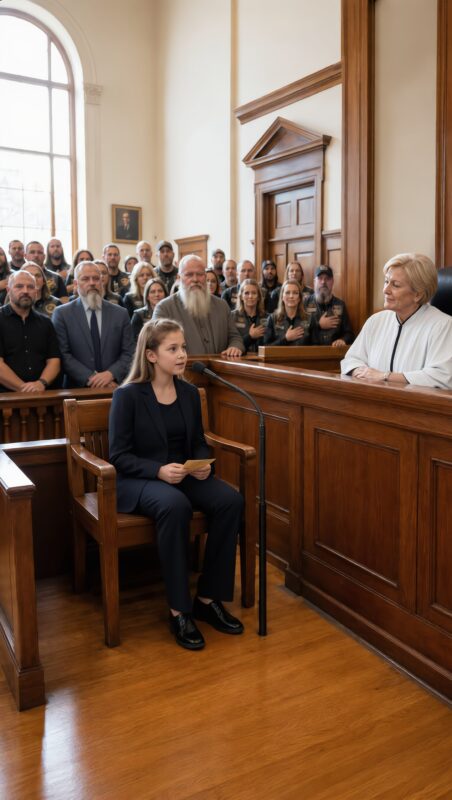
Three days later, thirty motorcycle riders walked through the doors of a courthouse in Wichita, Kansas.
As Piper’s child advocate, I had heard many unusual requests from frightened children. None had ever sounded quite like that.
Piper was a quiet girl with sharp gray eyes that seemed to notice everything. Whenever she became anxious, she pulled her sleeves over her hands. She memorized exits, listened for footsteps, and always seemed prepared for danger long before anyone else noticed it.
The court needed her testimony.
Piper needed reassurance.
More than anything, she needed to feel safe.
On the morning of the hearing, her foster mother, Denise Alder, cooked pancakes. Piper couldn’t bring herself to eat. Instead, she curled up beneath the table, hugging her knees tightly.
“What would help you today?” I asked.
For a moment, she remained silent.
Then she looked up.
“My highway family.”
That was what she called the bikers.
For months, members of a local motorcycle support group had quietly stood beside her. They attended counseling sessions, school meetings, and difficult appointments. They never pushed for answers. They never asked her to explain herself.
They simply showed up.
Among them were Redwood, a towering rider with a silver beard, and Magnolia, whose calm presence could ease tension in any room.
They had once given Piper a small denim vest with a patch she selected herself.
SPARK.
When asked why she chose it, she smiled.
“Because a spark is tiny,” she said, “but it can still light up the dark.”
When Redwood learned about her request, he didn’t offer empty promises.
Instead, he began making phone calls.
Courthouses have rules. Security approvals were needed. Attorneys had to agree. The judge had to approve.
For two straight days, Redwood worked through every requirement.
The riders accepted every condition.
No demonstrations.
No signs.
No speeches.
No disruptions.
They weren’t there to influence the proceedings.
They were there because one frightened child asked not to face the day alone.
By sunset, thirty volunteers had committed to coming.
The morning of the hearing arrived.
Piper wore a navy-blue dress and polished shoes. She made it through security and entered the courthouse.
Then she saw Raymond Pike.
The man she feared sat beside his attorney, dressed in an ordinary gray suit.
Nothing about him stood out.
To Piper, that made him even more frightening.
Her breathing became uneven.
“He’s looking for me,” she whispered.
“He can’t hurt you,” I assured her.
Tears gathered in her eyes.
“That doesn’t stop him from looking.”
Then the elevator doors opened.
Thirty riders stepped into the hallway.
Quiet.
Steady.
Unshakable.
Redwood removed his sunglasses.
“Good morning, Spark.”
Piper stared at them.
“You really came.”
“Every one of us.”
She counted them herself.
All thirty.
Her voice trembled.
“I’m still scared.”
Redwood nodded.
“That’s okay.”
She frowned.
“It is?”
“We didn’t come to make the fear disappear.”
“Then why did you come?”
Magnolia smiled softly.
“So fear wouldn’t be the only thing standing beside you.”
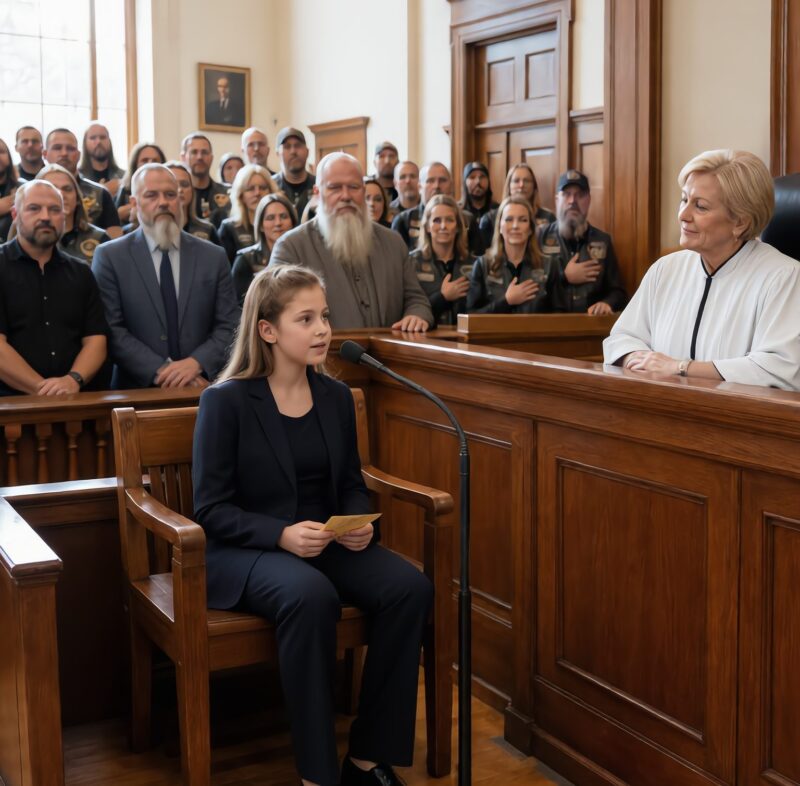
A short time later, Judge Elaine Porter allowed the riders to sit in two rows of the courtroom gallery where Piper could easily see them.
When she entered the courtroom, Raymond turned in her direction.
At the same moment, the riders shifted slightly.
Nothing dramatic.
Nothing noticeable to most people.
Just enough to create a comforting wall of support between Piper and the place she least wanted to look.
She climbed into the witness chair.
The prosecutor asked her to state her name.
For several seconds, no words came.
Then Redwood placed a hand over his heart.
Magnolia gave her a reassuring nod.
Piper inhaled deeply.
“My name is Piper Sloan.”
The courtroom fell silent.
Question after question followed.
Piper answered honestly.
Sometimes she remembered.
Sometimes she didn’t.
Sometimes she simply said, “I don’t know.”
But she never changed her story.
She never guessed.
She spoke only the truth.
At one point, the prosecutor asked what had helped her find the courage to testify.
Piper glanced toward the riders.
“My highway family.”
“What did they do for you?” he asked.
She thought carefully before answering.
“They told me I didn’t have to stop being scared before telling the truth.”
The room became still.
Then she added:
“They said I could be scared and tell the truth at the same time.”
When her testimony ended, Piper stepped down from the witness stand and walked directly toward the riders.
Redwood remained seated until she reached him.
Then she lifted her arms.
Without saying a word, he embraced her.
No one applauded.
No one cheered.
This wasn’t a victory celebration.
It was a child surviving a moment she once thought she couldn’t face.
Two days later, the jury accepted her testimony.
Yet the most important part of the story came afterward.
The riders never disappeared.
They attended school performances, repaired bicycles, planted gardens, and continued showing up whenever support was needed.
Years passed.
Piper grew older.
She grew stronger.
Not because fear vanished from her life.
But because she learned it no longer controlled her.
One spring afternoon, another nervous child asked Redwood how motorcycle riders helped people feel safe.
Before he could answer, Piper spoke.
“They stay where you can see them.”
The child looked confused.
“Does that really help?”
Piper smiled and touched the faded SPARK patch she still carried.
“It helped me find my voice.”
Then she shared the lesson that changed her life.
“I wasn’t brave because I stopped being afraid.”
She paused.
“I was brave because I spoke anyway.”
And that is what courage often looks like—not living without fear, but refusing to let fear have the final word.