I Left Our Four Children With My Husband for Just Twenty Minutes. He Claimed They Had Terrorized Him While I Showered. But When I Checked Our Home Security Camera, I Discovered a Lie That Changed Everything.
All I wanted was a shower.
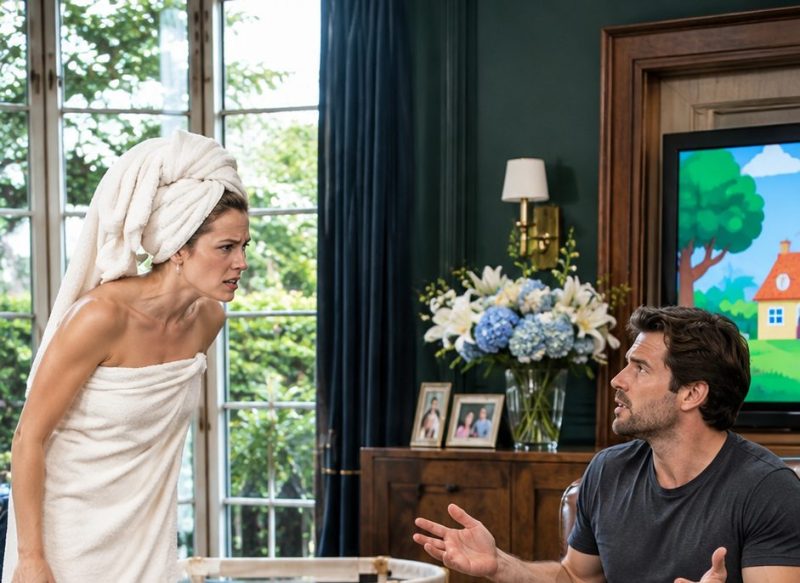
Not a vacation. Not a day off. Just twenty uninterrupted minutes to wash my hair and feel human again.
But when I came downstairs, my husband acted as though I’d abandoned him in the middle of a disaster.
What I discovered later that night made me question years of our marriage.
My husband, Patrick, and I lived near Columbus, Ohio, with our four young children. Maisie was four, our twin daughters, Lila and Wren, were three, and little Theo had recently celebrated his first birthday.
Our house was rarely quiet.
There were toys scattered across the floors, laundry baskets that never stayed empty, and someone constantly asking for a snack, a hug, or help finding a missing stuffed animal.
Patrick worked for an insurance company. I stayed home to care for our children, manage the household, and complete occasional bookkeeping assignments.
He believed that earning a salary meant he had done his share.
Once he returned home, he expected dinner, peace, and uninterrupted relaxation.
Meanwhile, my responsibilities continued from morning until long after midnight.
On one particular Tuesday, I was completely exhausted.
Two days had passed since I’d managed to take a proper shower. Every attempt had been interrupted by a crying baby, a disagreement between the twins, or another unexpected problem.
That evening, however, the children were unusually settled.
They had eaten dinner, enjoyed their baths, and changed into pajamas.
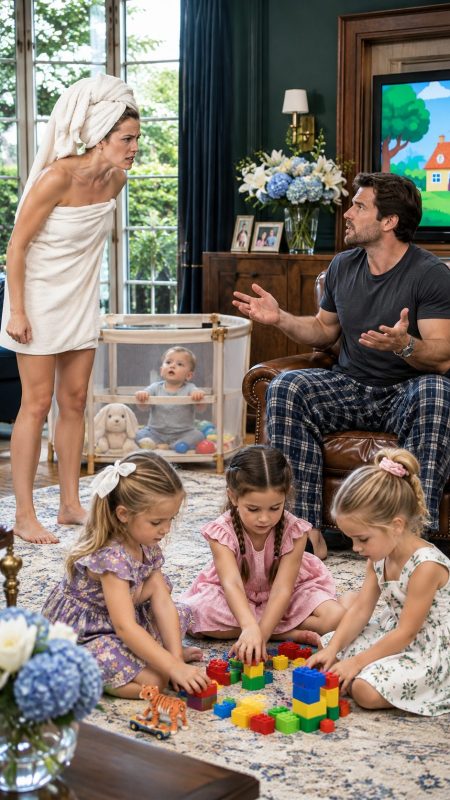
Maisie was absorbed in a cartoon. Lila and Wren were building a colorful block tower, while Theo played contentedly inside his playpen.
Patrick sat in his favorite recliner, scrolling through his phone.
I approached him.
«Could you keep an eye on the children for twenty minutes? I desperately need a shower.»
He looked up with obvious annoyance.
«Now?»
«Everything’s already done. They just need someone here with them.»
He sighed as though I’d asked him to sacrifice his entire evening.
«Fine. But don’t take forever.»
I hurried upstairs, showered as quickly as possible, and returned before the twenty-minute mark.
The moment I entered the living room, Patrick exploded.
«Unbelievable! Do you have any idea what I’ve just put up with?»
I froze.
«What happened?»
«Your kids have been screaming, fighting, and climbing all over me! I work hard all day, and then you leave me to deal with this chaos!»
I glanced around the room.
Maisie was peacefully watching television.
The twins were playing together on the carpet.
Theo was sitting quietly with his toys.
Nothing suggested that a terrible commotion had taken place.
Yet Patrick looked so angry that I instinctively apologized.
«I’m sorry. I didn’t realize they’d be difficult.»
«They were impossible!» he insisted.
I apologized once more, feeling ashamed for taking a few minutes for myself.
Then I resumed the evening routine.
I brushed little teeth, read bedtime stories, settled Theo into his crib, washed dishes, and prepared the kitchen for breakfast.
By the time the house became quiet, Patrick had already gone to bed.
That’s when I remembered Theo’s missing pacifier.
He had been searching for his favorite one earlier, and I suspected it had slipped beneath some furniture.
We had installed an indoor security camera several months earlier, mainly to monitor the family room and occasionally locate misplaced belongings.
I opened the recording from that evening.
I expected to find a pacifier.
Instead, I found something that made my stomach tighten.
The footage showed me leaving the living room at 7:04 p.m.
Patrick remained in his chair, staring at his phone.
The children continued their activities without any fuss.
Three minutes later, Maisie approached her father with a book.
She stood beside him for several seconds, holding it open.
Patrick barely acknowledged her before motioning toward the television.
She quietly returned to the couch.
At 7:11, Lila passed a toy block to Theo, who promptly dropped it.
Nobody cried.
At 7:15, Patrick stood up, walked into the kitchen, poured himself water, and returned to his chair.
The next several minutes were almost completely uneventful.
No arguments.
No shouting.
No children climbing over their father.
In fact, Patrick barely lifted his head.
Then came the moment that changed how I understood the entire evening.
At 7:23, the sound of my footsteps could be heard approaching the staircase.
Patrick immediately turned his phone facedown.
He straightened his shoulders, frowned, and positioned himself as though he’d just survived twenty minutes of absolute chaos.
Seconds later, I appeared.
And he began accusing me of making his evening miserable.
I watched the recording again.
Then a third time.
There was no misunderstanding.
Patrick had deliberately pretended that the children had behaved terribly.
He had made me feel guilty for something that had never happened.
I remained at the kitchen table for a long time, staring at the paused image on my screen.
The worst part wasn’t the lie itself.
It was the realization that I had believed him so easily.
How many times had he complained that the children were unbearable when I’d asked him to supervise them?
How many times had I rushed through an errand or abandoned a personal task because he claimed he couldn’t manage?
And how many times had I apologized afterward?
The next morning, curiosity turned into determination.
While Patrick was at work, I reviewed footage from several other evenings.
The same behavior appeared repeatedly.
He frequently ignored the children while scrolling through his phone.
When they asked him to play, he often redirected them toward toys or the television.
Sometimes he even went outside for a few minutes, leaving them inside without direct adult supervision.
Yet later, he would describe himself as exhausted from dealing with their supposedly terrible behavior.
It became clear that he wasn’t struggling because our children were unusually difficult.
He resented having to interrupt his free time to parent them.
That night, after the children were sleeping, I confronted him.
«Patrick, I looked at the camera footage from Tuesday.»
He glanced up.
«Why?»
«Because Theo lost his pacifier. But I saw what happened while I was upstairs.»
His expression hardened.
«So?»
«You told me the kids were screaming and fighting. They weren’t. They were quiet the entire time.»
Patrick shrugged.
«The camera doesn’t capture every little thing.»
«It captured you sitting on your phone for almost twenty minutes. It also captured you pretending to be angry the second you heard me coming downstairs.»
He looked away.
For several moments, he said nothing.
Finally, he snapped.
«All right! I exaggerated! Is that what you want to hear?»
«Why?»
«Because I was irritated! I wanted to relax, and you made me babysit.»
I stared at him.
«Babysit?»
«Don’t twist my words.»
«Patrick, they’re your children.»
He threw his hands into the air.
«I spend eight hours a day working! You stay home. You have no idea what it’s like to deal with a real job.»
That sentence silenced me.
Not because I agreed.
Because I’d heard versions of it throughout our marriage.
Somehow, the endless work involved in raising our children didn’t count unless an employer paid me for it.
I thought about the early mornings, the sleepless nights, the meals I prepared, and the dozens of responsibilities Patrick rarely noticed.
Then I answered.
«You get to finish your shift. I don’t. And the children don’t stop needing a father when you come home.»
For once, I didn’t apologize.
Patrick had no response.
Over the next few days, something shifted inside me.
I stopped asking permission to meet basic needs.
I stopped thanking Patrick excessively whenever he completed a responsibility that belonged to both of us.
And I started writing down how our household duties were actually divided.
The results were revealing.
I handled nearly every meal, appointment, bedtime, load of laundry, and unexpected childcare problem.
Patrick contributed occasionally, usually when I specifically requested it.
Even then, he expected praise.
When I spoke to my sister Nora about the recording, she wasn’t particularly surprised.
«You’ve been carrying almost everything for years,» she told me. «The footage just made it impossible to ignore.»
Her words stayed with me.
I’d spent so much time trying to be a good wife and mother that I’d forgotten I was allowed to have needs of my own.
A few days later, I asked Patrick to sit down with me.
This time, I wasn’t interested in arguing about one shower.
I wanted to address the larger problem.
I explained that our arrangement couldn’t continue.
We agreed that Patrick would take primary responsibility for the children three evenings each week and one weekend morning every month.
During those times, he would actively care for them, help with their routines, and put his phone aside when they needed attention.
I also began looking for part-time work.
I enjoyed being home with my children, but I wanted to restore some financial independence and reconnect with the professional skills I’d put aside.
Patrick didn’t welcome the changes.
He complained that I was making everything unnecessarily complicated.
But after several difficult conversations, he agreed to try.
I decided to pay attention to what he did rather than what he promised.
During the first month, there were encouraging moments.
One evening, I walked into the living room and found Patrick sitting on the floor, helping Lila and Wren construct a pretend castle.
Another night, Maisie excitedly told me that Daddy had read her three stories.
He also began handling Theo’s evening routine without constantly calling for my assistance.
Those moments mattered.
But they weren’t the whole story.
There were still evenings when Patrick retreated into his phone and became irritated whenever the children interrupted him.
And one Saturday morning proved how fragile his progress remained.
He had promised to take charge of breakfast and the children while I slept a little longer.
Instead, I woke to discover that he had already left for a run.
There was no warning.
No discussion.
He had simply assumed I would handle everything.
When he returned, I asked why he’d ignored our agreement.
«I needed some time to clear my head,» he replied.
«So did I. That’s why we made a plan.»
He frowned.
«You’re making a big deal out of nothing.»
«No, Patrick. I’m asking you to keep your word.»
That conversation didn’t end with a dramatic breakthrough.
But I didn’t back down.
As the weeks passed, Patrick became more involved in daily parenting.
His effort remained inconsistent, and I knew rebuilding trust would require much more than occasional good behavior.
I wasn’t certain whether our marriage would survive those changes.
But I was certain about something else.
I would never again accept the idea that caring for our children was exclusively my responsibility.
Then, one afternoon several weeks later, Maisie rushed into the kitchen holding something small.
«Mom! Look!»
Between her fingers was Theo’s long-lost pacifier.
She had discovered it wedged behind the playpen.
I couldn’t help thinking about that Tuesday evening.
A missing pacifier had led me to open a security recording.
That recording exposed a lie.
And that lie forced me to recognize an imbalance I’d tolerated for years.
My marriage didn’t become perfect overnight.
Patrick didn’t suddenly transform into an ideal father.
But I changed.
I stopped confusing constant sacrifice with good parenting.
I stopped believing that asking my husband to care for his own children was an unreasonable burden.
And I finally understood that a family should be supported by two responsible adults, not one exhausted parent and another who participates only when convenient.
Being a father means more than earning money and coming home at the end of the day.
It means listening when your daughter brings you a book.
It means noticing when your toddler needs attention.
It means sharing the messy, tiring, ordinary responsibilities that make up family life.
And being a mother shouldn’t mean surrendering every moment of personal time.
I had spent years feeling guilty for needing a break.
All it took was twenty minutes of security footage to make me realize that I had nothing to apologize for.